

Is an antique scapular suitable for daily use?
Last updated: October 24, 2026
Quick Summary
An antique scapular may be suitable for daily use, but often isn’t. A sturdy, well-preserved example can last for years, while a fragile piece with dry threads or loose seams is better kept in a display case than worn around your neck.
- Wear an old scapular over a thin cotton shirt to limit skin oils and sweat.
- The cord is often the weakest point on antique examples and breaks before the piece does.
- Take off the scapular when showering and swimming, as getting it soaked just once can weaken the fibers.
- A classic cloth scapular usually measures around 5 by 7 centimeters per piece.
- A scapular’s blessing does not expire through age or wear.
Table of Contents
- What an antique scapular is and why people want to wear one every day
- Brown scapular meaning: devotion, tradition, and symbolism
- Wearing a scapular every day: comfort, how to wear it, and wear
- Assessing its condition: how to tell if an old scapular is too fragile
- Cleaning an old scapular: how to clean it safely without causing damage
- Preserving a scapular: when storing or restoring is better than wearing it
- Religious validity and blessing of an antique scapular
- Choosing an antique scapular in the online shop
- Frequently Asked Questions
What an antique scapular is and why people want to wear one every day
An antique scapular is an old, blessed devotional object that Catholics wear over their shoulders as a sign of devotion.
The short answer: sometimes, but often not. A sturdy, well-preserved antique scapular can last for years.
Below, we explain exactly what to look out for. We cover material, condition, cleaning, and whether an old scapular retains its blessing.
From habit to devotion: the origins and history
The scapular originated as part of the monastic habit. Monks wore a shoulder garment that symbolized their work and prayer. Later, laypeople adopted a small version as a sign of devotion.
From the Middle Ages onward, its use grew among ordinary believers. The piece became a personal object of faith, often passed down within families. As a result, many old examples still exist, some more than a century old.
Cloth or medal: the available versions
There are two main types. The cloth scapular consists of two small pieces of textile connected by cords or straps. The scapular medal is a metal plate that hangs from a chain.
Cloth pieces are more traditional and feel warmer. However, they are more prone to wear. Medals last longer but lack the textile character.
Want to understand the difference between the two versions exactly? Read our comparison of the difference between a scapular and a medal before you choose.
Brown scapular meaning: devotion, tradition, and symbolism
The brown scapular is the best-known type and refers to Our Lady of Mount Carmel.
The brown color symbolizes simplicity and devotion to Carmel. Wearers see it as a daily reminder of their faith, not as an amulet.
The meaning doesn't change with the age of the piece. An old brown scapular carries the same symbolism as a new one.
Wearing a scapular every day: comfort, how to wear it, and wear
Wearing a scapular every day is perfectly possible, as long as you take comfort and wear seriously. An old piece can withstand less than a new one. The question isn't so much whether you can wear it, but whether the piece can withstand it. Below, you'll learn how to weigh this up in different situations.
Against your skin or over a shirt
Wear the scapular under your clothing, directly against your skin or over a thin undershirt. Wearing it directly against your skin feels the most traditional, but skin oils and sweat damage old fibers more quickly. Wearing it over a thin cotton shirt significantly reduces this risk, especially with antique fabrics that have already lost their natural protection. Pay attention to the straps: these are often the weakest point on old pieces and can catch on zippers or jewelry.
The cord: length and tension
A cord that's too tight pulls the fabric out of shape and creates pressure marks on the skin. A cord that's too loose lets the scapular rub against clothing. The right length lets the piece rest flat against your upper body without pulling. For antique pieces, it's often impossible to adjust the original cord to the right length without damaging it.
What we see in practice
- The cord is more likely to break than the cloth itself
- Moisture and sweat damage old fibers more quickly
- Friction against clothing causes the edges to fray
Showering, swimming, and sleeping
Take off the scapular when showering or swimming. This helps keep the fabric intact for longer. This is even more important for an antique piece: getting soaked just once can permanently weaken the fibers and cause the image to run. Store it flat at night, not crumpled up. Folding an antique scapular can create creases that can't be smoothed out without damaging the fabric.
When it's better to take it off
There are situations where it is wiser to take it off, even if you wear it every day:
- During strenuous physical work that causes a lot of sweating and friction.
- When wearing jewelry or clothing with sharp parts that could damage the cord.
- During medical treatments or examinations when the item gets in the way or is exposed to disinfectants.
The trade-off: wearing it daily versus preserving it
An antique scapular that you wear daily wears out faster than one you wear only on special occasions. That is no reason never to wear it, but it is a reason to choose mindfully.
Our guide to preserving religious heritage provides preservation tips step by step. If you want to know whether repair is worthwhile, read the considerations in our guide to restoring or leaving saint statues as they are, which follows the same principles.
Assessing its condition: how to tell if an old scapular is too fragile
Always assess an old scapular before wearing it daily. Place it on a light-colored surface and look at the seams, edges, and color of the fabric.
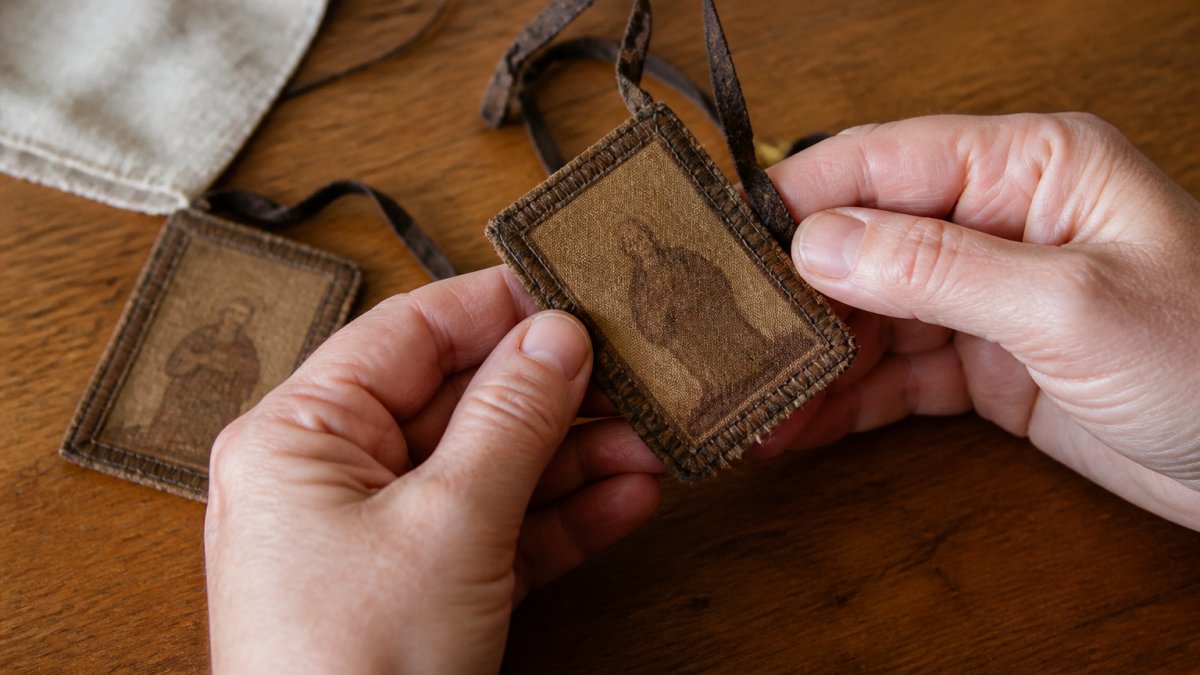
A few quick checks that many people forget:
- Gently pull on the cord: if it breaks immediately, it is too weak
- Gently rub the fabric: if it frays immediately, it is fragile
- Check whether the image is still sharp or has faded
How to systematically check the three weak points
With antique scapulars, the weak points are almost always in the same three places. Check them in this order, because a problem in one place often affects the others.
- The cord or straps. This is the most vulnerable part. An original cord more than fifty years old is often dried out. Test it by holding the cord between your thumb and forefinger and pulling with light, even force. If it stretches slightly or feels stiff without breaking, it is probably still usable. If it snaps immediately or feels like rope that could tear at any moment, replacement is the only safe option.
- The attachment points. These are the points where the cord is attached to the fabric. Check whether the stitches are still secure and whether the fabric around the hole is torn. A small tear of a few millimeters can develop into a complete separation within weeks of daily use.
- The edges of the fabric. Run your finger along the edge. If it feels rough or fuzzy, the fibers are fraying. On an antique piece, this usually means the fabric has lost its elasticity. A sign that it can no longer withstand daily rubbing against clothing.
What the condition of the image tells you
The image on an antique scapular is often hand-embroidered or printed. Check whether the outlines are still sharp. Faded or blurred images indicate past moisture or friction damage. This is not in itself a reason to reject the piece, but it does say something about the overall condition of the fibers.
Measuring and weighing: when the numbers help
A classic cloth scapular usually measures around 5 by 7 centimeters per panel. Medals are often a little smaller. Always measure it yourself, as old examples may differ. A difference of more than one centimeter in both directions may indicate a non-standard design or moisture damage causing distortion.
Weight can also tell you something. An antique cloth scapular typically weighs between 5 and 15 grams, depending on the type of fabric and finish. Weigh it on a kitchen scale.
The rule of thumb: wear it, store it, or have it restored
Use this simple rule of thumb if you're unsure:
- Wear it if the cord is sturdy, the attachment points are secure, the edges aren't fraying, and the image is still recognizable. A few small signs of wear are no problem.
- Store it if any of the three weak points show clear signs of damage, or if the piece is rare or emotionally valuable. Lay it flat in an acid-free box, away from moisture and direct light.
- Have it restored if the piece has historical or collectible value and you still want to wear it. Leave this to someone experienced in textile restoration, not a regular tailor.
Unsure about its authenticity and condition? On our page about how to recognize authentic devotional items, you'll find the specific features to look for.
Cleaning an old scapular: how to clean it safely without causing damage
Clean an old scapular as dry as possible and avoid water whenever you can. Moisture can weaken old fibers and cause the image to fade.
What works safely:
- Dust carefully with a soft, dry brush
- Blot stains with a lightly damp cloth; never rub
- Let the item dry flat, out of direct sunlight
What to avoid: the washing machine, soapy water, ironing, and dry cleaning. An old item rarely survives that.
Preserving a scapular: when storing or restoring is better than wearing it
Storing it is the better choice if the item is fragile, historically significant, or rarely worn. Lay it flat in an acid-free box, away from moisture and direct light.
Restoration is only worthwhile for items with sentimental or collectible value. Leave it to someone experienced with textiles, not a standard tailor.
Our guide to preserving religious heritage offers step-by-step preservation tips.
Religious validity and blessing of an antique scapular
In the Catholic tradition, an old scapular retains its meaning even after it has been worn.
However, it’s wise to have a damaged item blessed again if you want to wear it regularly.
For information on Roman Catholic teachings and customs regarding devotional items, visit the Catholic Church in the Netherlands and consult the Vatican documents on popular devotion.
Choosing an antique scapular in the online shop
When choosing an antique scapular, consider three things: its condition, authenticity, and whether you want to wear or preserve it. Always ask for photos of the seams and cord before buying.
Here’s how we do it at Chez Monique's 2e Leven:
| Your situation | Our advice | Why |
|---|---|---|
| You want to wear it every day | Choose a sturdy, relatively recent antique | Less wear, stronger seams |
| You want to preserve or collect | Choose a rare item in good condition | Its historical value is preserved |
| You’re unsure about its authenticity | Ask about the details and provenance | Know what you’re getting |
| You’re looking for a unique gift | Choose an item with a story | Personal and meaningful |
Our buying guide for antique devotional items will help you make the right choice.
We carefully check the condition and finish of every item. We wrap fragile objects in reused materials, without compromising safe transport.
Frequently Asked Questions
Can you wear an antique scapular every day?
You can, but only if the fabric is still sturdy. First check the seams, edges, and image for tears or loose threads. An antique fabric scapular is less resistant to sweat, friction, and washing than a new one. If the fabric is fragile or the print is flaking off, a scapular medal on a chain is a safer everyday alternative.
How can you tell if a scapular is too delicate to wear?
Check four things: the seams, the edges of the panels, the image, and the cord attachment. Loose stitches, frayed edges, a peeling image, or a cord that is nearly worn through are signs of wear. Gently tug on the cord and the edge to test them. If the fabric tears further right away, the item is suitable for keeping or having restored, not for everyday wear.
What is the meaning of the brown scapular?
The brown scapular is associated with the Carmelites and Our Lady of Mount Carmel. According to tradition, she gave the scapular to the English monk Simon Stock as a sign of protection. Believers wear it as an expression of devotion and dedication. The brown color refers to the Carmelite habit. An antique piece carries this meaning with it, even when it is kept mainly as a family heirloom or collector’s item.
How do you clean an old scapular?
Clean an old scapular as dry as possible. Gently shake out the dust and use a soft brush. If washing is necessary, hand-wash it in cold water with a mild, bleach-free detergent, then lay it flat to dry between two cloths. Never wring it out or put it in the washing machine. Test an inconspicuous area of the fabric first. If the print or embroidery is coming loose, dry cleaning is the only safe option.
When is it better not to wear a scapular every day?
Don’t wear an antique scapular every day if the fabric is fragile, the image is peeling, or the cord is nearly worn through. It’s also best to take it off during strenuous work, exercise, or showering to prevent wear and damage. If you still want to keep the object with you, store it in an acid-free box and wear a scapular medal as an everyday alternative.
Wondering whether an old scapular is still suitable to wear? We’d be happy to help you decide. At Chez Monique's 2e Leven, you’ll find carefully selected devotional items. We check the condition of every piece and ship it in sustainable packaging. That way, you can give a special object a second life. Browse our collection and add your favorite to your cart.
