

Restoring sacred statues vs leaving them as they are: guide
Table of contents
- Restoring vs leaving saint statues as they are: the comparison at a glance
- When does restoration make sense, and when is it better to leave it as is?
- Restoration costs, price factors, and grants
- Cleaning a statue of a saint: what you can and cannot do
- Protecting religious statues from moisture and mold
- Preserving patina on religious statues
- When should you call in a restorer of religious statues?
- Conclusion: how to make the right decision
- Frequently Asked Questions
Last updated: October 9, 2026
Restoring vs leaving saint statues as they are: the comparison at a glance
The question of whether to restore saint statues or leave them as they are is increasingly coming up among collectors of religious heritage.
Below, we compare both options honestly. We discuss when restoration makes sense, what it costs, how to clean carefully yourself, and when to call in a restorer.
Restoration means repairing a damaged saint statue to an earlier or stable condition. Conservation means limiting further damage without substantially changing its appearance.
| Situation | Restore | Leave as is (conservation) |
|---|---|---|
| Purpose | Restoring form and color | Preserving the current condition |
| Suitable for | Active damage, missing parts | Stable signs of age, patina |
| Effect on value | May increase or decrease value | Value is generally preserved |
| Costs | Higher, specialized work | Low, mainly maintenance |
| Risk | Incorrect intervention is irreversible | Slow damage if moisture persists |
When does restoration make sense, and when is it better to leave it as is?
Restoration makes sense as soon as the damage spreads or the statue becomes unstable. If the damage is limited to superficial signs of age, leaving it as is is almost always the better choice.
Symptoms that call for intervention
Watch for these signs. They indicate active damage that will worsen without treatment:
- Loose layers of paint that are flaking or turning to powder
- Cracking that becomes deeper or extends into the supporting plaster
- Missing parts on fingers, attributes, or the base
A crack that has remained unchanged for decades is usually no reason to panic. A crack that suddenly becomes longer after a move does require expert assessment.
When leaving it as is is the better choice
With a fine plaster statue featuring authentic patina, it is wise not to change anything. The patina tells the history of the piece and is often precisely what proves its authenticity to collectors. A Saint Anthony with Child from the 1930s with light signs of age is worth more in its original condition than with a fresh coat of paint.

Leaving it alone does not mean doing nothing. It means targeted conservation: place it securely, keep moisture away, and inspect it annually.
Restoration costs, price factors, and grants
Restoration is tailored to each piece, and the price depends heavily on the condition, material, and desired finish of the statue. The indications below are based on what restorers typically charge for common religious statues; exact amounts are only available after a preliminary examination.
Indicative price ranges (private clients, excluding VAT)
- Conservation only: dry cleaning, stabilizing loose paint, securing a loose part, often €75 to €250, depending on the size and number of treatments.
- Simple restoration: reconstructing one missing finger or attribute, filling a small crack, localized retouching, generally €200 to €600.
- Extensive restoration: reconstructing multiple missing parts, fully retouching the polychromy, structurally reinforcing the supporting plaster or wood, often €600 to €2,500 or more.
What drives up the price
- Extent of the damage: minor repairs versus complete reconstructions.
- Material: plaster is generally easier to treat than wood, which can move and is susceptible to woodworm.
- Paint layer and polychromy: conserving original paint requires more expertise than applying a new layer.
When restoration is not worth the investment
A simple mass-produced item from the 1950s to the 1980s with limited collectibility is usually better conserved than fully restored. Having a statue restored can cost more than the piece itself is worth.
Grants, tax schemes, and heritage status
For religious heritage with listed-monument status, grants or tax schemes may be available in some cases. The conditions vary by municipality and province. Some options worth investigating include:
- Cultural Heritage Agency of the Netherlands (RCE): manages national schemes for protected heritage and provides information on restoration and maintenance. Always check the current regulations via the Cultural Heritage Agency of the Netherlands before having restoration carried out.
- Provincial and municipal monument regulations: many provinces and municipalities have their own grants for maintaining and restoring protected objects. Check with the municipality whether the statue is part of protected heritage and which scheme applies.
- Church and religious institutions: for statues belonging to the furnishings of a church or monastery, the diocese or congregation may play a role in decision-making and financing.
Permits and heritage status
If the statue is part of protected heritage, such as a national monument, municipal monument, or a statue in a protected townscape or village conservation area, an environmental permit is often required for major restoration work.
Cultural Heritage Agency of the Netherlands, monuments and restoration
Cleaning a statue of a saint: what you can and cannot do
You can clean a statue of a saint yourself to a large extent, as long as you are careful and do not use moisture or harsh products. Plaster is porous and absorbs water, which causes permanent damage.
Here is how to do it safely:
- First remove loose dust with a soft, dry brush.
- Use a feather duster for the fine details around the face and hands.
- Always work from top to bottom so that dirt does not fall onto clean areas.
- Keep wet cloths, all-purpose cleaners, and rubbing alcohol away from the paint layer.
- Place the statue on a soft cloth while cleaning to prevent it from falling.
What you should especially avoid: immersing the statue, putting it in the dishwasher, or rubbing the polychrome surface with a damp cloth. Flaking paint and soft plaster areas cannot tolerate water.
Lovely Sacred Heart of Jesus statue Antheunis →
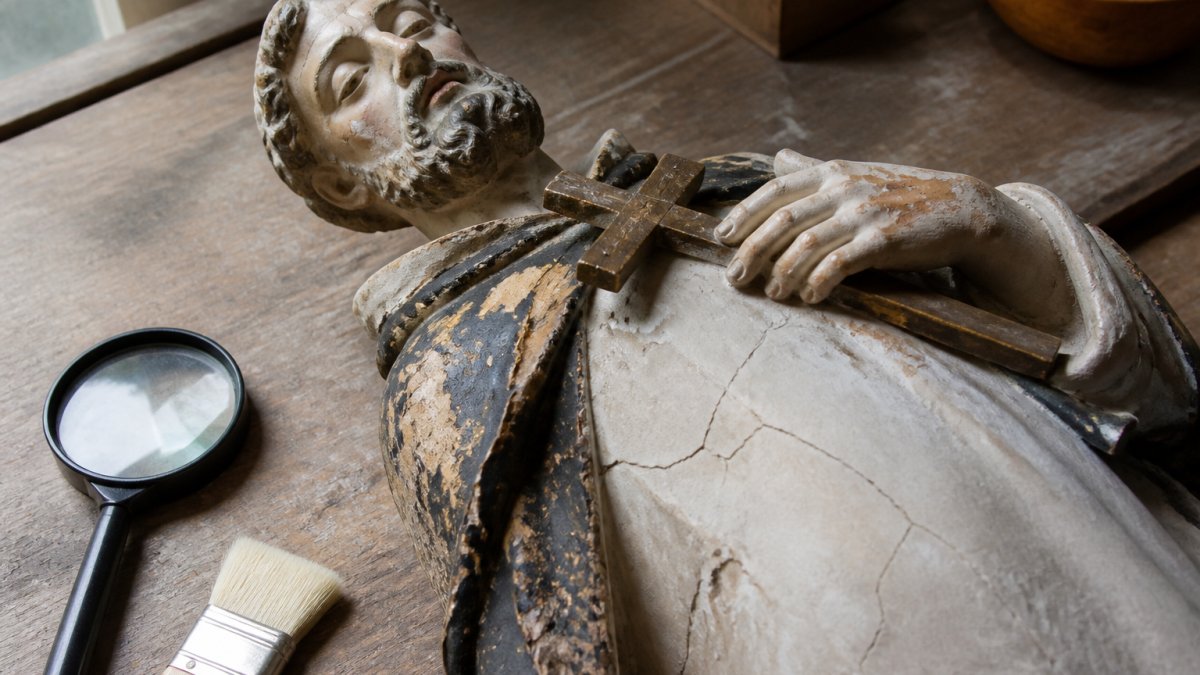
Protecting religious statues from moisture and mold
Protecting religious statues from moisture and mold starts with a stable location and a consistent climate. Plaster and wood respond to fluctuations in temperature and humidity, while mold thrives in damp, poorly ventilated spaces.
Follow these guidelines:
- Do not place the statue directly against a cold exterior wall
- Avoid the bathroom, kitchen, and other damp areas
- Keep the piece away from radiators and direct sunlight
- Ensure that the humidity remains reasonably stable
If you see white fuzz, dark spots, or a musty smell, mold is probably present. Move the statue to a dry room and have an expert take a look before you start scrubbing.
Preserving patina on religious statues
Preserving patina on religious statues means deliberately leaving the surface untouched. In an antique French statue of Mary and Child, the authentic patina is precisely the evidence of age and use.

Why collectors cherish patina:
- It shows the age and authenticity of the statue
- It gives depth and warmth to the surface
- It distinguishes an original piece from a modern copy
- It is part of the object's restoration history
If you polish the patina anyway, you remove irreplaceable material. Once removed, the original glow will never return. Our advice: leave the patina alone and limit yourself to dry dust removal.
When should you call in a restorer of religious statues?
You should call in a restorer of religious statues as soon as the damage is active, the statue becomes unstable, or its value is high enough to justify professional work.
Decision guide: do it yourself, leave it alone, or outsource it
- Is the damage active? Is a crack growing, is paint flaking, is plaster crumbling, or does the statue smell musty? Then an expert assessment is advisable.
- Is the statue stable? Is it standing firmly, without wobbling or loose parts? If not, stabilize it first and do not attempt it yourself.
- Is the statue valuable or rare? Signed, old, with original polychromy or devotional value? In that case, the cost of a specialist is more quickly justified by the need to preserve it.
- Do you have the knowledge and resources yourself? You can dry-clean and remove dust yourself. Anything involving moisture, paint, glue, or reconstruction should be left to a professional.
- What is the risk of doing nothing? If the damage remains limited to superficial signs of age, conservation is often the better choice. If the damage worsens, postponing treatment becomes more expensive.
Call in a specialist for:
- Deep cracks or loose parts that threaten stability
- Missing parts that you want reconstructed
- Suspected mold or woodworm
- A valuable or rare piece, such as a Saint Barbara of Nicomedia
What the restoration process involves
A good restorer begins with preliminary research: examining the material, assessing the condition, and preparing a treatment plan. A fixed quote based on that plan usually follows.
How to choose a restorer
- Ask about their training, experience with religious heritage, and references.
- Ask about the restoration ethics followed by the specialist: is intervention kept to a minimum, are treatments reversible, and is original material preserved as much as possible?
- Ask whether the restorer will advise you when doing nothing is the best option. A true professional will say so.
- Have a record made of what was done so that the statue remains traceable in the future.
Working with specialists
Conclusion: how to make the right decision
The core of the decision is simple: intervene when there is active damage, leave it as it is when the aging is stable. Do not confuse age with deterioration. A statue that is merely old usually needs nothing. A statue that is cracking, flaking, or retaining moisture requires an expert assessment.
At Chez Monique's 2e Leven, you will find a carefully curated collection of antique and vintage objects, with a particular focus on religious statues, devotional items, and unique collectibles.
Frequently Asked Questions
When is it advisable to have a saint statue restored?
Restoration is worthwhile when the statue's stability is at risk, for example due to deep cracking, detached parts, or active mold. Preservation also takes priority over leaving it as it is when a statue has high historical or religious value. First, have an expert assess its condition and material. For superficial signs of age, cleaning and monitoring are often sufficient, without intervention.
Can I clean a saint statue myself, or should I leave it as it is?
Removing surface dust with a soft brush is usually safe. Do not use damp cloths or harsh products, as these can damage plaster and paint layers. If the paint is flaking, or there are cracks or mold, it is better not to intervene yourself. A religious art restorer will first assess whether cleaning is safe. Incorrect cleaning can damage the patina and reduce the value of an antique saint statue.
When is patina valuable on an old saint statue?
Patina is valuable when it is authentic and supports the statue's story. On antique plaster statues from the 1920s to the 1950s, natural patina reflects age and use, which collectors particularly appreciate. Polishing it away completely can reduce the historical value. For a statue with active mold or a powdering surface, you must address the cause first. Preserving the patina usually matters more than achieving a cosmetically flawless result.
What should I do if there is mold on a religious statue?
Mold indicates moisture problems in the surrounding environment. Move the statue to a dry room and let it dry slowly. Do not remove mold with bleach or vinegar, as these can damage plaster and paint. Have an expert assess whether the mold has affected the material. Prevent its return by keeping humidity low and not placing the statue directly against a cold wall. In cases of severe mold, a restorer is the right choice.
When should I call in a restorer for a religious statue?
Call in a restorer for structural damage such as cracking, missing parts, flaking paint, or severe mold. Expert assessment is also advisable for a statue with cultural heritage or religious significance. The restorer will draw up a treatment plan and consider restoration ethics: what should be preserved and what should be restored? Always ask about experience with plaster, wood, and polychromy, and discuss the costs and expectations in advance.
Whether you choose restoration or preservation, the right decision starts with an honest assessment of the statue's condition. Chez Monique's 2e Leven can help you with a collection of antique saint statues, devotional objects, and vintage religious art, each with its own history. Browse our selection, add your favorite to the shopping cart, and give a special piece a second life in your interior.