

Scapular vs medal: the difference
Table of contents
- What is a scapular and what is it worn for
- What is a scapular medal and how does it differ from a traditional scapular
- Meaning and symbolism of religious medals
- Identifying and dating antique religious medals
- Materials and manufacturing techniques
- Scapular and medal as collectibles
- Why both devotional items are valuable
- Frequently Asked Questions
Last updated: October 10, 2026
What is a scapular and what is it worn for
A scapular is a religious devotional object consisting of two small pieces of cloth or medals connected by cords, intended to be worn over the shoulders. The two panels hang at the front and back of the body, each featuring religious depictions such as saints, crucifixes, or biblical scenes, and serve as a sign of faith and protection.
The scapular dates back to the Middle Ages, originally worn by monks as part of their habit and later becoming popular among laypeople as personal devotionalia symbolizing spiritual protection and devotion.
At Chez Monique's 2nd Life, we value antique scapulars as religiously significant objects and as examples of early Christian art and medieval manufacturing techniques.
What is a scapular medal and how does it differ from a traditional scapular
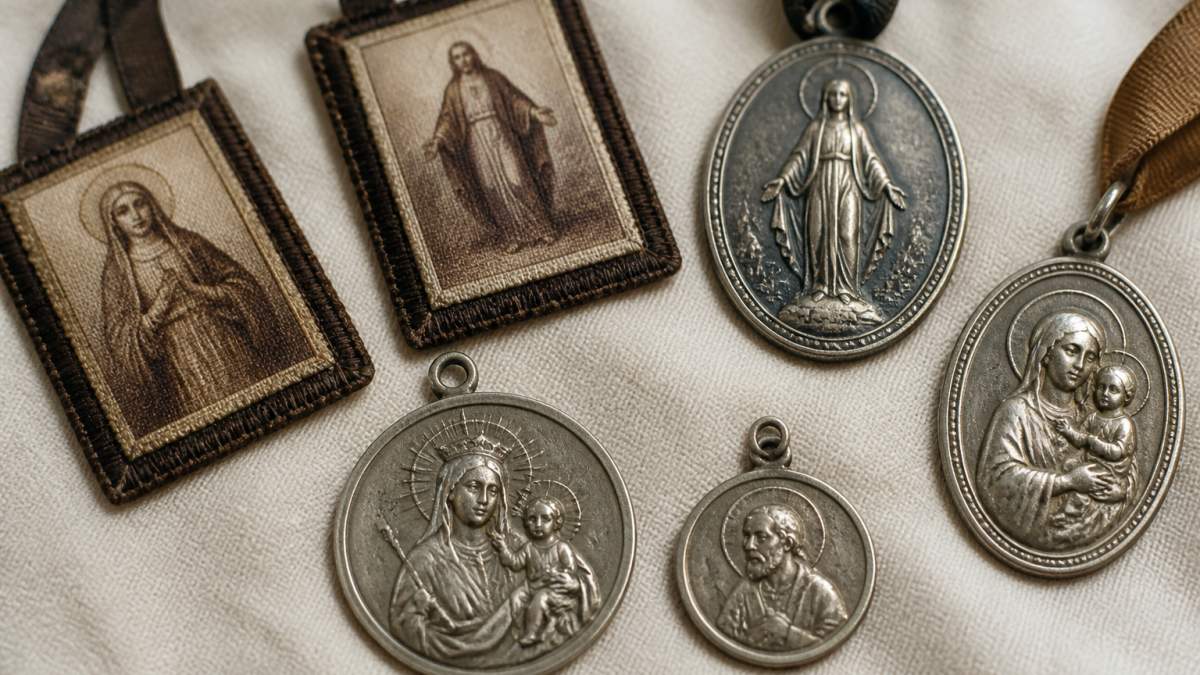
A scapular medal combines the concept of the traditional scapular with the form of a medal. Instead of two separate pieces of cloth, it is a single, often oval or round medal with religious iconography on both sides, worn on a cord.
The main difference lies in their construction: a traditional scapular consists of two separate pieces, while a scapular medal is an integrated, more compact form that is easier to wear under clothing.
The meaning of a religious medal remains the same as that of the traditional scapular: spiritual protection and personal devotion. Both forms of devotionalia are worn with the same intention and faith. The difference between a scapular and a medal is therefore more practical than spiritual.
Meaning and symbolism of religious medals
The meaning of religious medals is deeply rooted in Christian tradition and iconography. Each medal usually bears images of saints, Jesus, Mary, or other religious figures. The symbolism of these depictions refers to protection, faith, and spiritual refuge.
Show religious medals featuring biblical symbols such as the fish (early Christianity), the peacock (immortality), or grapes (the Last Supper), used in early Christian and Byzantine art as a visual expression of faith.
Manufacturing techniques range from cast metal to hand-carved reliefs. The value of a medal depends largely on its manufacturing quality and historical period.
Identifying and dating antique religious medals
Identifying antique religious medals requires examining the material, manufacturing traces, iconography, and documentation. This step-by-step guide will help you assess medals reliably.
Step 1: Determining the material and weight
Antique bronze medals (8th-19th century) feel significantly heavier than modern reproductions.
Silver (luxury examples, 18th-19th century) feels warmer and develops black patina (silver sulfide), while bronze turns green or brown.
Step 2: Examining casting marks and manufacturing traces
Antique cast medals show irregular edges, a visible casting seam, variations in thickness, and small air bubbles. Modern reproductions have smooth, uniform edges and an overly perfect finish.
Handmade medals show hammer marks or chisel marks that are not uniform. Early Christian medals (1st-5th century) have rougher marks than Gothic medals (13th-15th century).
Step 3: Analyzing iconography and inscriptions
Compare the style with known examples: Early Christian (1st-5th century) shows simple symbols and schematic faces. Byzantine (5th-15th century) saints are depicted frontally. Gothic (12th-15th century) has finer detail.
The lettering style is crucial: early Christian inscriptions are irregular and handwritten; 19th-century medals have uniform cast letters. Modern counterfeits often contain spelling mistakes or anachronistic texts.
Step 4: Assessing patina and wear
Genuine patina develops slowly and irregularly, with wear on raised areas. Modern artificial patina looks uniform and superficial and flakes off without exposing bare metal underneath.
Silver develops black patina in grooves that are difficult to clean. Superficial black paint (a counterfeit) comes off with a soft cloth.
Step 5: Checking provenance and documentation
Gather information about provenance, old photographs, museum catalogs, and restoration traces. Restoration reduces value but can be legitimate; check whether it was professionally done.
Practical example: Identifying a 19th-century Marian medal
Example: a medal with Mary.
Materials and manufacturing techniques
Materials and manufacturing techniques determine durability, authenticity, value, and distinction from modern reproductions.
Medallions: cast bronze versus forged silver
Cast bronze (most common, 8th-20th centuries):
Bronze (an alloy of copper and tin) was the standard material due to its durability, affordability, and suitability for fine details. An artist made an original model (wax or clay), which was used to make a mold, and molten bronze was cast.
Characteristics of authentic cast bronze medallions:
- Casting seam visible on the side (a thin line where two casting molds came together)
- Irregular edges and small imperfections
- Variations in thickness (front thicker than back)
- Small air bubbles or porous spots (especially in older castings)
- Weight: a 3 cm diameter medallion typically weighs 15-30 grams
Modern cast reproduction uses more perfect molds and has:
- Smooth, uniform edges
- No visible casting seam (or a very subtle one)
- Consistent weight and thickness
- No air bubbles
Forged silver (more luxurious examples, especially 17th-19th centuries):
Silver was used for more valuable medallions. The forging process: a silver sheet was hammered over a steel form, details were chiseled in, and the front and back were joined.
Characteristics of authentic forged silver medallions:
- Hammer marks visible on the back (irregular, overlapping marks)
- Silver oxidizes into a black patina (silver sulfide) that penetrates deep into the metal
- Weight: a 3 cm silver medallion weighs 25-45 grams (silver is heavier than bronze)
- Wear reveals exposed silver beneath the patina
- Often signed or marked by the silversmith
Modern silver imitation:
- No hammer marks (or artificially applied ones)
- Artificial patina that is superficial and flakes off
- Often too light (because cheaper metal was used)
Scapulars: hand-embroidered versus machine-embroidered
Antique scapulars (especially from the 18th-19th centuries) were textile devotional objects consisting of two pieces of fabric connected by cords. The material and embroidery determine authenticity and value.
Hand-embroidered (18th-early 19th century):
Each stitch was made by hand, often by nuns or specialized embroiderers. Materials included wool, linen, or silk.
Characteristics of authentic hand-embroidered work:
- Irregular stitch length (variations of 2-5 mm)
- Stitch direction varies subtly (following the embroiderer's hand)
- Thread sometimes appears visibly worn or faded
- Knots on the back are visible and irregular
- Patterns are never perfectly symmetrical
- Thread may fray or come loose (a sign of age)
Machine embroidered (late 19th-20th century):
Embroidery machines (invented in the 19th century) made mass production possible. Stitch length is uniform, patterns are perfectly symmetrical, and quality is consistent.
Characteristics of machine-embroidered work:
- Perfect, uniform stitch length (exactly 3 mm)
- Stitch direction is mechanically consistent
- No visible knots on the back (or very neat ones)
- Patterns are identical to each other
- Thread is tight and shows no wear
Material combinations and their meaning
The combination of material and technique tells you a great deal about period and origin:
| Combination | Period | Origin | Value |
|---|---|---|---|
| Wool, hand embroidered | 18th-early 19th century | Monastery or artisan | High (rare) |
| Linen, hand embroidered | 19th century | Artisan or small manufacturer | High |
| Silk, hand embroidered | 18th-19th century | Luxury, probably France/Italy | Very high |
| Cotton, machine embroidered | Late 19th-20th century | Mass production | Medium |
| Cast bronze, no patina | 20th century | Modern reproduction | Low |
| Forged silver, black patina | 17th-19th century | Goldsmith or luxury manufacturer | Very high |
What conservation and damage tell you
The condition of the material reveals authenticity and history:
Textile scapulars:
- Fading: Authentic antique scapulars show uneven fading (where they lay in sunlight) and discoloration from sweat. Modern reproductions are uniformly colored.
- Insect damage: Moths and silverfish eat wool and linen. Small holes and bare patches indicate authenticity (and require careful conservation).
- Wear on the edges: Where cords were attached, you can see worn fibers. This is normal and authentic.
- Traces of glue: Modern repairs with glue are visible and indicate restoration (which does not disprove authenticity but may reduce value).
Metal medals:
- Green patina on bronze: Authentic and valuable. Do NOT remove it; it protects the underlying metal.
- Black patina on silver: Authentic. Careful cleaning is acceptable, but do not remove it all.
- Visible red copper: Indicates wear and authentic use. Do not restore it.
- Signs of restoration: Soldering (for example, where a break has been repaired) is visible as shiny metal. This reduces value but may be legitimate.
Practical example: Comparing two 19th-century Marian medals
Medal A: Cast bronze, 18 grams, visible casting seam, green patina in the grooves, wear on Mary's face.
Medal B: Cast bronze, 12 grams, no visible casting seam, artificial green coating, no wear.
Medal A is probably an authentic 19th-century piece and more valuable. Medal B is probably a modern reproduction.
Why material and technique determine value
Collectors pay more for:
- Handwork (cast bronze with a visible casting seam, hand-embroidered textiles)
- More precious materials (silver, silk)
- Original condition (no restoration, authentic patina)
- Craftsmanship (fine details, consistent execution)
A handmade silver medal from the 19th century can be worth 3-5 times more than a cast bronze example from the same period because silver is more expensive and handmade items are rarer.
Scapular and medal as collectibles
Scapulars and medals are popular collectibles because of their historical significance, art-historical value, and spiritual importance. A well-curated collection contains objects from different periods: early Christian, Byzantine, medieval, and later.
Collecting requires knowledge of authenticity and dating. Many collectors focus on specific themes. Value depends on age, rarity, condition, and quality of manufacture.
According to research into antique art objects, interest in religious devotional items as collectibles is growing. This is because people increasingly value sustainable consumption and giving historical objects a second life. This aligns with the mission of Chez Monique's 2e Leven: to make unique, antique religious objects accessible to collectors and enthusiasts.
Why both devotional items are valuable
Both traditional scapulars and religious medals are valuable: spiritually, as a personal expression of faith, and as collectibles because of their art-historical value and craftsmanship.
Value is determined by age, provenance, material, and manufacturing technique. A handmade silver medal from the 19th century is considerably more valuable than a cast bronze example from the 20th century.
Research by experts in religious art objects shows that well-preserved antique religious objects are increasingly appreciated. This is partly because these objects not only have spiritual value, but also bear witness to historical artistic craftsmanship. By giving these objects a second life in a new home, we preserve cultural heritage and support sustainable consumption.
| Aspect | Traditional Scapular | Religious Medal |
|---|---|---|
| Form | Two cloths/panels connected by cords | Single medal on a cord |
| Material | Wool, linen, silk with embroidery | Cast or wrought metal |
| Wearing comfort | Larger, more visible | Compact, discreet |
| Collectible value | High (textiles are rare) | High (metal preserves better) |
| Spiritual meaning | Identical | Identical |
| Condition preservation | Requires caution | More sustainable |
The difference between a scapular and a medal is mainly practical and structural, not spiritual. Both are valuable as devotional objects and collectibles. At Chez Monique's 2e Leven, we invite you to discover these unique objects and give them a second life in your interior, with careful selection and sustainable packaging.
Frequently Asked Questions
What is the difference between a scapular and a medal?
A scapular is a garment consisting of two small pieces of cloth connected by cords, worn against the body as a sign of devotion. A religious medal is a small metal object, often attached to a chain, serving as an amulet or memento. The main difference is that scapulars are worn as a permanent garment, while medals are wearable jewelry or collectible objects.
How can you recognize a genuine antique scapular?
Genuine antique scapulars have natural discoloration on the fabric, wear along the edges, and authentic threads. Check whether the images are hand-painted or embroidered rather than printed. The fabric feels thin and fragile, not stiff or new. Look for signs of long-term use, such as discoloration from perspiration and the material's natural aging.
What does a religious medal mean?
Religious medals usually feature images of saints, Jesus, Mary, or religious symbols such as the fish or the cross. Each medal has a specific meaning: the Miraculous Medal represents divine protection, while Saint Christopher represents safe travel. They were worn as talismans, mementos, or expressions of faith. In the 19th and 20th centuries, they were popular devotional objects in Catholic households.
Are antique religious medals and scapulars suitable for non-religious collectors?
Yes, absolutely. Many collectors appreciate these objects purely for their art-historical value, artisanal quality, and unique design. Antique religious medals and scapulars are fascinating pieces of art history that speak to early Christian and medieval traditions. They add character to interiors and serve as conversation pieces, regardless of your personal faith.