

Recognizing authentic devotional items: tips and characteristics
Table of contents
- What are devotional objects, and why do people collect them?
- Collecting devotional objects: from medallions to rosaries
- Recognizing an antique rosary: 7 signs of authenticity
- Materials and techniques: plaster, enamel, and metalworking
- Recognizing forgeries: a step-by-step guide to authenticity features
- Determining the value of religious objects: collector value and historical context
- Safe Cleaning Methods for Devotional Objects
- Conclusion: begin your collection with confidence
- Frequently Asked Questions
Last updated: 15 September 2026
What are devotional objects, and why do people collect them?
Devotional objects are religious items that support believers in their personal prayer and popular devotion. Think of medallions, crucifixes, rosaries, and saint statues that were passed from hand to hand for generations. More and more people are looking for tips on recognizing authentic devotional objects, because the selection on online platforms is growing and quality varies widely.
At Chez Monique's 2e Leven, we notice that collectors look for two things: a piece of Roman Catholic heritage and an object with character for the interior. Both require the same skill: being able to look closely at the material, technique, and wear. Below, you can read exactly what to look for.
The difference between religious art and popular devotion
The distinction lies in origin and function. Religious art was often commissioned for a church or chapel, using craftsmanship and expensive materials. Popular devotion refers to objects that ordinary families bought themselves or received during a pilgrimage, First Communion, or wedding.
That difference determines the price. A signed statue from a studio carries a different value from a mass-produced plaster figurine bought at a market. Nevertheless, popular devotion is historically just as interesting, because it shows the everyday religious experience of a period.
Collecting devotional objects: from medallions to rosaries
Those who start collecting devotional objects usually choose one clear direction. This keeps the collection organized and makes it easier to recognize quality within a specific category. The most popular categories are medallions, crucifixes, rosaries, prayer cards, and saint statues.
Each category has its own signs of authenticity. With metal, look for patina and casting seams; with plaster, examine polychromy and weight; with textiles, consider the beads used and the small cross. Choose one category and get to know it thoroughly before expanding your collection.
Medallions, crucifixes, and saint statues
Medallions are small, often made of metal, and usually bear an image of Mary or a saint. Pay attention to the edges: genuine antique examples have irregular edges from being cast by hand, while reproductions are often perfectly round.
Crucifixes range from simple wood to enamel and brass. A crucifix with enamel inlay and visible wear on the corners often indicates a 19th-century or early 20th-century example. Saint statues, usually made of plaster, are the most collected and the hardest to date. An example from our own collection is an antique statue of Our Lady of Fatima, Portugal, a hand-painted plaster statue with glass eyes from the 1950s.


Recognizing an antique rosary: 7 signs of authenticity
Recognizing an antique rosary starts with the beads, the cross, and the connections between them. Old rosaries were strung by hand and show signs of use that a machine cannot replicate. Below are the seven features that carry the most weight.
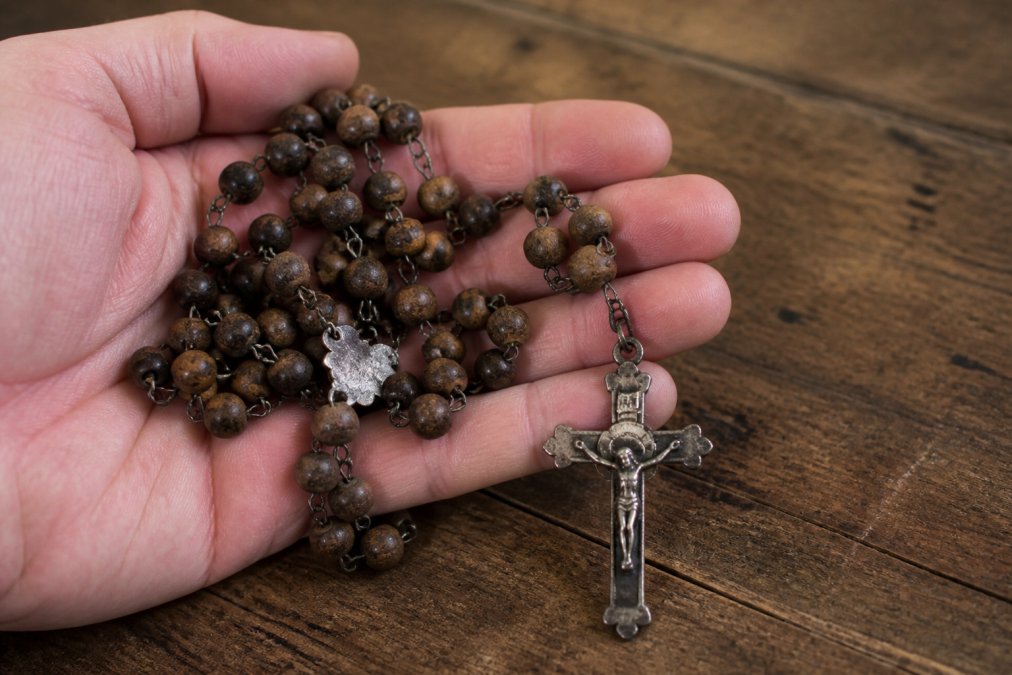
- Even wear on the beads where fingers repeatedly pass
- A cross with patina consistent with the age of the beads
- Hand-knotted connections instead of a continuous cord
- Consistent color and material across all the beads
- A clasp or medallion attached by hand
- Weight and warmth appropriate for wood, glass, or metal
- A faint scent of old wood or fabric in older examples
Cast seams, patina, and wear as evidence of age
Cast seams are the thin ridges left behind where two halves of a mold meet. On older metal objects, these seams were often finished by hand or deliberately left visibly rough. Perfectly smooth edges without any trace of processing usually indicate a modern reproduction.
Patina is the natural layer that metal and stone develop over the years. Genuine patina is irregular, dull, and settles into the pores. Artificial patina often forms an even layer on the surface and feels greasy.
Materials and techniques: plaster, enamel, and metalworking
Plaster, enamel, and metalworking together form the core of most devotional objects. Plaster was inexpensive and easy to shape, making it the standard for religious statues in the 19th and 20th centuries. Enamel was used for crosses and medallions because it retained its color.
Metalworking reveals the finest differences. Traditional techniques such as hammering, soldering, and engraving leave traces visible to the naked eye. An engraved name or date on the back is almost always a sign of an authentic piece, because reproductions skip that step.
Recognizing forgeries: a step-by-step guide to authenticity features
Recognizing forgeries requires a consistent routine, not luck. The market for religious devotional objects is large, and copies are often well made. With a fixed step-by-step process, you assess every object in the same way and miss nothing. The key is not to rely on a single feature, but on the combination of at least three independent signs that confirm one another.
- Weigh the object and compare it with what the material should weigh. Plaster feels noticeably light for its size; solid brass or bronze, by contrast, feels heavy. A hollow-feeling statue that nevertheless appears heavy is often a modern resin cast with a metal coating.
- Examine the edges for casting seams, touch-ups, and irregularities.
Material research and provenance assessment
Determining the value of religious objects: collector value and historical context
| Feature | Weak value | Strong value |
|---|---|---|
| Provenance | Unknown | Documented |
| Signature | None | Legible mark |
| Patina | Artificial | Natural and deep |
| Wear | Perfectly Smooth | Naturally Worn |
| Rarity | Mass Production | Rare Depiction |
Safe Cleaning Methods for Devotional Objects
Plaster and Polychrome
Metal: Brass, Bronze, and Silver
Textiles and Beads
What You Should Never Do
Conclusion: begin your collection with confidence
Frequently Asked Questions
What exactly falls under the term devotional objects?
Devotional objects are religious items used to support believers in their personal devotion. They include rosaries, medallions, crucifixes, prayer cards, statues of saints, and reliquaries. These objects are often associated with the Roman Catholic tradition and the veneration of saints. They differ from religious art because they were intended for daily use, not only for church use. It is precisely these signs of use that make them valuable to collectors.
How can I determine the age of a religious object?
Look at the patina, casting seams, and wear patterns. A 19th- or 20th-century object often has an even, natural patina that cannot be removed with a cloth. Casting seams indicate a handcrafted production method. Also look for stamps or signatures, such as 'Depose' or a maker's mark. Material analysis and provenance research provide additional certainty, but dating always remains a matter of combining multiple characteristics.
Are there hallmarks on antique devotional objects?
There are no legal hallmarks for devotional objects as there are for precious metals. However, you may sometimes find maker's marks, stamps, or signatures on the back or underside of statues. Examples include 'Depose', a round stamp, or an engraved name. These marks provide information about the origin and production period, but they are not a guarantee of authenticity. A forger can imitate a stamp. Therefore, always use hallmarks together with other authenticity indicators.
What is the difference between devotional art and religious art?
Religious art is intended for the liturgy or as representation in churches, such as altarpieces and large statues. Devotional art, or popular devotion, is personal and domestic. It concerns objects that people used at home for prayer and veneration. Devotional objects are often more simply made, from plaster or inexpensive metal, and show signs of use. This difference in context also determines their value and how they are collected.
What should I look for when buying antique rosaries?
Pay attention to the beads, the cross, and the connections. Antique rosaries often have irregular beads made of wood, glass, or bone, and a cross with visible patina. Check that the rings and wirework have not been replaced recently. New, perfectly uniform beads indicate a reproduction. Ask about the provenance and compare the finish with known 19th- or 20th-century examples. A magnifying glass helps reveal casting seams and wear.
How can I identify the materials used in antique devotional objects?
Plaster statues feel heavy and cool and often have hand-painted polychrome surfaces that flake in places. Enamel is smooth and glossy, but develops small cracks with age. Metal such as bronze or brass develops a patina that turns green or brown. Plastic or resin is suspicious in objects sold as antiques. Always combine touch, visual inspection, and weighing. Materials knowledge gives you the foundation, but experience from examining many objects is at least as important.
How do I clean an antique religious statue without damaging it?
Never use aggressive cleaning products or a wet cloth on plaster or polychrome surfaces. Remove dust with a soft brush. For stubborn dirt on stone or metal, you can use a slightly damp cloth, but always test it first in an inconspicuous spot. Leave the patina untouched, as it protects the surface and determines the collector's value. If in doubt, consult a restorer. Safe cleaning mainly means doing as little as possible.
How can I tell whether a devotional object is genuinely antique or a reproduction?
You can recognize a reproduction by its overly perfect finish, lack of patina, and modern materials such as synthetic resin. Genuine antique devotional objects have irregularities, casting seams, and signs of use that cannot be replicated without visibly compromising their authenticity. Examine the back, underside, and any stamps. Compare them with reference photos of 19th- and 20th-century objects. If in doubt, ask about the historical context and provenance. A seller who is transparent about defects inspires more confidence than one who calls everything perfect.