

Preserving Religious Heritage: A Practical Guide
Table of contents
- Inventory and documentation of your religious objects
- Protecting religious statues from moisture and mold
- Cleaning plaster sculptures without causing damage
- Maintaining antique devotional objects step by step
- Physical management and conservation of religious heritage
- Sustainable packaging and transport of fragile objects
- Funding sources and grants for private owners
- Digital archiving and documentation of your collection
- Frequently Asked Questions
Last updated: September 28, 2026
Preserving religious heritage requires care and knowledge. It is not only about preserving objects, but also about respecting their history and significance. At Chez Monique's 2nd Life, we focus on collecting and passing on religious statues and devotional items. In this guide, we will show you how to preserve religious heritage step by step, with practical tips that really work.

Inventory and documentation of your religious objects
The first thing you need to do is find out what you have. A thorough inventory forms the basis for all further management of preserving your religious heritage.
Photograph each object from multiple angles and record: name, dimensions, material, condition, and provenance. Use a numbering system you understand; many collectors use the year plus a sequential number (for example: 2026-001, 2026-002).
Enter your data in a spreadsheet or database. Make sure you have at least these columns: Object number, Name and type, Material, Dimensions, Current condition, Purchase date, Provenance, and Conservation notes. Back up your data on an external drive or in the cloud.
Protecting religious statues from moisture and mold
Moisture is the greatest enemy of religious heritage. It causes mold, rust, discoloration, and rot. Protecting religious statues from moisture and mold begins with understanding where it comes from: from the air (relative humidity), from the material itself, and through condensation.
Check your storage space. Avoid basements, attics, and bathrooms. A living room or bedroom is usually better. The ideal relative humidity is between 40 and 55 percent. Use a hygrometer to measure it and check it weekly.
Optimal climate control for heritage sites
A stable climate is essential. Avoid direct sunlight, nearby heating appliances, damp environments, and rapid temperature changes. Ensure good ventilation by regularly opening windows. Consider a small dehumidifying cabinet with silica gel for your most valuable pieces.
Preventive maintenance checklist
These are the essential steps for preserving religious heritage:
- Check humidity monthly with a hygrometer
- Inspect objects for mold or stains
- Ensure good ventilation by airing the room regularly
- Avoid direct sunlight on your collection
- Keep the temperature stable
- Clean the storage area monthly with a dry cloth
- Replace silica gel in the dehumidifying cabinet if necessary
- Check packaging for damage
- Record observations in your inventory register
Cleaning plaster sculptures without causing damage
Plaster is fragile. It dissolves in water and can easily be scratched. Never use water; this is the most important rule. Water permanently damages plaster.
Use a soft, natural brush (an old toothbrush works well). Brush your sculpture gently from top to bottom. For more stubborn dirt, you can use a slightly damp cloth, but it must not be wet. Wring it out thoroughly and dry the sculpture immediately.
Avoid abrasive agents, acid, strong chemicals, and polishing agents. These damage the plaster.
Maintaining antique devotional objects step by step
Antique devotional objects, such as crosses, rosaries, and statuettes, require specific care. Each material requires different treatment.
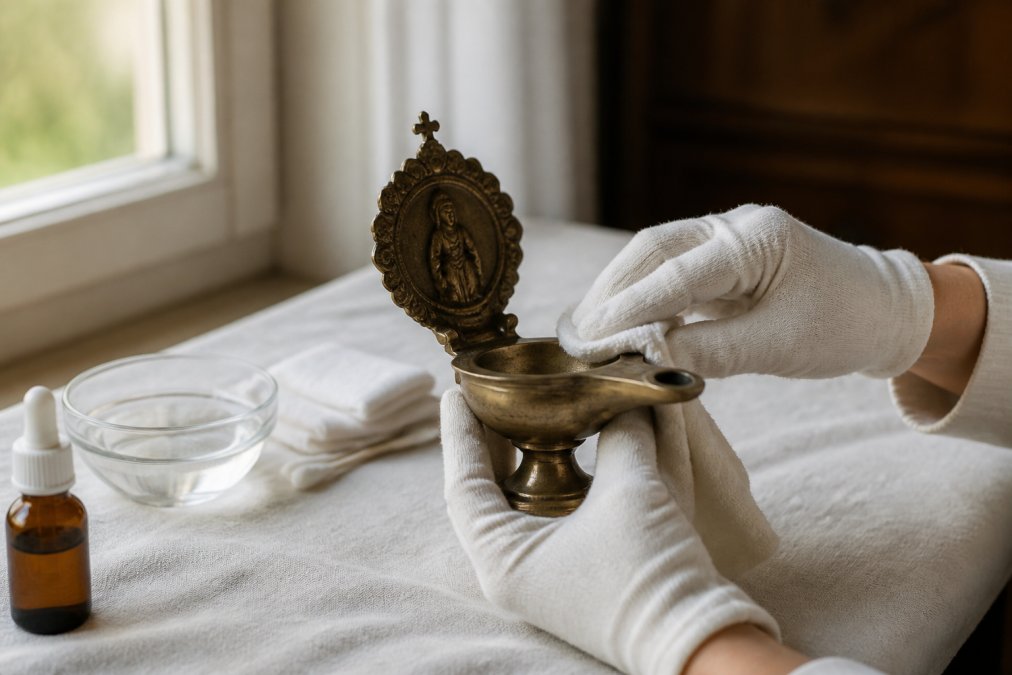
Step 1: Determine the material. Copper objects, wooden sculptures, plaster, porcelain-each requires different care. Examine your object closely to determine the material.
Step 2: Inspect for damage. Check for cracks, loose parts, or old restorations. Respect previous repairs.
Step 3: Gentle cleaning. For all materials: use a soft, dry cloth. Rub gently and avoid damaged areas.
Step 4: Surface treatment. Copper objects can develop a natural patina; this is protection, not dirt. For wooden sculptures: make sure they stay dry. Use only special restoration oil, not ordinary household oil.
Step 5: Storage. Pack each object separately in acid-free paper or cotton cloth. No plastic. For fragile pieces: use a box with padding.
Physical management and conservation of religious heritage
Caring for and conserving religious heritage goes beyond simply cleaning it. Physical damage is often caused by careless handling. Always have clean hands when touching objects; for valuable pieces, wear cotton gloves.
Do not simply stack objects on top of one another. Use separators and place each piece on a cloth. Avoid strong light and UV radiation, which fade colours and damage materials.
Sustainable packaging and transport of fragile objects
When moving religious heritage, you must pack it properly. At Chez Monique's 2nd Life, we use sustainable packaging materials, but safety comes first.
Packaging steps: Wrap each object in acid-free paper. For fragile pieces, use multiple layers. Place the wrapped object in a box and fill around it with cotton cloths or paper so it does not shift. Mark "Fragile" on the box and add a silica gel sachet. Do not place the box under heavy items and avoid large temperature fluctuations.
Funding sources and grants for private owners
Restoration and conservation of religious heritage can require significant investment. However, private owners have access to various sources of funding.
Antique Copper Last Rites Kit →
Grants through municipalities and provinces
Most municipalities have heritage budgets available. Contact your municipality's Culture or Heritage department. The provincial level also offers opportunities for larger restoration projects.
Heritage foundations and private funds
Dozens of heritage foundations are active in the country. Search online for heritage foundations in your region.
Tax benefits for art ownership
If you own religious heritage that is recognized as a work of art, tax benefits may apply. Consult a tax adviser or art broker.
Crowdfunding and private donations
For special objects, crowdfunding can work. Tell the object's story, post good photographs online, be realistic about the amount, and offer donors something in return.
Professional restorers and payment plans
Always request a detailed quote. Compare at least three quotes and check the restorer's experience with religious heritage.
Step-by-step grant application process
- Document your object with photographs and determine its material, condition, and value.
- Contact your municipality about available grants and criteria.
- Consult an expert for valuable pieces.
- Draw up a plan with a description and rationale.
- Gather documentation: photos, cost estimates, historical information.
- Submit the application according to the procedure.
- Wait for approval.
- Carry out the project according to the conditions.
- Submit accountability reports with photos and reports.
Appraisal and insurance
For expensive objects, insurance is essential. This protects you against loss and helps with grant applications.
Digital archiving and documentation of your collection
Digital archiving is essential for heritage preservation. Digital copies protect against loss from fire or theft, help future owners, and enable research without handling the original.
Why digital archiving is essential
Physical objects can be damaged, stolen, or lost. A well-digitized collection protects you against loss and neglect, and supports research. Digital documentation can be useful for heritage organizations and museums.
Photography: standards and best practices
Photos are the foundation of digital archiving. Quality is crucial.
Photography standards: At least 300 dpi for archiving. Use TIFF or PNG (lossless).
Metadata and descriptions
Photos without information are worthless. Metadata is essential.
Minimum metadata per object: Object number, Title/Name, Description, Material, Dimensions, Weight, Provenance, Purchase date, Purchase price, Condition, Dating, Maker/Artist, Religious significance, and Notes.
Use a structured format, such as Google Sheets or Excel.
3D scanning and digital modeling
3D scanning creates a digital model of your object. This allows you to view it from all sides without touching it, share it online, and let researchers study it.
Cloud storage and long-term preservation
Digital files must be stored securely in multiple locations.
Storage strategy (3-2-1 rule): 3 copies on at least 3 different media, 2 different types of media (cloud and physical storage), 1 copy in a different location.
Standards and interoperability
Relevant standards: Dublin Core (minimum set of 15 metadata fields), CIDOC-CRM (more complex standard for large museums), LIDO (standard for museum objects). For private collectors, Dublin Core is usually sufficient.
Practical checklist for digital archiving
- Photograph each object from at least 6 angles
- Save photos in TIFF format (at least 300 dpi)
- Enter metadata (at minimum: name, material, dimensions, provenance, condition)
- Put everything in a structured folder
- Create a backup on an external drive
- Put a copy in the cloud
- Keep a third copy in a safe location outside your home
- Check annually that all files are still accessible
- Consider 3D scanning for highly valuable objects
- Document your archiving procedure for heirs
Frequently Asked Questions
How do I clean antique religious statues without causing damage?
Always begin by removing dust with a soft, dry brush or microfiber cloth. For copper objects such as an antique oil lamp, use lukewarm water with a few drops of mild dish soap and a soft sponge. Dry immediately with a clean linen cloth. Avoid abrasive materials and harsh chemicals. For plaster statues, only careful dusting is safe; water can cause serious damage.
What is the best humidity level for preserving religious heritage?
Ideally, relative humidity should be between 45% and 55%. Higher humidity (above 65%) promotes mold and corrosion, while very low humidity (below 35%) can cause wood to shrink and crack. Measure regularly with a hygrometer and, if necessary, use a humidifier or dehumidifier to maintain stable conditions.
How can I prevent mold on wooden religious objects?
Ensure good ventilation and check humidity regularly. Do not place objects against exterior walls where condensation occurs. Avoid dark, damp corners. Inspect monthly for stains or musty odors. At the first signs of mold, isolate the object and consult a conservator. Silica gel packets can help regulate humidity in enclosed display cases.
How can I safely move and pack religious heritage objects?
Always use soft materials: acid-free paper, linen cloths, and cotton packaging. For fragile pieces such as plaster statues, create a protective layer with acid-free paper and provide support with cotton padding. Chez Monique's 2e Leven ships valuable objects using reused packaging materials, with the safety of your purchase as the top priority. Never transport objects through extreme temperature changes; allow them to acclimatize first.