

Theca vs. Relic: The Difference in Catholic Tradition
Last updated: November 3, 2026
Quick summary
The difference between a theca and a relic is simple: a relic is the revered remains or object itself, while a theca is the container in which those remains are kept. One is the contents, the other the place of safekeeping. A theca is usually a small metal box with glass at the back.
- Every theca is a relic holder, but not every relic holder is a theca.
- A wax seal or seal on the closure is the mark of authenticity for its provenance.
- The Church distinguishes between first-, second-, and third-class relics, each with its own storage rules.
- Never force a theca open, as the screw or seal can easily be damaged.
- The size of the relic determines which type of holder is suitable.
Table of contents
- Theca vs. relic: the difference at a glance
- Meaning of theca: a container, not a relic
- Meaning of relic: the venerated remains or object
- Theca, relic holder, and relic: three terms, three layers
- Types of relics and how they are stored
- Preserving relics: from wax seals to glass backs
- How to identify a theca containing a relic
- Choosing a theca or relic for your collection
- Frequently Asked Questions
Theca vs. relic: the difference at a glance
The difference between a theca and a relic is easy to sum up: a relic is the revered remains or object itself, while a theca is the container in which those remains are kept. One is the contents, the other the place of safekeeping. Those who confuse the terms often fail to understand that they refer to two different layers of the same devotional object.
An antique rosary with a cross-shaped relic holder shows how the contents and holder go together: the cross opens with a small screw and contains the relics themselves. The holder protects them; the relics carry the meaning.
Below, you’ll read how the terms relate to one another, how to recognize them, and what to look for when choosing a piece for your collection.
| Term | What it is | Function | Example |
|---|---|---|---|
| Relic | The revered relic or object | Carries the meaning and devotion | Bone fragment, garment, contact relic |
| Relic | The relic itself, as a designation | Same core meaning as relic, different word form | A piece of a saint’s clothing |
| Relic holder | The casing that protects the relic | Safekeeping and display | Gilt cross, reliquary, medallion |
| Theca | A specific, often round container | For safekeeping, usually with glass at the back | Metal box with wax seal |
Meaning of theca: a container, not a relic
Meaning of theca: a theca is a container for a relic, usually a small metal box that is round or cross-shaped and closed with glass at the back. The theca contains the relic, but is not itself a relic. The word comes from Greek and originally referred to a small box or place of safekeeping.
In the Catholic tradition, a theca is used to safely store small relics while also making them visible. The faithful want to be able to see the relic without touching it. That is why there is often a glass window in the back: you can look inside, but the relic remains protected.
A wax seal or seal on the back is traditionally used as a mark of authenticity. If the seal is broken, it is harder to verify the contents’ provenance.
Meaning of relic: the venerated remains or object
Meaning of relic: A relic is the physical remains of a saint or an object that has come into contact with a saint, which is venerated within the Catholic Church. It refers to the material itself, not the casing. A relic may be a bone fragment, a piece of clothing, or a cloth that a saint touched.
The veneration of relics is rooted in a long religious tradition. Believers attribute miraculous powers to some relics. What matters is the devotion: the relic is a tangible connection to a saint.
Important distinction: a relic is the contents. When you are talking about the box, cross, or medallion, you are talking about the holder.
Theca, relic holder, and relic: three terms, three layers
Three terms, three layers: the relic is the contents, the relic holder is the casing, and the theca is a specific type of relic holder. Each layer has its own meaning and role in devotional objects. Keeping them distinct helps you better identify and assess an object.
Relic holder is the overarching term. Every theca is a relic holder, but not every relic holder is a theca. A large gilded shrine in a church is a relic holder, not a theca. A small round case with glass on the back is a theca.
The same principle of contents and casing applies to related devotional objects. For more information about the place of such objects in the tradition, see the background in our article on is an antique scapular suitable for everyday use.
Confusion often arises around the word pair theca and relic, because both are used in one sentence: "the theca with the relic." Linguistically, they go together, but they describe different things. The theca is the metal case; the relic is what lies inside.
Types of relics and how they are stored
Relics are traditionally divided into three classes, and this classification partly determines how they are stored and what type of holder is appropriate. The Catholic Church distinguishes first, second, and third class relics. Each class has its own rules for storage and for the holder used. Below, the classes are listed side by side, along with the corresponding storage practices.
| Class | What it is | Examples | Common holder | Storage rule |
|---|---|---|---|---|
| First class | Physical remains of a saint | Bone fragment, piece of skin, hair | Small theca with glass on the back | Protect from moisture and direct sunlight; leave the seal intact |
| Second class | Objects used or worn by a saint during their lifetime | Garment, prayer book, rosary | Reliquary or theca, depending on size | Store textiles flat, do not fold; keep metal dry |
| Third class | Objects that have touched a first- or second-class relic | Cloth, medallion, scapular | Medallion or small theca | Do not open; keep provenance documentation |
Small first- and second-class relics are usually kept in a theca because it is compact and protective. Larger remains are housed in a more spacious shrine or reliquary in a church setting.
For third-class relics, the emphasis is less on the material and more on the chain of contact. A cloth that has touched a first-class relic is often enclosed in a medallion or small theca, sometimes together with a note stating its provenance.
Antique rosary with relic holder →
Symbols on devotional objects help identify what you are looking at. A theca or reliquary often bears signs that refer to its provenance or to the saint. Our article on how to read the meaning of symbols on devotional medals explains how to recognize and interpret these signs.
Preserving relics: from wax seals to glass backs
Preserving relics involves two things at once: protection and visibility. The theca achieves this with a simple construction. The front bears the decorative motif, the back has a glass window through which you can see the relic, and a seal around the edge closes the contents inside.
The wax or sealing-wax seal is more than decoration. It is the mark of authenticity with which a high-ranking church official confirmed the provenance. An intact seal indicates that the theca has not been opened since it was sealed. A broken seal does not automatically mean the relic is inauthentic, but it does make its provenance harder to establish.
Watch out: never force a theca open to get a better look at its contents. The small screw or seal is easily damaged, and then you lose precisely the mark of authenticity that determines its value.
How to identify a theca containing a relic
Identification begins with the shape. A theca is usually round or cross-shaped, made of metal, and fitted with a glass window on the back.
| Feature | What to look for | What it tells you |
|---|---|---|
| Shape | Round, oval, or cross-shaped; compact in size | Fits a theca; larger reliquaries are not thecae |
| Material | Metal, often gilded or silver-plated; sometimes black metal | The type of metal and wear indicate age |
| Back | Glass window through which the contents are visible | Distinguishes the theca from a closed medallion |
| Closure | Small screw, hinge, or secured edge | Reveals that the object can be opened |
| Seal | Wax seal or sealing wax over the closure | Strongest sign of authenticity and provenance |
| Inscription | Inscription on the edge or back | Refers to a saint, monastery, or place of origin |
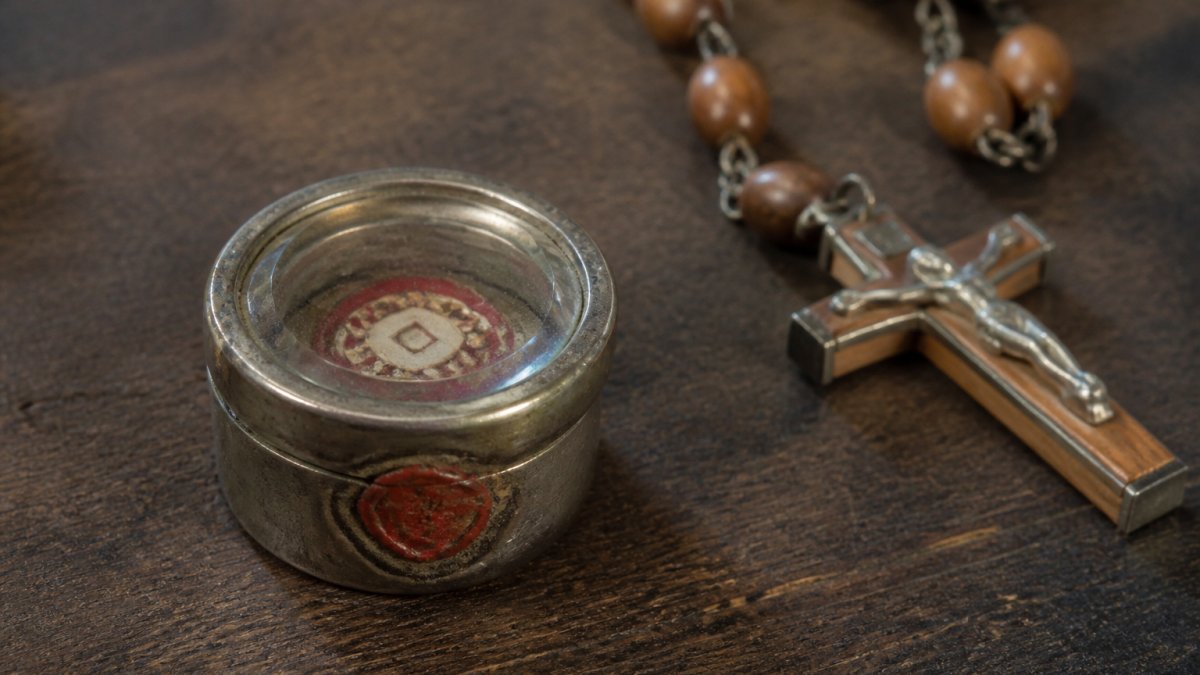
Next, examine the closure. A small screw, hinge, or secured edge indicates that the object can be opened. An intact wax seal over the closure is the strongest sign that you are looking at an authentic theca.
A concrete example helps show the difference in practice. Our antique rosary with relic holder from the 1930s-1950s features a cross-shaped holder that opens with a small screw, containing relics from the Holy Land.

A common mistake is to mistake a theca for a medallion or decorative object.
Watch out: never force a theca open to get a better look at its contents. The small screw or seal is easily damaged, and then you lose precisely the mark of authenticity that determines its value.
Choosing a theca or relic for your collection
Your choice depends on what you are looking for: the contents or the container. If you want to preserve a relic, you need a suitable theca. If you are looking for a historical object for your collection, you can focus on the quality of the container, the seal, and its provenance. Each approach calls for a different perspective.
To assess the age of a piece, it helps to know the characteristics of 19th-century religious objects, such as the materials used and the style of the decorative motif. Our article on 19th-century religious statues: identifying their characteristics offers useful guidance, including when you want to estimate the age of a theca or relic.
Those building a devotional collection should first decide what direction they want to take it in. An overview of the top 10 most collected religious statues shows which categories are popular and helps you choose pieces that suit the rest of your collection.
Our stock includes pieces in various price ranges, from a rosary to an 18th-century XL rosary with a Lourdes cross.
Frequently Asked Questions
What exactly is a theca?
A theca is a small, often round container made of metal or precious metal, with a glass cover, intended to hold and display a relic. The word comes from Latin and literally means “little box” or “small case.” In the Catholic tradition, the theca is used during Mass and for veneration to show the relic to the faithful without touching the remains themselves. The back is usually sealed with a wax or lacquer seal as a mark of authenticity.
What is the difference between a theca and a relic?
A relic is the venerated remains themselves, such as a bone fragment of a saint or an object that came into contact with them. A theca is the container in which those remains are kept. The difference is therefore contents versus container: the theca has no religious significance without the relic inside it, while the relic is the very reason the theca exists. Comparing a theca and a relic therefore comes down to the distinction between an object and its contents.
Is a theca the same as a reliquary?
Not exactly. A reliquary is the umbrella term for any object that contains a relic, from a large church shrine to a small pendant. A theca is a specific type: a compact, usually round metal box with glass, often worn on a rosary or chain. So every theca is a reliquary, but not every reliquary is a theca. When identifying antique devotional objects, this distinction helps you use the right term.
How can you identify a theca containing a relic?
Look for a small metal box with a glass window on the front, through which a piece of fabric, bone, or another fragment is visible. The back is usually closed with a wax or lacquer seal, sometimes bearing the impression of a signet ring and a small paper label with the saint's name. The theca is often attached to a cross-shaped pendant or rosary. If the seal is missing or the glass has been replaced, its authenticity can no longer be established.
How were relics kept in the past?
Relics were kept in thecae, reliquaries, and other relic holders, depending on their size and status. Small relics were placed in a theca attached to a rosary or chain, while larger ones were given a place in a church shrine. The holder was sealed by a senior church official, establishing its authenticity and provenance. This centuries-old sealing tradition explains why many antique thecae still have a wax seal on the back.
The hardest part about devotional objects is not finding a beautiful piece, but assessing its authenticity and provenance. We carefully inspect every object before adding it to our collection and package fragile pieces with reused materials so they arrive safely. At Chez Monique's 2e Leven, you will find antique and vintage religious objects with a story, from rosaries to devotional items. Add a piece to your cart and give a special object a second life in your home.
