

Religious images from the 19th century: recognizing their characteristics
Last updated: October 23, 2026
Quick Summary
Religious statues from the 19th century are characterized by a combination of artisanal production, devotional use, and a shift from church to home use. Workshops still made hand-carved works, but cast and mass-produced plaster statues emerged. This distinction between technique and style is the key to determining origin and date.
- After 1850, demand grew for smaller devotional statues for the home, alongside monumental church art.
- The saint’s attribute identifies the figure; the style indicates when and where the statue was made.
- A clean, geometric base points to neoclassicism; a base with pointed arches suggests neo-Gothic style.
- Always combine three clues for reliable dating: technique, paint layer, and wear pattern.
- A signed piece from a well-known workshop carries more weight than an anonymous example.
Table of Contents
- Religious statues from the 19th century: what sets them apart
- Identifying 19th-century saint statues by style and iconography
- Antique religious statue materials: wood, stone, plaster, and metal
- Dating Religious Statues by Visible Characteristics
- Value of an antique saint statue: what collectors look for
- Original, restored, or replica: how to tell the difference
- Conclusion: features that make the difference
- Frequently Asked Questions
Religious statues from the 19th century: what sets them apart
Religious statues from the 19th century are characterized by a combination of artisanal production, devotional use, and a shift from church to home use.
The nineteenth century was a transitional period in religious art. Workshops still produced plenty of hand-carved work, but cast and mass-produced plaster statues emerged. This distinction is the key to almost every question about origin and dating.
From church use to home devotion
After 1850, demand grew for smaller devotional statues for the home. Church art remained monumental, but the statuette on the sideboard became a market of its own. As a result, Catholic art from this period is often smaller, more finely finished, and less damaged than church decor that spent decades in a damp chapel.
Identifying 19th-century saint statues by style and iconography
A saint statue is first and foremost identified by its saint’s attribute: the distinctive object associated with that saint. Iconography is the visual language used to identify a figure, and in the 19th century that language changed less than the style around it. To identify a statue, it is best to look at two layers: the attributes (who is this?) and the style (when and where was it made?).
Attributes as identification keys
Look for these bearers of meaning:
- Mary with a halo, a serpent underfoot, or a globe
- Christ with a crown of thorns, cross, blessing gesture, or the Sacred Heart
- A monk in a habit with a book, skull, or lily
The symbolism is often more subtly rendered than in the Baroque period. While 17th-century statues feature lavish drapery, the 19th century favors cleaner folds and a more restrained face. If an attribute is missing, the combination of clothing, posture, and any inscription on the pedestal can help identify the figure.
Styles that coexisted
The 19th century had no single style. Different movements coexisted during the same period, which makes recognizing style especially useful for dating:
- Neoclassicism (early 19th century): smooth, closed forms, balanced poses, few dramatic folds, and often a marble-like or white-painted finish. The statue looks calmer and cooler than Baroque work.
- Nazarenism and Romantic devotionalism (from around 1820-1840): a return to early Christian and medieval examples, reserved faces, elongated figures, and flatter, sometimes almost Pre-Raphaelite painting.
- Neo-Gothic style (from around 1840, dominant after 1850): pointed-arch motifs on the pedestal, rich but neatly arranged drapery, often polychromy with gold accents, and a distinctly ecclesiastical look. This style was associated with the revival of church building and monastic orders.
A useful clue: look at the pedestal. A clean, geometric pedestal with Classical moldings points more toward Neoclassicism; a pedestal with pointed arches, tracery, or Gothic motifs points toward Neo-Gothic style. The polychromy also differs: Neoclassical statues are more often monochrome or white, while Neo-Gothic statues are more richly painted.
What style does not tell you
Style says something about the period and taste, not the exact age. A Neo-Gothic statue may have been made around 1860, but also around 1900 or later in the same tradition. So always consider style alongside material, technique, and wear patterns before settling on a date.
Antique religious statue materials: wood, stone, plaster, and metal
The material tells you more about origin and dating than the subject. Wood was hand-carved in workshops, stone was reserved for larger commissions, and plaster made affordable mass production possible. Metal is mainly found in decorative elements and fittings.
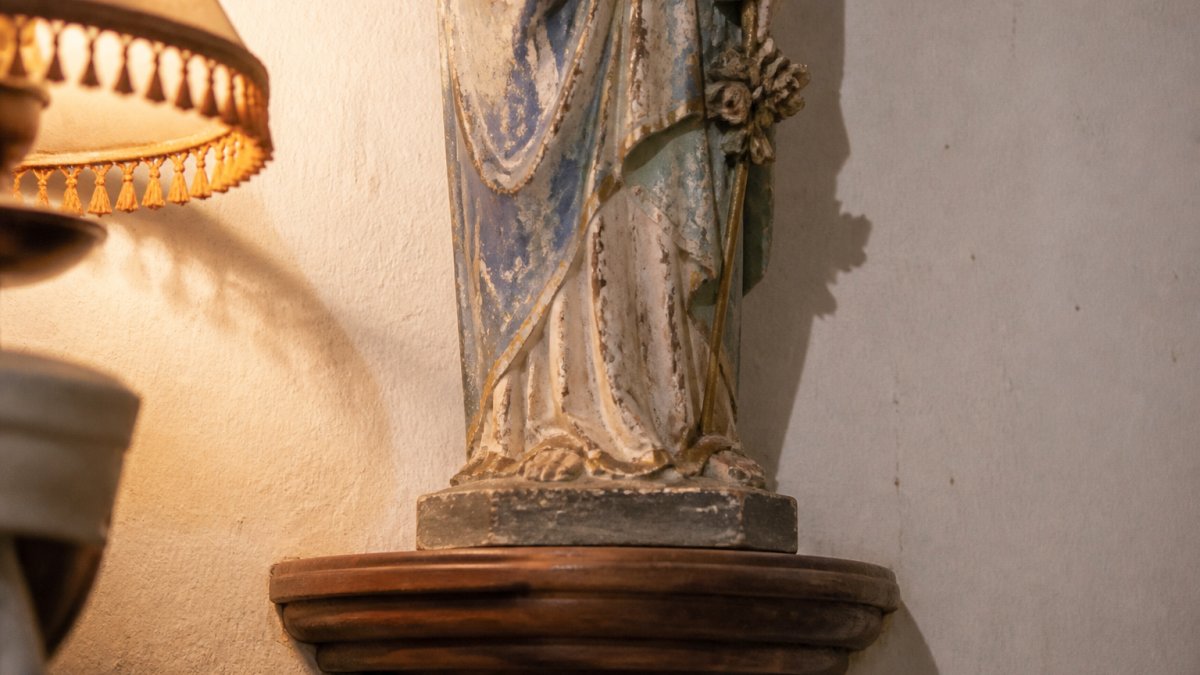
Polychromy, the painting of the statue, is a reliable indicator. Original paint layers from the 19th century are often matte and slightly yellowed; later repaints are brighter and more even.
Hand-Carved Versus Cast: What the Technique Reveals
Hand-carved work shows small differences between the left and right sides, and cutting marks in recesses. Cast statues are more symmetrical and sometimes have a mold seam. A sculptor signed their work more often than a factory workshop, so a signature is a major plus.
Dating Religious Statues by Visible Characteristics
Dating begins with the material, technique, and wear, but anyone who looks only at wear misses half the clues. The characteristics below are each visible without laboratory equipment and together provide a more reliable picture than any single indicator.
1. Posture and Proportions
- Neoclassical statues often stand upright, with a closed posture and balanced proportions.
- Neo-Gothic statues sometimes have taller, slimmer figures and a more pronounced vertical effect.
- A curved posture or dramatic gesture is more likely to be associated with neo-Baroque or eclecticism at the end of the century.
2. Clothing and Drapery
The drapery is one of the strongest dating indicators. Crisp, geometric folds point to classicism; deep, irregular folds with lots of movement point to neo-Baroque. Also look for garments that only became common in 19th-century devotional art, such as a wide, flowing mantle on figures of Mary.
3. Polychromy and Paint Layers
Original paint layers from the 19th century are often matte and slightly yellowed; later repaints are brighter and more even. Under a microscope or magnifying glass, you can sometimes see older layers beneath a newer one. Craquelure in the paint is an indication of age, but it can also be applied artificially; therefore, combine it with other characteristics.
Large Antique Nativity Figurine of King Melchior – Signed G.L.V. Gerard Linssen →
4. Pedestal and inscriptions
The pedestal is often surprisingly useful for dating: moldings, Gothic motifs, or a cast edge reveal the period. Inscriptions on the pedestal or back may name a workshop, patron, or year. However, a year is not always reliable: it may have been added later or refer to a restoration.
5. Signs of manufacture
- Hand-carved work shows small differences between the left and right sides and cutting marks in hollows.
- Cast statues are more symmetrical and sometimes have a mold seam.
- A sculptor signed their work more often than a factory workshop, so a signature is a strong plus.
6. Wear pattern
True age shows in the wear on the spots people held: hands, pedestal, crown rim. Even, artificial wear is suspicious. Also look for damage consistent with use in a church or chapel, such as moisture marks or candle soot.
Would you prefer to proceed step by step? In our dating guide for religious statues, you can go through the features one by one.
Value of an antique saint statue: what collectors look for
The value of an antique saint statue depends on rarity, condition, provenance, and signature.
Our own stock clearly shows the difference. The large nativity statue of King Melchior is signed G.L.V. The rare plaster angel wall console from 1890 costs €325.00 precisely because its church provenance and function are rare.


Would you like to know whether a plaster saint statue is a good purchase? Then read our article about plaster saint statues as an investment.
| Feature | What it tells you | Effect on value |
|---|---|---|
| Signature | Known workshop | Strongly value-increasing |
| Original polychromy | Little restoration | Value-increasing |
| Church provenance | Documented provenance | Value-increasing |
| Missing components | Visible loss | Value-reducing |
| Later overpainting | Inappropriate color use | Strongly reduces value |
Original, restored, or replica: how to tell the difference
An original piece visibly bears its age: craquelure in the paint, slightly worn gilding, a pedestal that fits the period. A restoration is not a problem in itself, as long as you know which parts have been renewed.
The distinction between vintage and antique is practical here: antique pieces are older and usually crafted by hand, while vintage pieces are newer and often mass-produced. In our article about the difference between vintage and antique religious art, you can read exactly where that line is.
Conclusion: features that make the difference
Technique, polychromy, iconography, and wear patterns together provide the most reliable indication of age and origin. Knowing how to read these four clues helps distinguish an original from 1880 from a reproduction from 1980.
Curious about which religious statues are collected most often? Check out our top 10 most collected religious statues, or browse the selection of religious statues to compare their features in person.
Frequently Asked Questions
What materials were used for religious statues in the 19th century?
The most common materials were wood, plaster, stone, and metal. Wood was hand-carved and often polychromed, plaster was cast in molds and then painted, and stone or marble was used mainly for monumental church statues. Metal, such as bronze or brass, was used for smaller devotional objects and decorative elements. In the 19th century, plaster was an affordable alternative for churches and households with smaller budgets, which is why many saint statues from that period were made of heavy plaster.
How can you recognize a 19th-century saint statue by its appearance?
Look at the combination of style, material, and finish. 19th-century statues often have a sweeter, more theatrical expression than their Baroque predecessors, with flowing drapery and fine polychromy. The back or underside often reveals the production process: casting seams on plaster, saw marks on wood. The attributes are also important. A statue of Saint Anthony with a lily and book, or a Madonna with a serpent and crescent moon, fits the iconography common in the 19th century.
How can you tell whether a religious statue is made of plaster?
Plaster feels relatively light for its size and sounds hollow when tapped gently. Damaged areas, for example on the base or back, reveal a whitish, powdery texture. Nineteenth-century plaster figures are often hollow-cast, with thick walls and an opening at the back. Also look for casting seams and a matte, grainy surface beneath the paint layer. If you’re unsure whether it’s plaster or wood, a careful examination with a magnifying glass is often enough.
What’s the difference between an antique and a vintage saint statue?
Antique generally refers to objects more than a hundred years old, so in practice, figures dating from before around 1920. Vintage refers to younger pieces, often from the period between 1920 and 1980. A 19th-century figure therefore falls into the antique category. The difference isn’t just age: antique figures are often hand-carved or cast in small workshops, while vintage examples are more often mass-produced. For collectors, this difference influences both the value and how the piece should be preserved.
How do you determine the value of an antique saint statue?
The value depends on five factors: age, maker or workshop, condition, rarity, and provenance. A signed figure from a well-known workshop, such as Gerard Linssen from Venlo, is more valuable than an anonymous piece. Original polychrome finishes considerably increase the value; overpainting reduces it. Missing attributes or crown pieces lower the price, but an expressive face and complete composition can make up for this. Provenance documentation, for example from a church or monastery, adds extra appeal.
How do you clean an old religious statue without damaging it?
Leave the paint layer alone. Remove dust with a soft brush or feather duster, never with a damp cloth on plaster or polychrome finishes. Tackle stubborn dirt in crevices with a dry, soft brush. Don’t use alcohol, vinegar, or commercial cleaners: they damage the polychrome finish and plaster structure. If there’s loose paint or cracking, it’s best to consult a restorer rather than glue it yourself. Then store the figure in a dry place, out of direct sunlight, to prevent further deterioration.
The hardest part of collecting isn’t recognizing an item, but trusting it: are you sure it’s authentic and will arrive intact? At Chez Monique's 2e Leven, we carefully inspect every object and take extra care to pack fragile figures safely, reusing packaging materials wherever possible. This gives a nineteenth-century figure a second life without it being damaged in transit. Add your favorite piece to your cart and explore its history up close.
