

How old is my religious statue: Dating guide
Table of contents
- Why determine the age of your religious statue
- Recognizing marks on religious statues
- Materials as clues to age
- Identifying antique plaster statues by style and patina
- Determining the value of religious statues
- Practical dating methods for readers
- Restoration versus preserving the original
- Conclusion
- Frequently Asked Questions
Last updated: September 22, 2026
Why determine the age of your religious statue
Determining how old my religious statue is helps you better understand its value, authenticity, and significance. Customers want to know how old their statues of saints or Madonna statues are.
The material, style, painting, and manufacturer's stamps provide clues about when the statue was made. A plaster Madonna statue from the 1920s tells a different story than a devotional object from the 1950s.

Knowing the age also helps you take better care of your statue: antique objects require different maintenance than modern reproductions.
Recognizing marks on religious statues
Manufacturer's stamps and signatures
Manufacturer's stamps and signatures are the most direct way to estimate the age. Many antique religious statues, especially plaster examples from the nineteenth and twentieth centuries, bear marks from their maker.
Where to look: Check the bottom, back, sides, and inside (for hollow statues). Use a magnifying glass and good lighting, as many stamps are subtly impressed.
How to interpret stamps:
-
"Depose" or "Dépôt": This French or Belgian word means that the design was registered with the government. This points to manufacturers from the period 1870-1920. Depose stamps are very valuable for dating.
-
Full addresses: A stamp with a full address (for example, "Aux Santons D'Art, 8 Rue Barbaroux, Marseille") provides the exact geographical origin and the possibility of looking up the manufacturer in historical archives. Factories usually operated for 30-60 years.
-
Name only without address: A stamp with only "Spery" or "Lefebvre" is less specific. This may indicate a smaller manufacturer or craftsman. Such statues are usually older (nineteenth century) or from a smaller town.
-
Numbers after the name: Serial numbers indicate mass production from 1900-1950. The higher the number, the later in the production period the statue was probably made.
-
Signatures: When you see a handwritten name instead of a stamped name, you probably have a handcrafted, small-scale product. This suggests an older statue, probably from the nineteenth or early twentieth century. Signatures are rare and increase the value.
How to photograph stamps for research: Photograph stamps from multiple angles using side lighting (raking light) to make impressed stamps more visible. Also photograph the entire statue for context.
Date markings and serial numbers
Some religious statues have explicit date markings or serial numbers, providing an accurate answer to how old my religious statue is.
Serial numbers and their meaning: Serial numbers were especially common in mass production during the 1920s-1960s. They are located on the bottom, back, or inside hollow statues. A higher number may indicate a later year, although factories did not always use their numbering chronologically.
Year and decade markings: Year markings (for example, "1925") are the most reliable evidence for dating. Decade markings ("the 1930s") are less precise but still provide a clear framework.
Trademark and patent markings: Markings such as "Marque Déposée" (registered trademark) indicate officially registered designs from France and Belgium (1880-1920). These increase value and authenticity.
How to combine stamps for accurate dating: Consider all stamps, numbers, and markings together. A statue with "Depose", a Marseille address, and serial number "45" indicates approximately 1910-1920. A name without a Depose stamp alone indicates nineteenth-century work or a smaller manufacturer.

Materials as clues to age
Plaster and cast iron in religious art
Plaster was the most popular material for the mass production of devotional statues. Plaster statues from 1870-1920 are usually heavier and have thicker walls with a warm, cream-colored tint. Plaster from the 1920s to the 1950s is lighter and has a finer texture.
Cast-iron statues are rare and usually date from the late nineteenth century. Copper religious statues probably date from the nineteenth century or are modern reproductions.
Woodcarving and other handcraftsmanship
Wooden religious statues date from the sixteenth to the eighteenth century. Check for natural patina, small cracks, and weathering; original woodcarving displays these characteristics. Handcraftsmanship (carved details, irregular surfaces) suggests an age of at least 150 years.
Identifying antique plaster statues by style and patina
Polychrome painting and craquelure
The way your religious statue has been painted provides important clues about its age. Antique plaster statues often have polychrome painting, meaning they were painted in multiple colors.
Antique statue of the Virgin Mary with the Christ Child →
Genuine antique paintwork shows characteristic craquelure (fine cracks caused by different shrinkage rates of paint and plaster). These cannot be imitated and indicate an original statue at least 80-100 years old.
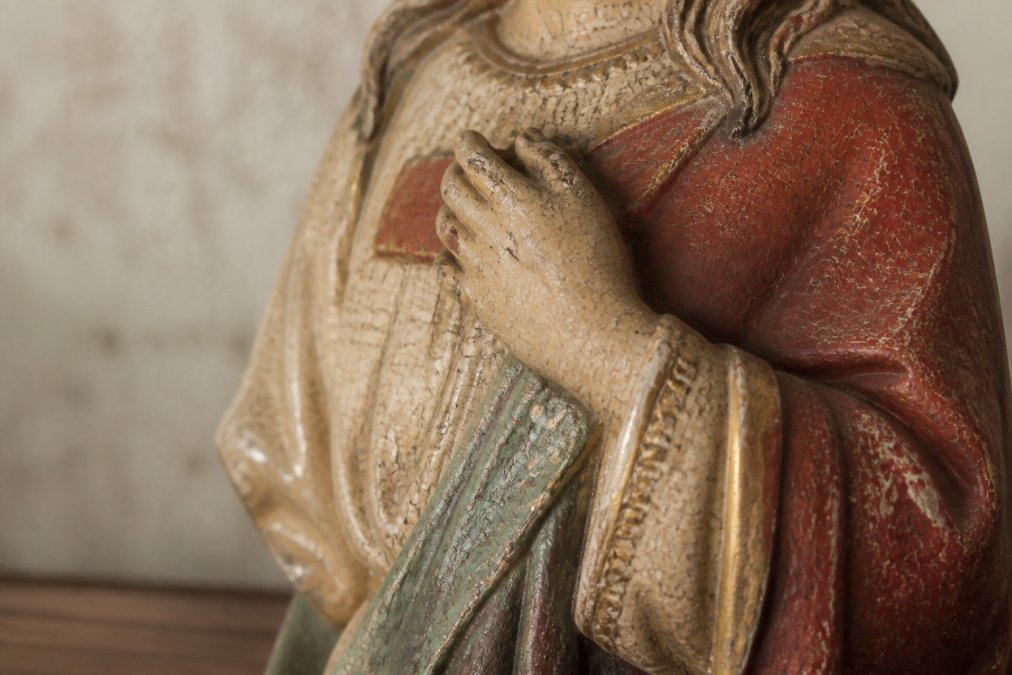
Original antique statues show natural paint flaking in areas that have been touched frequently. Modern reproductions have smooth, uniform paintwork without craquelure and with brighter colours.
Stylistic features by period
Saint statues from different periods have recognizable stylistic features. Nineteenth-century statues (1800-1900) have a romantic, highly detailed style with expressive faces. Art Deco statues (1920s-1940s) have smoother forms and more serene faces. Statues from the 1950s have simplified forms with fewer details.
Determining the value of religious statues
Authenticity and provenance
The value of your religious statue depends heavily on its authenticity and provenance. A genuine antique statue is worth much more than a modern reproduction, even if they look almost identical.
Authenticity is determined by all the factors we have discussed: maker's stamp, material, paintwork, patina and stylistic features. When all these elements are consistent with a particular period and place, the statue is probably authentic.
Provenance is the history of who has owned the statue. A statue with clear provenance, for example "from a French monastery" or "an heirloom from a Catholic family since 1930", is more valuable. This story makes the object more interesting to collectors.
Collector appreciation and market prices
The market value of religious statues varies considerably.
Large, well-preserved statues in perfect condition command higher prices. A statue 50 centimetres tall is more valuable than a small 15-centimetre figurine. Statues with interesting iconography, such as Mary with the Christ Child and a lamb, are rarer and therefore more valuable.
At Chez Monique's 2nd Life, we see that collectors place particular value on statues with a clear provenance and an interesting story. A Belgian statue of the Virgin Mary from around 1900 with a "Depose 12" stamp and original patina is a valuable object. A French statue from the same period, but with more wear, can also be a beautiful addition to a collection.
Demand for religious statues is stable among antique collectors and vintage interior enthusiasts.
Practical dating methods for readers
Determining how old your religious statue is does not have to be complicated. Follow these steps:
Step 1: Identify the saint through iconographic attributes. This is crucial for dating, as certain saints were depicted in particular ways during specific periods. Look for characteristic objects held by the saint:
- Mary: Usually depicted with the infant Jesus, sometimes with a rosary, lily, or crescent moon beneath her feet. Statues of Mary dominated the nineteenth and early twentieth centuries.
- Saint Joseph: Recognizable by a staff with flowers, sometimes with the infant Jesus. Much less common than Mary.
- Saint Lucy: Carries a candlestick or eyes on a dish. Very specific iconography, pointing to Northern European devotion.
- Saint Sebastian: Young man with arrows in his body. Popular in sixteenth- to eighteenth-century art, rarer in plaster.
- Saint Anthony: Old man with a pig or bell. Common in nineteenth-century plaster statues.
- Saint Francis: Usually with animals (birds, wolf), sometimes with stigmata. Points to nineteenth-century religious devotion.
- Saint Thérèse: Young woman with an arrow through her heart or a book. Popular during the Art Deco period (1920s-1930s).
Once you have identified the saint, search online for images of the same saint from different periods. This will help you roughly estimate which century your statue was probably made in.
Step 2: Examine the material. Carefully feel the statue. Is it light plaster or heavy wood? Plaster points to the nineteenth or twentieth century.
Step 5: Analyze the art-historical style. Compare your statue with images of statues from different periods:
- Nineteenth century (1800-1900): Romantic, highly detailed style. Faces are expressive, garments richly decorated.
- Art Deco period (1920-1940): More stylized forms, smoother lines, more serene faces, less overloaded details.
- 1950s-1960s: Simplified forms, faster production, less elaborate details, more modernist appearance.
Restoration versus preserving the original
Once you know how old your religious statue is, the question arises: should I restore it or preserve it as it is?
- Keep it out of direct sunlight. UV radiation fades paint and damages plaster.
- Avoid damp environments. Plaster can be damaged by moisture.
- Dust carefully with a soft cloth. Do not use abrasive materials.
- Do not repair small cracks yourself. Consult a conservator.
- Do not remove paint or patina.
Conclusion
Determining how old your religious statue is is a fascinating journey through the history of craftsmanship, art, and devotion. By examining manufacturer’s stamps, materials, paintwork, and style, you can discover a great deal about your object without engaging an expensive expert.
Frequently Asked Questions
How can I recognize an antique plaster statue?
Antique plaster statues display characteristic features: natural patina, visible craquelure in the paintwork, and often a rough surface where plaster has flaked off. Check the underside for manufacturer’s stamps or signatures. The polychrome paintwork (multicolored) is usually worn but not uniform; genuine age produces selective wear. Plaster feels heavier than modern reproduction materials and has a distinctive smell. Many antique statues from the 19th and early 20th centuries have glass eyes or handmade details that industrial products do not.
Where can I have a religious statue appraised?
For a professional valuation, you can contact antique dealers who specialize in religious art or appraisers who evaluate art objects. Many municipalities have certified appraisers for heritage valuations. You can also consult auction houses that sell religious devotional objects; they can provide insight into market prices. Chez Monique's 2e Leven offers carefully selected religious statues.
What is the difference between a reproduction and an antique statue?
Antique statues show natural wear, patina, and craquelure that cannot be convincingly imitated. Reproductions have clean, uniform paintwork and no natural signs of age. Check for manufacturer’s stamps or “Depose” markings (legal protection for the design) underneath the statue - these indicate authenticity. Antique plaster statues feel heavier and more humid than modern copies. The iconography and stylistic features (facial expression, clothing, attributes) can also help distinguish between periods.
What materials were used for religious statues in the past?
Plaster was the most common material for mass-produced devotional statues from the 19th century onward, especially in France and Belgium. Carved wood (often painted in polychrome) was used for church statues and private devotional objects. Cast iron and copper appeared in later periods for smaller objects. Natural stone and marble were reserved for expensive church works. Many statues combined materials: a plaster figure with a wooden base, or glass eyes in plaster faces. The material provides an immediate clue to dating - mass-produced plaster points to the 19th or 20th century, while craftsmanship and traditional techniques indicate older pieces.