

Religious statues as interior décor: style and maintenance
Table of contents
- Why religious statues are becoming increasingly popular as interior decoration
- Materials and finishes: from plaster and wood to bronze and concrete
- Styling devotional art at home: from sacred art to modern interiors
- Protecting religious statues from moisture and mold
- Restoring antique saint statues: what you can do yourself
- Prices and what to look for when buying
- Conclusion: Give religious statues a second life
- Frequently Asked Questions
Last updated: September 10, 2026
Why religious statues are becoming increasingly popular as interior decoration
Religious statues as interior decoration are no longer just for church councils or dedicated collectors. More and more people are choosing a saint statue, statue of the Virgin Mary, or angel statue as a calming focal point in a modern interior. At Chez Monique's 2e Leven, a vintage Saint Anthony from the 1960s is just as likely to go to a design enthusiast as to a religious family.

The reason is simple: a religious statue carries a history that no mass-produced item can match. It is an art object with a story and a spiritual accent that brings calm to a room.
From devotional object to design piece
In the past, a saint statue stood in a fixed place: on the sideboard, in the hallway, or on the bedside table. It was a devotional object, not a decorative piece. That function has not disappeared, but has expanded.
People who do not consider themselves religious buy a statue of the Virgin Mary or a sculpture of praying hands purely for its aesthetic value. An artisan-carved wooden statue next to a sleek designer lamp works surprisingly well: the contrast between old and new gives an interior a character that a completely new design can never match.
The spiritual dimension in a modern home
A religious statue does not have to be merely decorative. Many buyers tell us that placing a statue in a fixed location, for example on a shelf in the bedroom or by the front door, has a calming effect: a small religious focal point in the home, without a complete altar.
That combination of aesthetics and meaning explains why sacred art continues to grow in popularity in interiors: you are not buying a trend, but something with a history.
Materials and finishes: from plaster and wood to bronze and concrete
The material determines not only what a statue looks like, but also where you place it and how you maintain it. Plaster, wood, bronze, stone, and concrete each require a different approach; anyone who does not know the difference can damage an antique piece sooner than necessary.
Here is what you can expect from each material:
| Material | Appearance | Maintenance | Best location |
|---|---|---|---|
| Plaster | Warm, matte, fine detail | Dust, keep dry | Indoors, sheltered |
| Wood | Artisanal, engraved | Wipe dry, reapply oil | Indoors |
| Bronze | Heavy, patina, exclusive | Low maintenance | Indoors and outdoors |
| Stone/concrete | Durable, weather-resistant | Rinse off, keep frost-free | Outdoors |
Plaster statues are loved for their detail and warm appearance, but they are porous. Wood requires a stable climate because it expands and contracts with changes in humidity. Bronze and stone withstand more, although frost remains a risk for stone with fine details.
Handcrafted versus machine-made: what should you look for?
You can recognize handmade woodcarving by its small irregularities, subtle differences in depth, and the sense that a human hand was involved. Machine-made work is cleaner and more uniform—not inferior, but different.
A common mistake is treating a hand-carved statue like a mass-produced product.
Styling devotional art at home: from sacred art to modern interiors
A genuine styling guide to combining a classic religious statue with a modern interior is often missing. We fill that gap here with concrete design principles instead of isolated tips.

The key is contrast rather than similarity. In a contemporary interior, a religious statue works not among other religious objects, but beside materials and forms that deliberately differ from it. A 19th-century polychrome statue of the Virgin Mary next to a matte-black designer lamp, a rough concrete wall, or a sleek oak shelf creates more tension than a statue surrounded by other devotional objects.
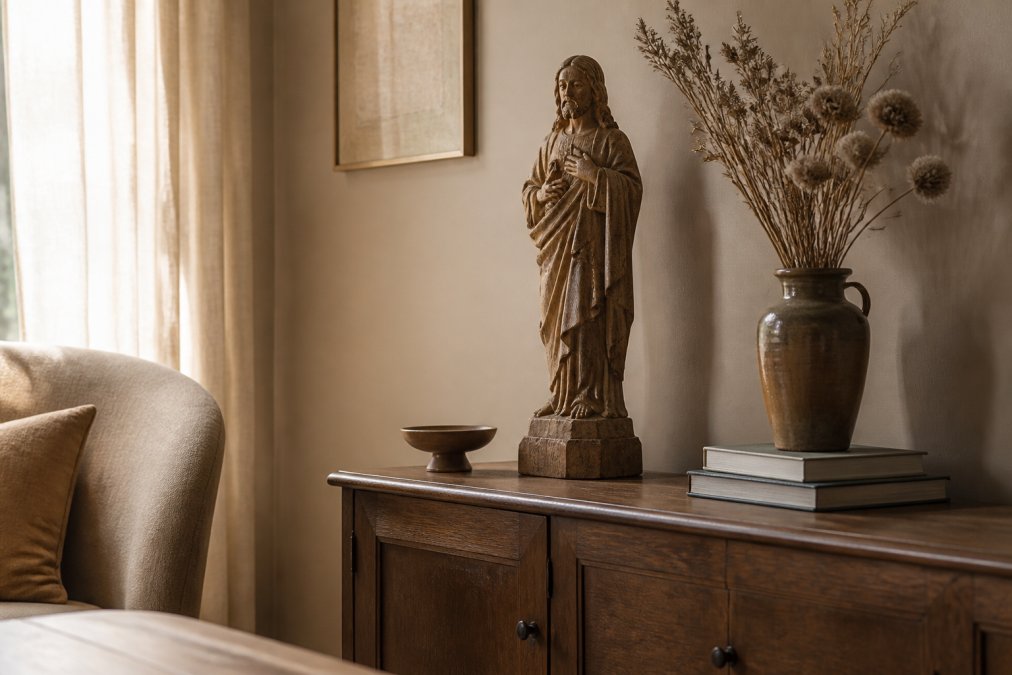
Three design principles that make the difference
1. Scale contrast. A small 20 cm sculpture disappears in a large, empty space; place it on a compact console or in a niche so the proportions feel right. A large sculpture of 60 cm or more needs at least half a meter of space on both sides; otherwise it feels confined.
2. Color as a bridge. A sculpture with warm earth tones (terracotta, gold, aged wood) complements natural tones, sand, and off-white; a gray-white plaster sculpture suits cooler, minimalist schemes better. Repeat one color from the sculpture, such as the red of a cloak, elsewhere in a cushion or vase, so it does not read as an isolated element.
3. Height and light. Never place a sculpture in bright daylight or beneath a harsh overhead spotlight; it flattens the details. Light from the side of a window or a warm lamp at eye level brings out the form and patina best, working better in a minimalist interior than general lighting.
Styling by room, with modern interiors as the starting point
- Living room in a minimalist scheme: one piece as a focal point on a low, wide console or in an open niche. Keep the rest empty: a single book and a ceramic bowl are enough; three small sculptures side by side make the space feel busy and lose its sense of calm.
- Bedroom: a small statue of Mary or an angel statue on the bedside table next to a table lamp with warm light. Choose a statue no larger than the lamp; otherwise, it becomes dominant instead of creating a sense of calm.
- Hallway or entryway: a sturdy stone or bronze statue on a console makes a strong first impression. In a sleek hallway with polished concrete or microcement, a rough stone statue looks best; a delicate plaster statue seems fragile there.
- Outdoors: place a Catholic garden statue in a sheltered spot, out of the wind and not in a puddle. Combine it with gravel, corten steel, or simple planting; formal boxwood hedges quickly make it look old-fashioned.
What to avoid
The most common mistake is treating a religious statue as part of a “theme corner” with candles, rosaries, and prints. That works in a devotional setting, but in a modern interior it looks like a museum display. The strength lies in the isolated statement: one statue, one place, space around it.

The rule remains simple: give each statue space and let the contrast with its surroundings do the work. A religious statue squeezed between other items loses its calming effect, whether the interior is classic or minimalist.
Protecting religious statues from moisture and mold
Protecting religious statues from moisture and mold starts with choosing the right location, not with a product. Moisture is the greatest threat to plaster, wood, and stone, and mold affects not only the surface but also glue and paint. Never place a statue against a cold exterior wall or in a damp basement without taking precautions.
Here’s how to approach it:
- Keep the humidity in your home stable; around 40–60 percent is fine for most materials (the EPA).
- Never place wooden or plaster statues directly on a cold floor or against an exterior wall.
- Ventilate the room where a statue is displayed regularly, especially after cooking or showering.
- Check the underside of a statue from time to time for dark spots or a musty smell.
Indoors and outdoors: what should you look out for?
Outdoors, only stone, concrete, and bronze truly withstand the elements well. Plaster and wood belong indoors, period. Even a covered stone garden statue can be damaged by frost: water in small cracks expands and forces the material apart (nps.gov).
Restoring antique saint statues: what you can do yourself
Before you pick up a cloth or brush, it is worth knowing what you have in your hands. The iconography of a saint statue, its posture, attributes, and clothing reveal whom it represents and which period and tradition it comes from. This knowledge determines whether restoration is worthwhile and how carefully you should proceed.
Iconography as a key to dating and value
Every saint has distinctive attributes that have been passed down for centuries. Saint Anthony the Abbot carries a pig and a bell; Saint George stands with a dragon; Mary often wears a crown or a mantle with stars. These attributes are not decoration, but a visual language that the faithful were meant to understand.
For a restorer or collector, this visual language is useful. If the pig is missing or the bell has broken off, the statue is not necessarily worth less, but it does show that something was lost. Sometimes this points to a repair or to a piece assembled from parts of different statues, which was not uncommon among resellers in the past.
When examining an antique statue, pay attention to these points:
- Posture: standing, seated, kneeling, or praying. Praying hands and a lowered gaze often indicate a 19th- or early 20th-century devotional piece.
- Clothing: a simple habit or a richly draped cloak with folds. Rich folds with deep cuts indicate hand-carved work; flat, uniform folds are more likely to indicate a mold.
- Attributes: a book, lily, sword, skull, or animal. Each attribute belongs to a specific saint and a specific story.
- Material and patina: the color and texture of the surface reveal its age and previous treatments. An overly uniform color may indicate a later repainting.
What you can safely do yourself
Cleaning and stabilizing are the only tasks you can responsibly carry out without experience. First remove dust with a soft brush or feather duster. Then use a slightly damp cloth, never a wet sponge (si.edu). Always test first in an inconspicuous spot, for example on the back or underneath the base.
- Remove dust with a soft brush or feather duster.
- Do not glue loose paint with household glue; this damages the original layer and is difficult to remove later.
- Carefully stabilize a loose plinth or base without applying force.
- Detect woodworm by looking for holes and fine wood dust; do not treat it yourself with chemical products.
When to consult a restorer
If parts are missing, there is active woodworm, paint layers are coming loose, or an arm or head is broken: stop and seek a restorer. DIY intervention often reduces the value more than the problem itself. A restorer can also determine whether a statue is original or composite.
Prices and what to look for when buying
The price of a religious statue varies greatly depending on its material, age, and provenance. A vintage plaster saint statue from the 1960s costs around 75 euros, a heavy stone statue from a well-known workshop around 130 euros, and an antique hand-carved wooden statue from the 1930s to the 1950s between 155 and 175 euros.
At Chez Monique's 2e Leven, for example, you can find a 1960s Saint Anthony the Abbot with a pig for 75 euros, a heavy stone statue by Schutt St. Anthonius Tegelen for 130 euros, and an antique wooden statue from the 1930s–50s for 155 euros. A rarer Belgian hand-carved example from the 1940s–50s costs 175 euros.
Pay attention to these points when buying:
| Checkpoint | Why it matters |
|---|---|
| Provenance and age | Determines authenticity and value |
| Material stability | Prevents damage after purchase |
| Original finish | Restoration lowers the value |
| Symbol and patron saint | Determines the spiritual meaning |
Always ask about the history of a piece. A reseller who knows their objects can tell you where a statue came from and what happened to it: that is the difference between an art object and an anonymous statue.
Conclusion: Give religious statues a second life
A religious statue in your home is more than decoration: it is a handcrafted piece with a story, a calming presence in a room, and a sustainable choice in an era when buying new is the norm. Give such a piece the right place and proper care so that it lasts for decades to come.
At Chez Monique's 2e Leven, we select antique and vintage religious statues with attention to their provenance and condition, and ship them in reused packaging materials that we carefully check for safety. This gives each statue a second life without making the environment pay the price. Browse our collection and add your favorite piece to the cart.
Frequently Asked Questions
How do you combine religious statues with a modern interior?
Place a religious statue as a focal point on a sleek sideboard or open shelf, with plenty of empty space around it. Deliberately choose one or two statement pieces instead of a crowded collection. Combine an antique wooden or plaster statue with natural materials such as linen, ceramics, and wood. Placing the statue at eye level and illuminating it with a spotlight gives it the look of an art object without making it feel dated.
What should you look for when buying antique religious statues?
First check the material: plaster, wood, bronze, and concrete each require a different approach. Look for wear on the hands, face, and feet, as this reveals something about the age. Ask about the provenance and whether any restoration work has previously been carried out. Look for cracks, loose parts, or traces of earlier glue. A well-detailed design and an intact finish indicate craftsmanship. Compare prices by material type.
How do you protect religious statues from moisture and mold?
Never place wooden or plaster statues directly against a cold exterior wall or in a damp room such as a bathroom without ventilation. Keep the humidity in your home between 40 and 60 percent. Place a dehumidifier in enclosed display cabinets. For statues kept outdoors, it is better to choose stone or concrete instead of wood or plaster. Regularly check for white deposits or a musty smell, and if in doubt, let the statue dry in a well-ventilated room away from direct sunlight.
How do you clean delicate religious statues without damaging them?
For wooden and plaster statues, use a soft brush or a dry microfiber cloth. Avoid damp cloths, chemical cleaners, and anything containing alcohol. For stubborn dust in fine details, you can use a soft makeup brush. You may polish bronze statues with a dry cloth, but leave the patina intact: it protects the metal and contributes to its aesthetic value. Always test a cleaning product on an inconspicuous spot at the back of the statue first.