

Top 10 Most Collected Religious Statues
Table of contents
- Top 10 Most Collected Religious Statues
- Identifying saint statues: seven specific features
- Antique religious statues: dating them by their beads, connections, and crucifix
- Religious statues made of wood and plaster: identifying materials with safe, non-destructive checks
- Determining the value of a religious statue without promising an exact appraisal
- Distinguishing authentic aging, ordinary wear, and artificial aging
- Conclusion: Give religious statues a second life
- Frequently Asked Questions
Last updated: October 13, 2026
Top 10 Most Collected Religious Statues
Religious statues are devotional objects that have been passed down from hand to hand for generations, which is precisely why collectors cherish them.
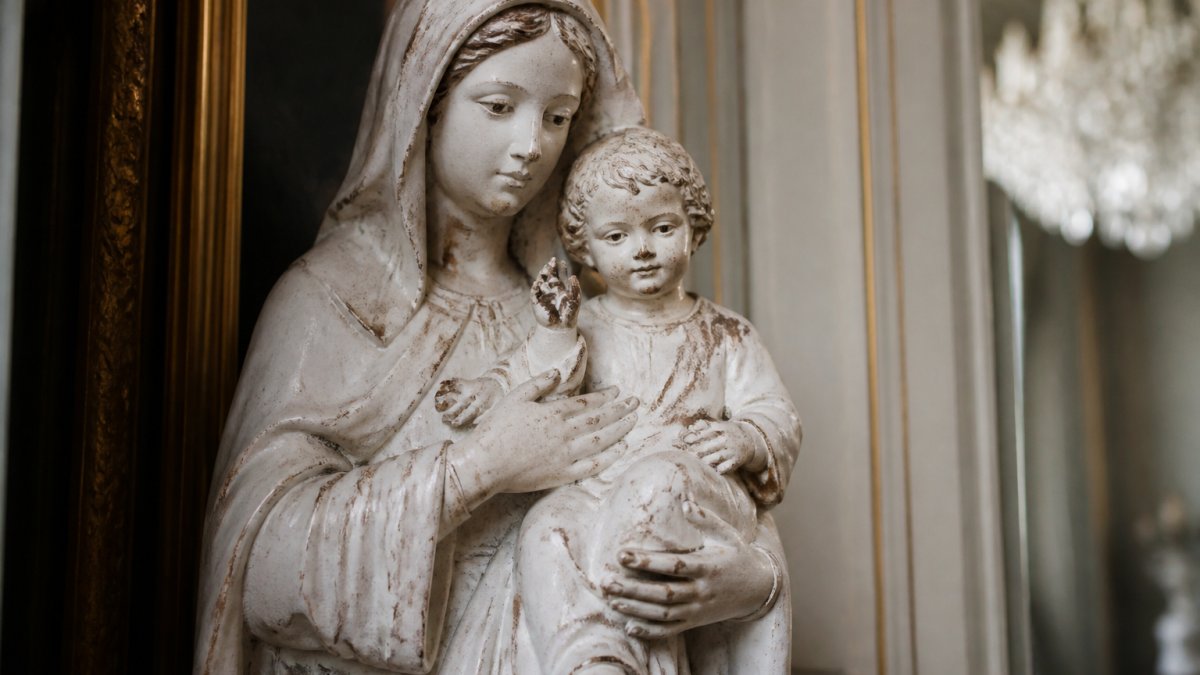
A religious object only truly becomes a collectible when history, material, and symbolism come together.
What surprises most buyers: value rarely comes down to size.
1. Mary with the Christ Child
Mary with the Christ Child is the most collected religious statue in the Netherlands. The motif appears in almost every material: wood, plaster, porcelain, and glass.
Our Large rare Madonna with Child by Steph Uiterwaal, 37 cm is an exceptional example. This piece was made in 1929 by Glasfabriek Leerdam and combines religious iconography with Art Deco design. For collectors of Dutch glass art, this is one of the most sought-after categories.

2. Jesus with the Sacred Heart
The Sacred Heart is one of the most recognizable Catholic symbols. Jesus is depicted with a flaming heart on his chest, often surrounded by rays.
This motif was especially popular in the 1930s. Our Sacred Heart of Jesus statue from that period shows exactly the characteristic signs of age that collectors value: soft colors and a warm patina.
3. Saint Anthony
Saint Anthony is the patron saint of lost objects, making him one of the most beloved subjects for religious statues. He is usually depicted with the Christ Child in his arms.
There are two versions: Anthony of Padua with the child, and Anthony the Abbot with a pig. Both are commonly found in copper, bronze, and plaster.
4. Thérèse of Lisieux
Thérèse of Lisieux, also known as the Little Flower, is popular for her simple, approachable appearance. Statues of her are often smaller and more intimate than those of other saints.
Our sitting statue of Thérèse from the 1930s comes from a Belgian workshop and bears a seal on the underside. Such markings make a piece especially interesting to anyone trying to trace its origins.
5. Saint Barbara of Nicomedia
Saint Barbara is the patron saint of miners, and many statues of her have been preserved in the mining regions of Belgian and Dutch Limburg. Her attributes include a tower and a miner’s lamp.
This makes her statues cherished heirlooms with a strong regional history.
6. Our Lady of Fatima
Fatima statues refer to the apparitions in Portugal and are often recognizable by their ornate crown and the small rosary in their hands. Our example from the 1950s has glass eyes and a wooden base.
7. Mary Pietà
The Pietà depicts Mary with the body of Jesus on her lap. This motif is often made from marble or alabaster, giving it a heavier, more stately character.
8. Our Lady of Miracles
Our Lady of Miracles is a smaller devotional figurine made mainly in porcelain. Our example from the 1950s is just 16 cm tall, but finely finished.
9. Copper and bronze saint statues
Copper and bronze saint figurines are prized for their patina. The greenish layer that forms over decades is a sign of authenticity for collectors. Our copper St. Anthony figurine from the 1920s is a fine example.
10. Rare glass art and porcelain
Glass and porcelain are at the top of the collectors’ market. Pieces from studios such as Leerdam are rare and actively sought by collectors of Dutch decorative arts.
| Statue type | Feature | Most common period |
|---|---|---|
| Madonna and Child | Symbolism and size | 19th-20th century |
| Sacred Heart | Flaming heart on chest | 1930s |
| Saint Anthony | Child or pig | 1920s-50s |
| Thérèse of Lisieux | Small and intimate | 1930s |
| Saint Barbara | Tower and miner’s lamp | 1930s |
| Fatima | Crown and rosary | 1950s |
| Pietà | Marble or alabaster | 1970s |
| Our Lady of Miracles | Fine porcelain | 1950s |
| Copper and bronze | Patina | 1920s-30s |
| Glass and porcelain | Studio mark | 1920-1950 |
Identifying saint statues: seven specific features
Identifying saint statues starts with seven specific features. Checking them in a set order helps you determine in minutes whether a statue is authentic and what period it comes from.
- Material: plaster, wood, porcelain, copper, or glass
- Attributes: the objects the saint carries
- Facial expression: calm and devout, or theatrical
Antique religious statues: dating them by their beads, connections, and crucifix
Dating antique religious statues requires three clues: the beads, the connections, and the crucifix. Each part reveals a different period.
Step 1: the beads. Beads are the quickest part to date.
- Hand-turned wooden beads with slightly irregular shapes are associated with devotional objects from 1900-1940. They have often darkened slightly from skin oils and candle smoke.
- Glass beads and blue glass became common mainly in the 1950s and 1960s, when glass studios were able to produce more cheaply. They are more uniform in shape than their wooden predecessors.
- Czech beads, fine, uniform, and sometimes subtly lustrous, indicate production from the 1920s to the 1960s. This is a recognizable type of craftsmanship, not a guarantee.
Step 2: the connectors. The connectors between the beads and the chain tell you just as much as the beads themselves.
Large rare Madonna and Child by Steph Uiterwaal, 37 cm →
- Metal chains with small soldered links are older. They date to the period 1900-1940 and are often slightly heavier.
- Metal wire threaded through the beads without links is found mainly from the 1930s to the 1950s.
- Plastic connectors and nylon thread became popular later, from the 1950s and 1960s onward.
Step 3: the crucifix. The crucifix at the end provides the final clue.
- A simple wooden cross belongs to devotional items from the first half of the 20th century.
- Metal and ornate typography became common later, especially from the 1950s onward.
- A crucifix with a raised corpus and a neat, symmetrical finish fits the period after 1950.
This sequence isn't an exact science - a rosary may have been repaired or partly replaced - but it gives you a useful initial date range that general guides usually don't provide.
Religious statues made of wood and plaster: identifying materials with safe, non-destructive checks
You can identify religious statues made of wood and plaster without drilling, scratching, or weighing them. Four safe checks are usually enough to tell.
Check 1: looking. Always start with your eyes.
- Plaster has a dull, matte surface texture. Under a magnifying glass, you can see small pores and a grainy texture. Paint often adheres somewhat unevenly, leaving slight irregularities.
- Wood shows grain beneath the paint, especially on older pieces where the paint has dried out. Look for small cracks along the grain, which are typical of old wood and follow its natural growth direction.
- Porcelain is smooth and thin. Hold it up to the light to assess the wall thickness: genuine porcelain is often translucent, while plaster and wood never are.
Check 2: listening. Gently tap the bottom of the statue with a fingernail.
- Plaster sounds short and dull; the sound is dampened immediately.
- Wood sounds warmer and a little fuller, with a slight reverberation.
- Porcelain sounds clear and long, almost like a little bell.
- Copper and bronze sound metallic and clear, but shorter than porcelain.
Check 3: touch. Carefully pick up the statue and note its temperature and weight.
- Plaster feels heavy and cool, even on a warm day.
- Wood feels warmer and lighter than plaster of the same size.
- Porcelain feels smooth and cool, but is surprisingly light for its size.
- Copper and bronze feel cold and are noticeably heavier than a plaster statue of the same size.
Check 4: minimal test. Only if the first three checks are inconclusive, you can perform a minimal test in an inconspicuous place, such as the underside of the base.
- A drop of water is quickly absorbed by plaster and leaves a dark spot.
- On wood, water beads off slowly, depending on the finish.
- On porcelain and glass, water remains as a droplet.
- On copper and bronze, water leaves a light mark that you can gently wipe away.
Determining the value of a religious statue without promising an exact appraisal
Determining the value of a religious statue is not an exact science. But we can explain which factors drive up the price.
Four factors matter most:
- Rarity: a studio that operated only briefly makes a piece rarer
- Condition: original paint and no cracks increase its value
- Provenance: a monastery, studio, or well-known foundry adds a story
- Marking: a monogram, seal, or signature indicates where it was made
A signed statue of the Virgin Mary from the 1920s is worth more than an identical unmarked one. The difference can amount to hundreds of euros.
Distinguishing authentic aging, ordinary wear, and artificial aging
Authentic aging, ordinary wear, and artificial aging look alike at first glance.
Genuine aging is asymmetrical. Paint wears away where the statue is handled: the shoulders, the hands, the edge of the base. Wear follows use.
Artificial aging is too uniform.
Look at the glaze, too. Irregular glaze is typical of handmade pieces from the 1930s to the 1950s.
Conclusion: Give religious statues a second life
The market for religious statues is small but steady. Those who have inherited one often don't know where to begin researching, comparing, and dating it.
At Chez Monique's Second Life, we select antique and vintage religious objects with care for their provenance and condition.
Browse our latest arrivals and give a special religious statue a second life in your home.
Frequently Asked Questions
Which religious statues are collected most often?
Mary with the infant Jesus is the most popular, followed by Jesus with the Sacred Heart, Saint Anthony, Thérèse of Lisieux, and Saint Barbara. Our Lady of Fatima, the Pietà, and the Miraculous Madonna are also popular. These statues often date from the 1920s to the 1970s and are made of plaster, porcelain, wood, or bronze. Collectors look at rarity, condition, and provenance.
How can you identify an antique religious statue?
Look for seven features: wear at contact points, patina on metal, uneven glaze, asymmetry in shape, old paint with craquelure, construction with handmade joints, and a crucifix or inscription appropriate to the period. A signed mark or medal on the underside, as on a statue of Thérèse from the 1930s, points to a workshop. Compare details with photos of dated pieces.
How do you determine the value of a religious statue?
Value depends on rarity, material, condition, provenance, and demand. A rare glass Madonna by Steph Uiterwaal from 1929 may cost around €262.50, while a smaller porcelain figurine starts at €40. Look for signatures, original paint, and whether the statue is complete. Comparing it with sale prices for similar pieces will give you an estimate.
What is the difference between an antique and a vintage religious statue?
Antique usually means more than 100 years old, so dating from before around 1925. Vintage refers to pieces from the 20th century, often between 1920 and 1980. A plaster statue of Mary from the 1920s or 1930s is neither antique nor vintage in the strict sense, but is often sold as antique. A Pietà from the 1970s is vintage. The terms indicate age, but condition and rarity ultimately determine its collectible value.
What should you look for when buying a religious statue?
First, check the condition: cracks, missing fingers, or repainting lower the value. Ask about its provenance and whether it has any markings or seals. Look for safe, non-destructive checks, such as weighing the statue and examining the underside. When buying online, ask for extra detail photos and confirmation of the dimensions. A reliable seller provides clear information about the age and shipping.