

Identifying statues of saints without markings: step by step
Table of contents
- Why a mark is often missing from old statues of saints
- Identifying saints by their attributes: iconography as the key
- Materials used for religious statues: plaster, wood, bronze and stone
- Dating a saint statue: construction, wear and paintwork
- Step by step: how to inspect a statue safely without damage
- Original or reproduction: when you should have doubts
- Determining the value of an antique saint statue: what does an appraiser look for?
- Conclusion: what you can determine yourself and when to call in an expert
- Frequently Asked Questions
Last updated: October 7, 2026
Why a mark is often missing from old statues of saints
Most antique statues of saints bear no mark at all. This does not mean that anything is wrong, but results from how such statues were made.
Until well into the twentieth century, most devotional items came from small workshops. A plaster caster rarely stamped their work. Sometimes there was only a number on the bottom, or a round stamp indicating the department where the statue came from.
When identifying statues of saints without a mark, you should therefore pay attention to three things:
- Attributes associated with a specific saint
- Material and construction that indicate the period
- Wear and paintwork that tell the story of the statue
This is precisely the area in which Chez Monique's 2e Leven works every day. We examine every statue that comes in for these three points before it enters our collection.
Identifying saints by their attributes: iconography as the key
Iconography is the study of fixed symbols that help you identify statues of saints. Each attribute refers to a story from the life of that saint. Once you know the symbols, you can read a statue like a book.

Some attributes appear so often that they are almost like a signature. Others are subtler and require a second look.
Common attributes and what they mean
- Child Jesus in her arms is associated with Mary
- Lily or lily branch points to Joseph or Anthony of Padua
- Bread and fish refers to Anthony the Abbot
- Dog's head or torch is associated with Dominic
- Sword in the chest indicates a martyr
- Book with a lamb points to John the Baptist
- Skull beside a cross is associated with a hermit or penitent
Pay attention to the posture. A praying figure with downcast eyes is usually a devotional statue for the home. A standing figure with an outstretched arm often formed part of a processional statue.
Materials used for religious statues: plaster, wood, bronze and stone
Plaster is the most common material for religious objects from the nineteenth and early twentieth centuries. It is easy to shape and light enough to move. Plaster statues feel cool and heavy, and sound dull when tapped gently.
Wood is less common for small home altars, but is very common for larger church statues. Wood has a warmer color and shows grain in places where the paint has worn away.
Bronze and copper are rarer. They are heavy, develop a patina that darkens over the years, and feel smooth to the touch. A bronze statuette from the 1920s or 1930s is usually a small devotional piece.

Stone, such as a wall plaque, is often intended for both indoor and outdoor use. This makes stone suitable for a garden wall or a niche.
Dating a saint statue: construction, wear and paintwork
You should never date an object based on a single characteristic. Weigh the construction, wear and paintwork against one another.
Look at the underside. Is it hollowed out or solid? Hollow undersides with a rough edge indicate an object cast in a mold. Solid statues are heavier and usually older.
Wear also reveals a great deal. Paint worn away in the same places, such as on the nose or hands, indicates frequent touching. Cracks in plaster are normal in old pieces. New, sharp breaks are not.
Polychromy and layers of paint as dating aids
Polychromy is the application of multiple layers of color to a statue. Old statues often have several layers of paint on top of one another.
Sometimes a much older layer lies beneath a later one. Color tones from the 1920s and 1930s are softer and more muted than modern paint. A glossy, brightly colored layer over a matte surface was usually applied later.
Step by step: how to inspect a statue safely without damage
A statue can be examined without damaging it. The secret lies in working carefully, using a soft surface and following a set sequence. Always examine it in daylight or with a weak flashlight; bright light conceals relief and layers of paint.
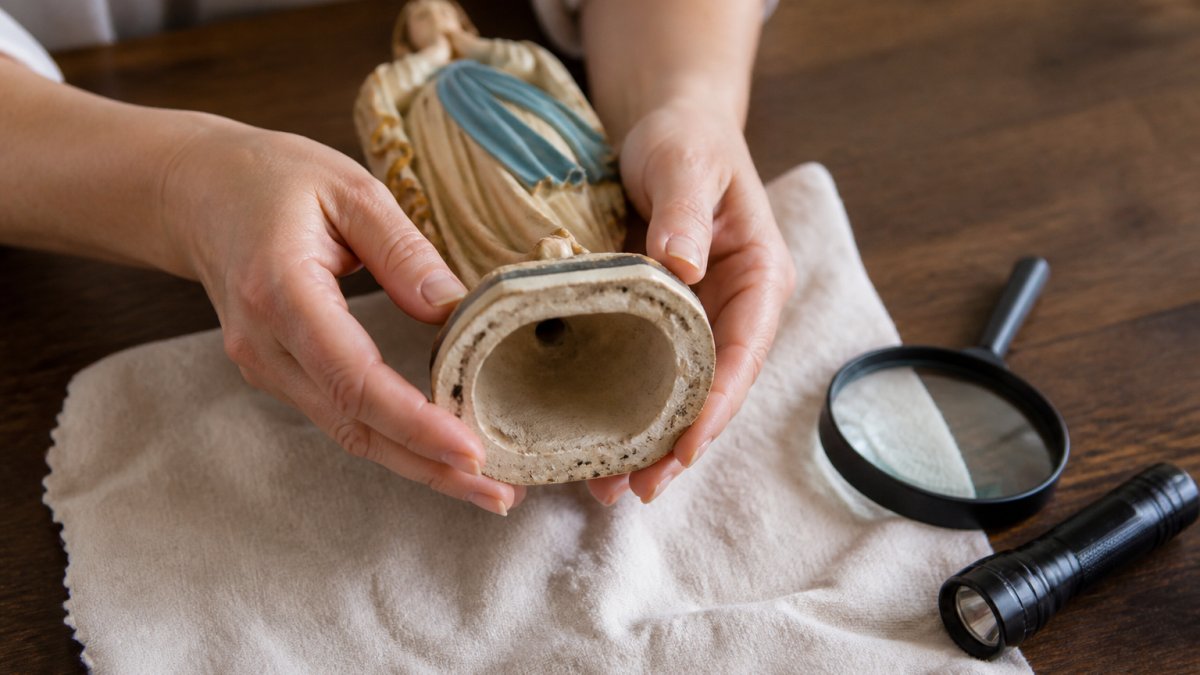
Proceed as follows:
- Place a soft cloth or foam rubber on the table
- Set the figure down before tilting it
- First examine the front in daylight
- Carefully turn the figure over and examine the underside
- Look for a maker's mark, signature, or inscription
- Photograph every side with your phone
- Record what you see before drawing conclusions
What you can safely check
- Underside: hollow or solid, rough casting edge, number, stamp, or signature.
- Rear: irregularities, plugs, old repairs, traces of a fastening.
- Pedestal: loose parts, cracks, paint running over the edge.
- Paint layers: matte or glossy, craquelure, worn spots on the nose, hands, and folds.
- Construction: visible seams, screws, nails, glue residue.
What you should and should not do during the examination
- Wear cotton gloves when handling gilded or painted surfaces
- Shine a flashlight obliquely across the surface to reveal relief and cracks
- Photograph in daylight, never with flash
- Never polish, sand, or remove paint
- Never use glue on a loose arm or foot
- Never lift the figure by one arm
- Never force or push back a loose part
Photographing for identification
Good photographs are often the difference between guessing and knowing. Always photograph:
- front view in daylight;
- rear view;
- underside with any marking;
- detail of face and hands;
- detail of attributes;
- any cracks or repairs.
Place a ruler or measuring tape next to the figure to show its scale. This helps a specialist assess it later without having to handle the figure again.
Antique statue of the Virgin Mary with baby Jesus - 1920s/1930s - large plaster figure →
Original or reproduction: when you should have doubts
Doubt is healthy with any unmarked figure. Still, there are clear signs that reveal a reproduction. It is not about one feature, but a pattern of clues.
Casting seams and molds
A cast figure often has a visible casting seam: a thin ridge where two mold halves met. On older plaster figures, that seam has sometimes been sanded away or retouched by hand. On modern reproductions, the seam instead runs cleanly and mechanically, for example down the side of the head or along an arm.
Also look for repetition. An original statue is never perfectly symmetrical. Small differences in the hands, face, or folds indicate handwork. A reproduction, by contrast, is suspiciously uniform: both hands are positioned identically, and the folds fall exactly the same way.
Finish and tool marks
Old statues bear traces of hand tools: a small knife, a sanding block, a brushstroke. Modern reproductions are often smoother, with sharp edges and a uniform, almost plastic-like finish.
Look at the underside. A smooth, machine-finished base is not consistent with a statue from around 1900. A rough edge with casting residue is. A modern screw or bolt in the construction is also a strong sign.
Material and weight
Plaster is heavy and cool. Plastic or cast resin is light and feels warmer. A statue that is suspiciously light for its size is often a modern reproduction. Bronze and copper are rarer, heavy, and develop a patina that darkens with age.
Other signs to look out for
- Paint running over the edge of the base
- A modern screw or bolt in the construction
- Plastic or cast resin instead of plaster
- An excessively sharp, glossy finish
- A mark that is too perfect or too recent
At Chez Monique's 2e Leven, we regularly see statues with a round stamp or a signature such as "Depose 12" on the bottom. Such a mark supports authenticity, but is never the only proof. A mark may also have been added later or belong to a reproduction.
No single characteristic proves authenticity or age on its own. Only when multiple clues point in the same direction does a statue become convincing.
Determining the value of an antique saint statue: what does an appraiser look for?
An appraiser looks at more than age. Rarity, condition, and provenance carry just as much weight.
A rare depiction, such as Mary with a sheep, is worth more than a common statue of Mary. Good condition without major breaks is a significant factor. And a known origin or provenance further increases its value.
Size also plays a role. A large statue with fine details attracts more collectors than a small mass-produced piece.
For a first impression of what is generally available, you can view our collection of antique saint statues.
Conclusion: what you can determine yourself and when to call in an expert
You can determine a great deal yourself: the material, the attributes, the wear, and the layers of paint. This usually tells you which saint it is and what period the statue dates from.
What you cannot determine yourself is the exact age and value. This requires experience, comparative material, and sometimes laboratory research.
Unsure about a statue you want to buy or sell? At Chez Monique's 2e Leven, we carefully inspect every piece before it enters our collection. We ship fragile statues using reused packaging materials that we first assess for safety, so your purchase arrives undamaged.
View our collection and give a special religious heirloom a second life in your interior.
Frequently Asked Questions
How can you identify an antique statue of a saint without a mark?
Start with the attributes: a lily, staff, book, or animal indicates which saint is depicted. Then look at the material and construction. Plaster statues from the 1920s-1930s often have a hollow base with plaster residue, while bronze develops a patina that is not uniform. Examine the underside and back for tool marks or old repairs. A combination of stylistic features, wear patterns, and material provides a more reliable assessment than any single characteristic.
What materials were used for old statues of saints?
The most common materials are plaster, wood, bronze, copper, ceramics, and stone. Plaster was popular for home devotion because it was inexpensive to cast in moulds. Bronze and copper developed a patina through oxidation. Each material reacts differently to moisture, heat, and light, leaving visible traces that help with dating.
How can you tell how old a religious statue is?
Look at four things: the material, the construction technique, the paintwork, and the wear. A plaster statue with a hollow base and sharp detail edges often points to early twentieth-century mass production. Wood carving with manual tool marks is older. Polychromy with craquelure and localised flaking indicates age. Do not forget the back: it often has less restoration, making the original finish and old mounting holes more visible.
When is it advisable to have a statue of a saint assessed by an expert?
Consult an expert if you suspect the statue is valuable, its provenance is unclear, or you want to sell or insure it. If you have doubts about its authenticity or it may be a rare piece, professional advice is wiser than guessing. Photograph the statue from all sides before making an appointment.