

5 best ways to date religious statues
Table of contents
- Introduction: why dating saint statues is more than a guess
- Method 1: Recognizing stylistic characteristics and art-historical periods
- Method 2: Marks on religious statues as a dating source
- Method 3: Recognizing a plaster religious statue by its material and technique
- Method 4: Iconography and Attributes for Identification and Dating
- Method 5: Recognising an antique statue of a saint by its provenance and provenance history
- Value of an antique statue of a saint: what dating means for collectors
- Safely documenting and storing: from photography to conservation
- Frequently Asked Questions
Last updated: October 6, 2026
Introduction: why dating saint statues is more than a guess
Dating a saint statue means determining the period in which a religious statue was made, based on style, material, marks, iconography, and provenance.
The reason is simple: many owners of a statue of Mary, an apostle statue, or a devotional object think that age can be determined from a single detail. One mark, one crack, one color.
Cultural Heritage Agency of the Netherlands, knowledge and advice on religious heritage
Method 1: Recognizing stylistic characteristics and art-historical periods
Style characteristics are the fastest route to identifying a broad period. Visual language, posture, drapery, and facial expression change from one era to another, and these changes are reasonably consistent in religious sculpture. What most online guides overlook is that style is never separate from material and technique: the same period can be recognized by the type of wood, tool marks, polychromy, and construction method.
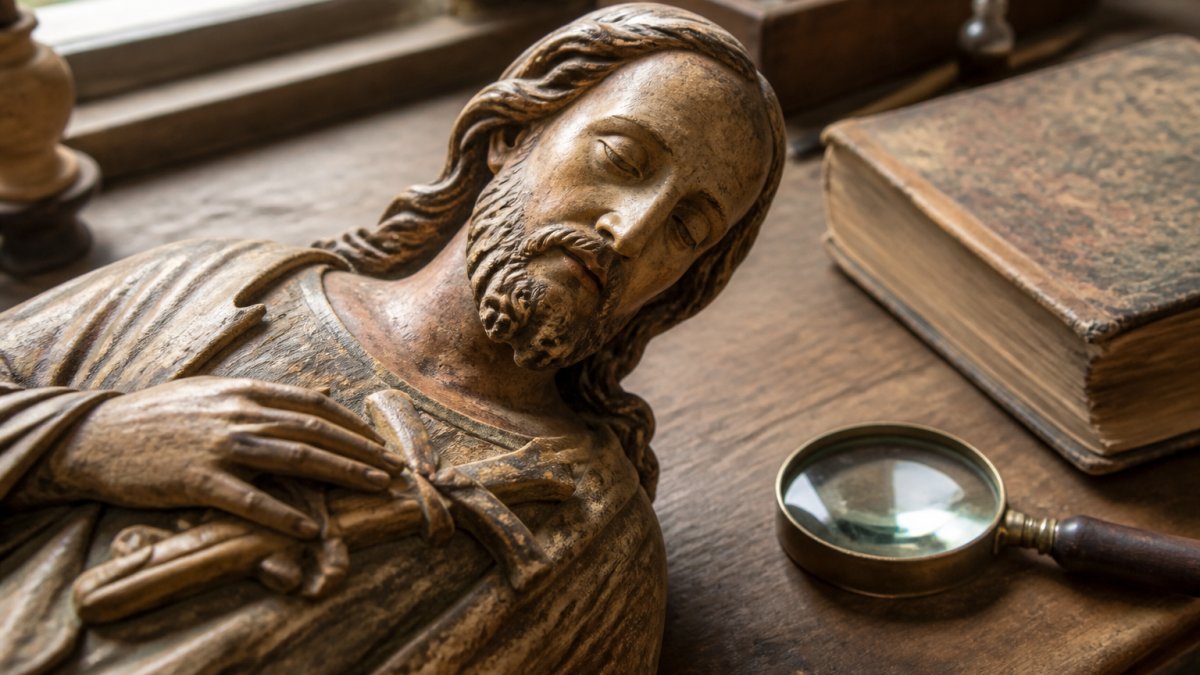
From the Middle Ages to Neo-Gothic: what changes in the visual language?
Medieval statues are often frontal and somewhat stiff, with a strong emphasis on symbolism over anatomy. Gothic statues become more three-dimensional, with more naturalistic folds in the clothing. Baroque statues twist the body, with movement and dramatic drapery. In the nineteenth century, Neo-Gothic returns to medieval motifs, but is usually executed more smoothly and regularly than the original.
Material and technical characteristics by period
The table below summarizes what is most distinctive in practice. Use it as a first filter, and only then assess the style.
| Period | Wood type and workmanship | Tool marks | Polychromy and finish |
|---|---|---|---|
| Middle Ages (approx. 1100-1500) | Oak and walnut, from a single block or a few parts | Broad chisel strokes, hollow back, visible joints | Earth pigments, chalk ground, matte and craquelé paint |
| Gothic (approx. 1200-1500) | Oak, sometimes limewood for finer parts | Finer gouge cuts, deeper folds, carved veins | Tempera and oil, gold leaf on garments |
| Baroque (approx. 1600-1750) | Oak, limewood, sometimes poplar for large works | Bold gouge cuts, separate parts, turned elements | Rich gilding, oil paint, strong chiaroscuro |
| Neo-Gothic (approx. 1840-1900) | Oak and limewood, machine-prepared | Regular, smooth cuts, few tool marks | Factory-applied paint, even coverage, less craquelure |
| Devotional items (circa 1850-1950) | Plaster, papier-mâché, bisque, bronze | Casting seams, molds, no carving marks | Hand-painted or sprayed, glazed or matte paint |
With wood, pay attention to the direction of the grain and the underside of the pedestal: medieval statues were often carved from a single block, whereas nineteenth-century pieces more often consist of glued sections. With plaster and bisque, the seam reveals whether the piece was made in a mold, which is characteristic of devotional items from the nineteenth and twentieth centuries. With bronze, casting seams and an even patina indicate mass production, whereas an irregular, deeply ingrained patina may indicate age.

Cultural Heritage Agency of the Netherlands, knowledge and advice on religious heritage
Method 2: Marks on religious statues as a dating source
Marks on religious statues are impressed, stamped, or painted signs identifying a maker, factory, or workshop, and they are often the most concrete clue to a period. Check the underside, the back, and the edge of the pedestal.
Examples from our own collection show how varied such marks can be. A Belgian Madonna statue bears the signature "Depose 12" plus a round stamp near Mary's foot. A French standing Madonna and Child statue bears the mark "Aux Santons D'Art / J Spery" with the address 8 Rue Barbaroux in Marseille.

Method 3: Recognizing a plaster religious statue by its material and technique
Recognizing a plaster saint statue involves examining its weight, grain, and finish. Plaster is heavy, feels cool, and has a fine, matte texture. Beneath the paint layer, damaged edges often reveal a powdery core. Plaster was widely used for devotional objects in the nineteenth and twentieth centuries, precisely because it was easy to model and paint.
Plaster, wood, porcelain, and bronze: material as a period indicator
Each material belongs to a different era of production and price range. This makes material a useful first filter.
| Material | Characteristics | Typical period | Where to find |
|---|---|---|---|
| Wood | Carving marks, grain, often polychrome-painted | Middle Ages to the nineteenth century | Churches, choir stalls, museum collections |
| Plaster | Heavy, matte grain, hand-painted | Nineteenth and twentieth centuries | Devotional objects, home altars |
| Porcelain and bisque | Smooth, glossy or matte white, factory mark | Twentieth century | Collectibles, factory marks |
| Bronze and copper | Patina, casting seams, heavy | Nineteenth and twentieth centuries | Small saint statues |
A porcelain Madonna and Child from 1929, made by Glasfabriek Leerdam, tells a different story from a plaster devotional statue from the same period. The material partly determines who made it and for whom.
Method 4: Iconography and Attributes for Identification and Dating
Iconography and attributes first identify the saint and only then the period. Attributes are the established symbols that make a saint recognizable: a lily, a book, a child, a sheep, a crown, or a staff.
Saint Anthony with the Christ Child is an example of a depiction that changed little over the centuries, meaning that the attribute identifies the saint but rarely indicates the date. Depictions of Mary are different. Our Lady of Fatima with a small crown and glass eyes refers to a devotion that only emerged in the twentieth century, which immediately narrows down the period.

Method 5: Recognising an antique statue of a saint by its provenance and provenance history
Recognising an antique statue of a saint by its provenance means tracing the object's journey: where it came from, who owned it and which documents support that history. Provenance is not a luxury; it is often the only solid evidence besides the maker's mark. Provenance only works when combined with the distinction between an original, a copy and a later restoration, and with the question of when to call in a specialist.
Antique statue of a saint with the Christ Child – 1920s/30s – large plaster statue →
Who, where and when: how to establish provenance
Work in this order and record every step:
- Object details, record the dimensions, weight, material and all markings, including their location on the object.
- Direct evidence, look for labels, inventory numbers, workshop or shop stamps, and old repairs.
- Documents, collect purchase receipts, deeds of gift, auction catalogues, family correspondence and photographs showing the statue at an earlier date.
- Exhibition and publication history, a mention in a catalogue or specialist publication places an object within a period and strengthens its provenance.
- Comparison, place the statue next to dated examples from museums or recognised collections to assess its style and material.
Think of a Portuguese statue of the Virgin Mary, recognisable by its association with the Fatima devotion, or a French plaster statue with an address in Marseille on the underside. Such details place an object in a region and therefore within a production tradition. If all provenance is missing, dating remains an estimate based on style and material.
Original, copy or later restoration: the difference that determines the dating
A nineteenth-century copy of a medieval design, an early twentieth-century casting of an old model, and an original with a later overpainting all look old at first glance. Yet they require different dating. Look out for these signs:
- Original, tool marks consistent with the period, layers of paint applied at the same time, and wear that is uniform throughout.
- Copy, a smooth, regular finish, machine-prepared wood or a casting seam, and a model produced in series.
- Later restoration, differences in colour between original and later layers of paint, a new piece of wood or plaster that does not match the grain or texture, and a missing or added attribute.
When to call in a specialist
Dating it yourself works to a certain extent, but when in doubt between an original, a copy, and a restoration, consulting a specialist is advisable. Art historians, conservators, and materials researchers can establish more through dendrochronology (tree-ring analysis in wood), pigment analysis, and X-ray examination than the eye alone. Keep in mind that even they rarely arrive at an exact year: it usually remains a period spanning several decades.
Value of an antique statue of a saint: what dating means for collectors
The value of an antique statue of a saint is strongly linked to its date, but dating is rarely the only factor that determines the price. Condition, rarity, signature, and provenance carry at least as much weight.
In our collection, this ranges from a small porcelain/bisque statue of the Virgin Mary from the 1950s, priced at €11.50, to a rare Madonna and Child by Steph Uiterwaal, made by Glasfabriek Leerdam in 1929, priced at €262.50. A Goebel Hummel Madonna and Child, model HM 35 from 1945-1949 with the early TMK-1 crown mark, is priced at €116.50.
Safely documenting and storing: from photography to conservation
Documentation and conservation protect both the value and the object itself. Start with photos of all sides, including the underside, maker's mark, and any damage, with a ruler beside it for scale. Record dimensions, weight, material, and provenance in a simple file.
A few practical rules apply to storage:
- Keep statues out of direct sunlight, as paint and patina fade
- Avoid damp rooms; plaster and wood react to fluctuating humidity
- Support heavy statues at the base, not by a protruding part
- Do not clean with aggressive products; dry dusting is usually sufficient
- Leave structural damage to a specialist, not to a do-it-yourself repair attempt
When you are unsure whether it is an original, a copy, or a later restoration, it is wise to consult a specialist. Material research and comparison with dated statues can reveal more than the eye alone.
Dating a statue of a saint requires patience and multiple sources, and that is precisely where its value lies.
Frequently Asked Questions
How can you tell how old a statue of a saint is?
You combine several indicators: stylistic features, material, marks, and patterns of wear. A plaster statue with glass eyes and hand-painted decoration often points to the 1950s, while a heavy plaster statue with a stamp from around 1900 was common. Pay attention to the finish on the back, the type of paint, and whether it has a base. One feature says little; only when three or four clues suggest the same period does dating become reliable.
What do marks on saint statues reveal about their age?
Marks such as 'Depose 12', a round stamp, or a signed marking often indicate a production period or manufacturer. A hard-to-read signature on the back of a statue of Mary from the 1920s-1930s, for example, is typical of that period. Pay attention to the location of the mark: on the bottom, on the back, or underneath the base. A mark alone is no guarantee, but combined with style and material, it makes dating considerably more precise.
How can you identify a plaster saint statue?
Plaster statues feel heavy for their size and have a matte, somewhat porous exterior. Tap one gently: plaster sounds dull, while porcelain sounds clear. Many plaster statues from the 1920s-1950s are hand-painted, have glass eyes, and a wooden or plaster base. Cracks or flaking paint are more common with plaster than with porcelain. An intact condition in a plaster statue that is several decades old is exceptional and indicates careful storage.
What is the difference between an antique and a vintage saint statue?
Antique generally means more than 100 years old, while vintage refers to pieces approximately 20 to 100 years old. A Belgian statue of Mary from around 1900 is antique; a Fatima statue from the 1950s is vintage. This distinction affects value: antique pieces often have greater collectible value due to their rarity and historical context. With vintage statues, recognition of a specific period, such as the 1950s, plays a greater role.
What should you look for when buying an old saint statue?
First check the condition: cracks, missing fingers, flaking paint, or loose bases. Ask about its provenance and whether it has undergone any restoration. Check the back and underside for marks or signatures. Compare the style with dated examples from the same period. If you are unsure about its authenticity, you can consult an art historian or restorer. A good seller documents defects honestly and packs fragile statues carefully for transport.