

Difference between vintage and antique religious art
Table of contents
- What are antique and vintage religious objects?
- The key differences: age, period, and provenance
- Recognizing antique religious art: characteristics and styles
- Determining the age of an antique statue: practical methods
- Recognizing an antique rosary: specific guidelines
- Value of antique religious statues: what determines the price?
- Step 1: Determine the base price based on age and type
- Step 2: Adjust for provenance
- Step 3: Adjust for condition
- Step 4: Adjust for rarity
- Step 5: Check current market trends
- Vintage religious art: why it is different
- Practical guide: how do you choose between antique and vintage?
- Frequently Asked Questions
Last updated: October 10, 2026
What are antique and vintage religious objects?
The difference between vintage and antique religious art begins with age. At Chez Monique's 2e Leven, we see every day that many collectors confuse these two categories, with significant consequences for value and authenticity.

Definition of antique religious art
Antique religious art consists of religious objects that are more than 100 years old, usually made before 1926. These include devotional objects, crucifixes, statues of saints, rosaries, and religious paintings from the Early Christian, Byzantine, medieval, or Gothic periods. These objects have direct historical value and bear natural patina, wear, and traces of manufacture.
Definition of vintage religious objects
Vintage religious objects are religious pieces approximately 40 to 100 years old, usually from the 1920s to the 1980s. Vintage religious art was produced in a more industrial context than antique pieces, although many were still handmade or semi-handmade. These objects offer art-historical value through their style, such as Art Deco statues of Mary or 1960s wall sculptures.
| Characteristic | Antique | Vintage |
|---|---|---|
| Age | 100+ years old (before 1926) | 40-100 years old (1920-1980) |
| Provenance | Early Christian to medieval period | Modern production (industrial or semi-handmade) |
| Patina | Natural, deep, distinctive | Less pronounced, often preserved |
| Value | Primarily historical and collector value | Artistic and design value |
| Materials | Plaster, stone, wood, metal (traditional) | Plaster, glass, plastic (more variation) |
| Authenticity | Critical for value | Less decisive |
The key differences: age, period, and provenance
Age determines almost everything: how the object was made, what it is worth, and what you can expect from it. An antique statue of Mary from the 1920s is fundamentally different from a vintage statue of Mary from the 1960s, even though they have the same height and material.
Antique religious art dates from periods when production was entirely handmade. Each piece is unique in its details. Vintage religious objects were produced with greater mechanization, meaning more uniformity and fewer individual characteristics per piece.

Origin tells another story as well. Antique religious art emerged from ecclesiastical contexts and local artists. Vintage objects were more often produced by commercial manufacturers who viewed religious items as a single product category. This difference in intent is reflected in quality and detail.
Recognizing antique religious art: characteristics and styles
Recognizing antique religious art requires knowledge of art-historical periods and their visual characteristics.

Characteristics of Early Christian and Byzantine art
Early Christian art (1st-5th century) and Byzantine art (5th-15th century) have clear identifying characteristics. Figures are stiff and formal, with large staring eyes and hands in gestures of blessing. Gold and rich colors dominate. Byzantine icons have flat perspective without depth. The faces have a serene, almost inhuman quality, intentionally expressing the spiritual rather than naturalism.
Medieval and Gothic styles
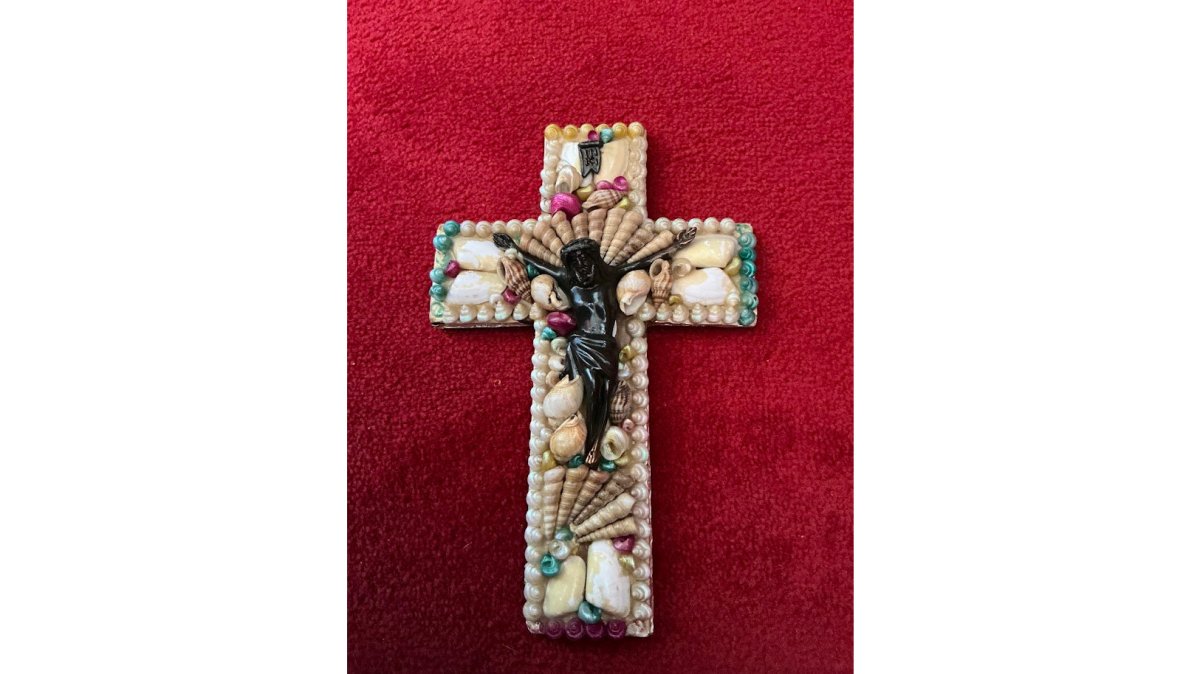
Medieval religious art (5th-15th century) shows more variation. During the Gothic period (12th-16th century), everything changes. Gothic religious art is characterized by slender, elegant figures with more naturalistic proportions. Drapery becomes more detailed, and faces become more expressive. Crucifixes depict a suffering Christ with anatomical accuracy. Statues of saints become more individualized, with greater emotional involvement.
Determining the age of an antique statue: practical methods
Determining genuine age requires systematic observation. This is not a single check, but a series of observations that together determine authenticity.
Step 1: Examine the material and production method
Always start with the material.
Plaster: Antique plaster statues (made before 1926) were cast in two- or three-part molds. Seams are often irregular and roughly finished. The plaster itself is not smooth but slightly porous. Modern plaster is much more uniform and smooth. Antique plaster feels warm and porous; modern plaster feels colder and smoother.
Wood: Antique wood shows natural cracks along the grain caused by drying out over decades. Genuine cracks are deep, irregular, and follow the wood structure. Look for wormholes; these prove that the wood is old enough to have been affected by woodworm. Modern reproduction wood has no wormholes or imitation holes of uniform size.
Stone: Antique stone statues have erosion on sharp edges due to centuries of exposure to the elements. Corners, noses, ears, and fingers are rounded by erosion. Antique stone shows even discoloration, not mottled, but an overall grayish or brownish tint.
Metal (bronze, silver, lead): Antique metal statues have distinctive patina. On bronze, it is green or brown; on silver, dark gray or black. This patina cannot be quickly imitated. Modern chemical patina feels smooth and superficial.
Step 2: Checking patina and surface aging
Patina is your best authenticity test.
Plaster: Look for a light grayish haze across the entire surface from accumulated dust and oxidation. Check corners and edges for a darker tint. Small cracks should have aged edges, not fresh ones. Areas that are frequently touched (hands, feet, face) have thinner patina from natural wear.
Wood: Discoloration should be irregular from moisture, sunlight, and dust. Check the back and underside for genuine patina. Look for natural flaking of paint or gilding caused by wear, not deliberate damage.
Stone: Check for moss or crust growth, which only grows on old stone. Look for even discoloration. Antique stone has an overall aged tint; modern stone often has spots or uneven discoloration.
Step 3: Searching for a signature, mark, and provenance
Antique religious statues often have maker's marks: engraved names or initials (usually on the back or underside), a manufacturer's mark (especially on plaster from the 19th-20th century), or numbering. The mark should be covered by the same patina as the rest. Clean marks on statues with patina suggest a later addition.
Documentation is valuable. Old photographs, written provenance records, and church archives significantly increase authenticity.
Step 4: Warning signs of forgery
These signs suggest that a statue is not antique:
- Surface that is too clean (antique statues have patina)
- Artificial patina (smooth and superficial)
- Perfect symmetry (handmade antique statues have minor irregularities)
- Modern dyes (uniform rather than naturally discolored)
- No wear (antique statues show wear in frequently touched areas)
- Plastic components (antique statues do not contain plastic)
- Modern adhesive residue (antique repairs used natural glue or metal clamps)
Step 5: Checking style and art-historical context
Does the image fit a known art-historical style? Antique religious statues follow recognizable stylistic periods. Elements from different periods or styles that do not fit the claimed age suggest modern work. Compare with verified examples in museums or specialized catalogs.
Recognizing an antique rosary: specific guidelines
Rosaries are frequently counterfeited because they are small, easy to transport, and popular.
An antique rosary (before 1926) has beads made of natural materials: bone, wood, stone, or glass. Hand-cut beads have small variations. The connections are made of natural silk or linen, not plastic. The medal or cross is usually cast metal with finely crafted details. The back is not smooth; you can see traces of the casting process.
Vintage rosaries (1920-1980) more often have plastic beads or more uniform glass beads. The medal is stamped rather than cast. Silk or linen is more often replaced.
Antique statue of the Virgin Mary with the infant Jesus – 1920s/30s – large plaster statue →
Value of antique religious statues: what determines the price?
Value follows a logic you can learn. No single factor determines the price on its own; it is the combination that counts.
The valuation model: six factors
1. Age and period
Age is the foundation. A statue made before 1850 is rarer than one from 1900.
2. Provenance and maker
A statue by a known maker is worth considerably more. A plaster statue of the Virgin Mary bearing the mark of a well-known French factory increases its value. Ecclesiastical provenance is also valuable. Anonymous statues are cheaper because authenticity is more difficult to establish.
3. Rarity and demand
The more examples that exist, the lower the value. A mass-produced plaster statue of the Virgin Mary from 1920 is generally more affordable than a rare handmade wooden saint statue from 1600. Statues of the Virgin Mary and crucifixes are popular. There is interest in Art Deco religious statues (1920s-1930s).
4. Condition and restoration
Condition is an important factor in value. An antique statue in pristine condition is more valuable than one with damage or aggressive restoration. Careful restoration may be acceptable.
5. Size and material
Large statues (more than 50 cm) are worth more than small ones (less than 20 cm). Stone statues are worth more than plaster. Bronze is worth more than wood.
6. Art-historical significance
A Gothic crucifix that displays all the characteristic features (slender figure, more natural proportions, emotional expression) is more valuable. Statues that are part of a series may be worth more if you have multiple pieces.
Practical valuation guide
Step 1: Determine the base price based on age and type
Step 2: Adjust for provenance
Step 3: Adjust for condition
Step 4: Adjust for rarity
Step 5: Check current market trends
Warning: prices are local and volatile
Prices vary greatly by region and time. Market trends change. The best way to estimate value is to research comparable sold items through antique websites, auction houses, and specialized dealers.
Vintage religious art: why it is different
Vintage religious art is often underestimated as "not old enough" to be interesting. This is a mistake. Vintage religious art has value of its own. The Fostoria Glass Madonna "Silver Mist" (€72) is not antique, but a masterpiece of American glass art from the 1950s. It is valuable because of its beautiful design, renowned manufacturer, and good preservation.
Vintage religious objects are more accessible in terms of price and suitable for those who want religious art without the high cost of antiques. They are more practical, designed for modern living rooms. Quality varies enormously. Some vintage pieces are poorly made; others are works of art with collector's value. The difference lies in the design, materials, and maker.
Practical guide: how do you choose between antique and vintage?
Choose antique if:
- You are interested in art history and genuine historical value
- You are willing to spend more money for authenticity and rarity
- You are looking for an investment
- You want a unique piece without duplicates
Choose vintage if:
- You want religious art for decoration without extreme costs
- You like a specific style or period (art deco, the 1960s)
- You are looking for a functional piece that is also beautiful
- You want a sustainable choice, vintage gives objects a second life
Many people have both. An antique crucifix for the bedroom, a vintage statue of Mary for the living room. They complement each other.
At Chez Monique's 2e Leven, we help you discover both categories. We have antique pieces such as the Antique statue of Mary with the infant Jesus (€185) and vintage pieces such as the Wall statue of Mary with child (€35). Each piece is carefully checked for authenticity and condition. We package everything sustainably, without compromising safety.
The difference between vintage and antique religious art concerns provenance, authenticity, value, and meaning. An antique statue carries centuries of history. A vintage statue brings character and sustainability to your interior. Both have their place. More information about art history and dating religious objects can help you explore the subject in greater depth. Guides to determining authenticity and Conservation advice for religious art objects are valuable resources. Discover our collection at Chez Monique's 2e Leven and give one of these special objects a second life in your home.
Frequently Asked Questions
What is the difference between antique and vintage religious art?
Antique religious art is generally more than 100 years old and belongs to specific art-historical periods such as Early Christian, Byzantine, or Gothic. Vintage religious objects date from the 20th century, usually the 1920s-1980s, and belong to more recent styles such as Art Deco or retro. The main difference is age: antique pieces are much older and are often defined by historical value and art-historical significance, while vintage is more about nostalgia and design style.
How can you tell if a religious statue is antique?
First, check the material: antique religious statues are often made of plaster, wood, stone, or metal, with visible patina and natural wear. Look for handcrafted details that would be difficult to produce by machine. Check for maker's marks or signatures on the back. Antique pieces usually have an authentic, warm color and surface characteristics typical of their period. A plaster statue of Mary from the 1920s-1930s, such as Chez Monique's 2e Leven Antique Statue of the Virgin Mary with Baby Jesus (€185), displays characteristic patina and a hand-signed marking.
What determines the value of antique religious statues?
Value is determined by age, rarity, material, condition, and historical provenance. Pieces with maker's marks or documentation are more valuable. Art-historical significance also plays a role: pieces from the Byzantine or Gothic periods are generally more expensive than industrially produced 19th-century objects. Condition is crucial: original patina increases value, while serious damage reduces it. Religious statues by renowned makers or from specific regions, such as French Provençal devotional art, command higher prices.
Can you use antique religious objects as interior decoration if you are not religious?
Absolutely. Many people appreciate antique and vintage religious art purely for its historical, artistic, and decorative value. An antique statue of the Virgin Mary or a crucifix can add a classic, spiritual, or nostalgic touch to your interior without necessarily being intended as a religious statement. Pieces such as the Wall-Mounted Virgin Mary with Baby (€35) or the Fostoria Glass Madonna Silver Mist (€72) are popular with collectors and interior designers, who appreciate them for their beauty and character, regardless of religious beliefs.