

How to read the meaning of symbols on devotional medals
Last updated: November 1, 2026
Quick Summary
You can read the meaning of symbols on devotional medals by deciphering each image and inscription as a symbol of prayer: the rays on the Miraculous Medal represent grace, while the M with a cross and two hearts refers to Mary and Christ. Saints can be identified by familiar attributes such as a lily beside Joseph, while monograms like IHS and AM, along with Latin phrases, reveal a medal's name and origin.
- The Miraculous Medal originated in Paris in 1830 after Saint Catherine Labouré had a vision.
- On the reverse, the twelve stars refer to the Apocalypse and the Church.
- IHS stands for the name of Jesus, while AM refers to Mary (Ave Maria).
- A soldered loop indicates older workmanship, generally dating from before 1900.
- An even, dark patina indicates age; polishing reduces its value.
Table of Contents
- What devotional medals are and why their symbols have meaning
- The meaning of the Miraculous Medal and its images
- Identifying saints on medals: Mary, Joseph, and the familiar figures
- Inscriptions on Catholic medals: letters, monograms, and Latin inscriptions
- Cross and Christ symbols: from a simple cross to a crucifix
- Recognizing old religious medals: a step-by-step guide
- Faith or superstition: what a devotional medal does and does not promise
- Choosing a medal or rosary for your own collection
- Frequently Asked Questions
What devotional medals are and why their symbols have meaning
A devotional medal is a small, often coin-shaped metal object that Catholics wear as a sign of devotion to Mary or a saint. The meaning of symbols on devotional medals lies not in the metal, but in what each image and inscription evokes in prayer and faith.
Many people inherit a medal without knowing what it depicts; others buy one at a flea market because its design moves them. In either case, it helps to learn how to read its imagery.
Devotional medals come in many forms:
- Saint medals featuring a portrait of Mary, Joseph, or another saint
- Miraculous Medals featuring the familiar rays from Mary's hands
- Religious medals featuring only a cross or monogram
The meaning of the Miraculous Medal and its images
The Miraculous Medal is the most widely distributed devotional medal in the world. It originated in Paris in 1830, where Saint Catherine Labouré reportedly had a vision of Mary. The design has barely changed since then, making it instantly recognizable.
The meaning of the Miraculous Medal lies in the combination of its two sides. Each side tells its own story.
The front: Mary with rays streaming from her hands
The front shows Mary with her hands outstretched. Rays of light stream down from her fingers. These rays represent the grace she bestows on believers.
The surrounding text often repeats the words attributed to the vision: "O Mary, conceived without sin, pray for us who have recourse to you." These words make the medal a symbol of prayer, not an amulet.
Look out for details that reveal variations:
- Number of rays per hand may vary by design
- The position of the feet sometimes points to a specific period or manufacturer
- The edge inscription may be in French, Latin, or Dutch
The reverse: the letter M, the cross, and the two hearts
The reverse shows a large letter M, crowned with a cross.
The M refers to Mary, and the cross to Christ. Together, they symbolize the bond between mother and son.
A common mistake is to think the M stands for “Mary” alone. In Catholic symbolism, it is often read as “Mary at the foot of the cross.”
Identifying saints on medals: Mary, Joseph, and the familiar figures
You can identify saints on medals by their distinctive attributes. Each saint has a symbol that appears on almost every medal. If you know these symbols, you don’t even need to read the inscription.
The most common figures:
- Mary appears with rays, a crown, or a cloak symbolizing protection
- Joseph carries a lily or holds the Christ Child
- Christ is depicted with a cross-shaped halo or making a blessing gesture
Not sure which of two saints it is? Look at the combination of attribute and clothing: a lily plus a cloak points more likely to Joseph, while a sword plus a book points to a martyr.
Inscriptions on Catholic medals: letters, monograms, and Latin inscriptions
Inscriptions on Catholic medals are often the key to their origins: letters and monograms tell you more than the image alone. The guide below provides a systematic overview of which abbreviation stands for which name, in which language, and what the formula says about the medal’s use.
The most common monograms and their meanings
A monogram is one or more letters designed as a single symbol. On devotional medals, they appear in established groups:
- IHS stands for the name of Jesus (from the Greek IHΣΟΥΣ), often shown in a halo of rays; one of the oldest Christian monograms.
- AM refers to Mary (Ave Maria) and is common on French medals.
- S. Mary or S.M. indicates a Marian medal; the period after the S is an abbreviation for Sancta or Saint.
Latin inscriptions and prayer formulas
Latin inscriptions are also common. Short texts such as Ora pro nobis (“pray for us”) or Ave Maria turn the medal into a prayer symbol you carry with you. Other common formulas:
- Sub tuum praesidium ("under your protection"), an ancient Marian prayer
- Salve Regina ("Hail, Queen"), a Marian antiphon
- Ad maiorem Dei gloriam (AMD G), "to the greater glory of God," the Jesuit motto
The language of the inscription tells you something about its origin. French is common on nineteenth-century medals from France; Latin points to an ecclesiastical or older tradition; Dutch to a locally made or later-dated medal.
Letters along the edge and maker's marks
Alongside monograms and sayings, small letters often appear along the edge or at the bottom of the reverse: maker's marks, hallmarks, or the engraver's initials, usually smaller and less deeply engraved than the main inscription. A hallmark indicates the metal (for example, silver), while a maker's mark identifies the producer. They are less important for understanding the meaning, but all the more important for dating and authenticity.
How to approach an unknown inscription
Work in this order:
- Isolate the letters: which characters stand alone, and which form a monogram?
- Determine the language: Latin, French, Dutch, or another language?
- Look for the formula: is it a name, a prayer, or a motto?
- Look at the placement: the main inscription around the edge, or a small one on the rim?
- Compare it with the image: a Marian monogram belongs with a figure of Mary, an IHS with a figure of Christ.
An insider tip: the reverse bears an inscription more often than the front. So always turn the piece over before drawing conclusions.
Would you like to know more about combining inscriptions with other features? Read the article about identifying old religious medals.
Cross and Christ symbols: from a simple cross to a crucifix
Cross symbols on medals come in many variations.
Antique French Rosary in Ebony/Bakelite →
On devotional medals, you usually see:
- Simple cross as a separate element or as a pendant above the medal
- Crucifix with the body of Christ on it
- Cross with rays around the intersection
The reverse of a medal sometimes shows a small cross without any further decoration. This is not a design flaw, but a deliberate choice for simplicity.
For believers, the cross is not jewelry but an expression of faith; that's why antique examples often show visible wear on the cross, which was touched during prayer.
Recognizing old religious medals: a step-by-step guide
Recognizing old religious medals takes patience and a magnifying glass: most clues are in tiny details you might miss with the naked eye.
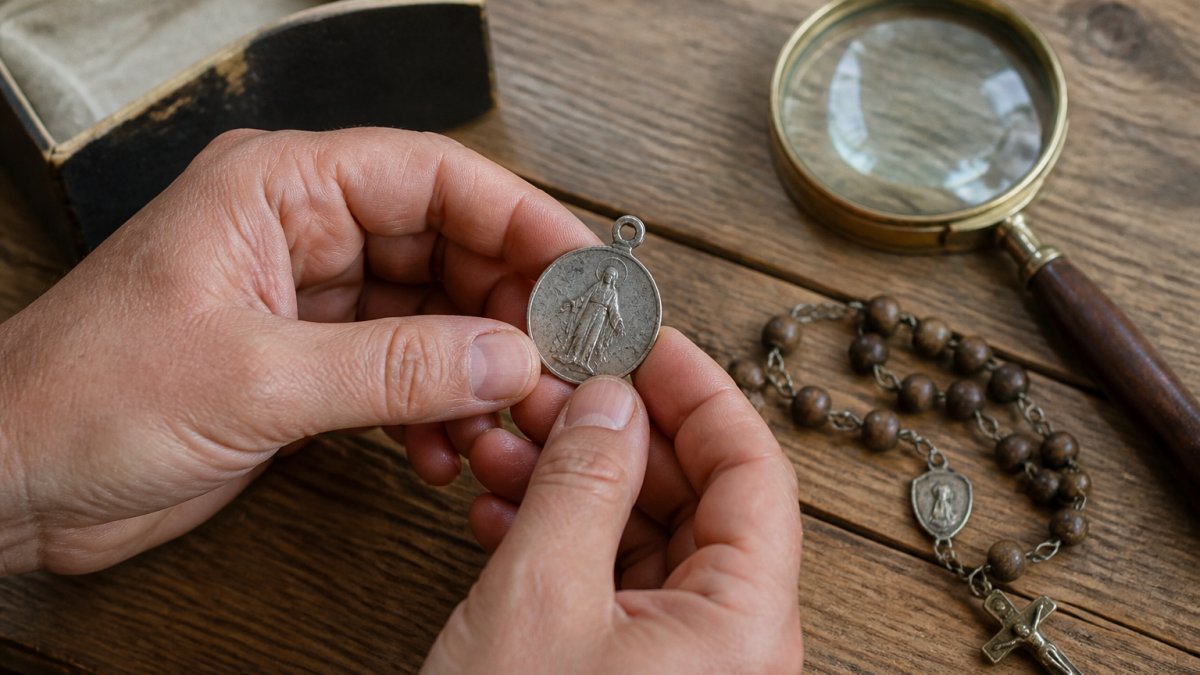
Step 1: Determine the shape and attachment
First, look at the shape: round medals are the most common; oval, shield-shaped, or flower-shaped examples are rarer. The attachment often tells you more than the design: a soldered loop indicates older craftsmanship, while a machine-stamped loop points to mass production. A medal without a loop is usually a token kept in a pocket or book, not worn.
- Round with a smooth edge: mass-produced from the late nineteenth century onward
- Oval with a scalloped edge: often nineteenth-century or earlier
- Shield-shaped: often a commemorative medal, not a devotional medal
Step 2: Read the front as a portrait
Identify who or what is depicted. You can recognize a saint by their attributes: a lily for Joseph, a child on a book for Anthony, a staff for Christopher. If there is no figure but a monogram or cross, the medal is probably older or simpler in design. Note what the figure is holding, what clothing they are wearing, and whether there is a halo.
Step 3: Turn it over and read the reverse
The reverse often holds the key: an inscription, a monogram, or a second image, sometimes a prayer or abbreviation that explains the front. A reverse with only a small cross is a deliberate choice for simplicity. Note every letter you see, even if you don't yet know what it means.
Step 4: Decipher letters and monograms
Work from large to small. Start with the most prominent monogram, then look for smaller letters along the edge. Common abbreviations include IHS (Jesus), AM (Mary), S.M. (Saint Mary), and ND (Notre-Dame). Latin phrases such as Ora pro nobis or Ave Maria indicate a devotional medal. A maker's mark or hallmark is often stamped discreetly on the edge or at the bottom of the reverse and can reveal its origin.
Step 5: Assess the material, wear, and patina
The coin-like shape of a medal often indicates its period. Nineteenth-century medals are often thinner and have less regular edges than twentieth-century examples. Look for these signs:
- Metal: silver, bronze, aluminum, or silver-plated copper
- Wear: shiny spots on the highest points indicate prolonged wear
- Edge: smooth or notched, sometimes with a maker’s mark
An antique medal with an even, dark patina has usually not been polished. That’s good news: polishing removes the historical layer and reduces its value.
Step 6: Weigh the meaning against the context
A medal inherited from a family member often has a different context than a piece from an antiques shop. If it was inherited, ask about the person who wore it: which saint were they devoted to?
Want to learn more about dating and valuation? Read more about the historical value of religious devotional objects. And if you’d also like to learn how to tell what is rare and what isn’t, the article on how to identify genuinely rare devotional objects can help.
Faith or superstition: what a devotional medal does and does not promise
A devotional medal is an expression of faith, not a good-luck charm. This distinction is important for both collectors and believers.
The Catholic Church teaches that a medal has no power of its own.
Yet in practice, they are often used superstitiously.
An honest guide makes that distinction clear. Anyone who buys a medal as religious jewelry or as a devotional object is buying a piece of tradition.
Choosing a medal or rosary for your own collection
A collection often begins with a single piece that speaks to you. If you want to build a collection, you’ll find practical tips in the guide to building a rosary collection.
A fine example from our collection is the Antique French Rosary with Mary Medal and Ebony.

Recognizing symbols on devotional medals takes practice, but it’s worth it.
At Chez Monique's 2nd Life, you’ll find a carefully curated collection of antique and vintage religious items.
Get started with Chez Monique's 2nd Life and give a special religious heirloom a place in your own home.
Frequently Asked Questions
What do the symbols on a devotional medal mean?
Each symbol refers to a truth of the faith or a saint. Mary with rays streaming from her hands represents grace being bestowed, a cross represents Christ’s sacrifice, and a monogram such as IHS stands for the name of Jesus. Letters and Latin mottos often indicate which congregation or prayer the medal is associated with. Reading the front and back together usually gives you a complete picture of the piece’s original purpose.
How can you recognize Mary on a religious medal?
Mary is almost always depicted as a woman with a veil, often with her hands folded or holding the infant Jesus. On the Miraculous Medal, she appears standing on a half-sphere, with rays streaming from her fingers and words surrounding her figure. Other distinctive features include a crown of twelve stars and a serpent beneath her feet. If the figure has no veil and has a beard, it is almost certainly Christ or a male saint.
What does the letter M on the Miraculous Medal mean?
The M on the back stands for Mary and is generally read as part of her monogram. Beneath the M, a crossbar and a cross intersect, with two hearts below: Mary’s heart pierced by a sword and Jesus’s heart surrounded by a crown of thorns. Together, these elements convey the medal’s message: the suffering and love of Mary and Jesus, united beneath the cross. The twelve stars around them refer to the apocalyptic woman.
How do you determine the age of an old devotional medal?
Look at the material first: aluminum only appeared at the end of the nineteenth century, while silver, bronze, and silver-plated copper may be older. Then consider the details: the style of the lettering, the degree of wear on the highest points, the type of loop or attachment, and any hallmarks or maker’s marks. A medal attached to a rosary from the 1920s or 1930s is often from the same period. If in doubt, it’s best to compare the piece with dated examples.
