

Historical Value of Religious Devotional Items
Table of contents
- What are devotional objects and why do they have historical value?
- The history of devotional objects: from craftsmanship to mass production
- Recognizing an antique rosary: what should you look for?
- Determining the value of religious statues: appraisal and authenticity features
- Care of antique devotional objects: conservation and storage
- Typology of devotional items: memorial cards, saint statues, and more
- The market shift: why devotional items are now more highly valued
- Conclusion: cherishing devotional objects as cultural heritage
- Frequently Asked Questions
Last updated: September 11, 2026
What are devotional objects and why do they have historical value?
Religious devotional objects are items that support believers in personal devotion: rosaries, prayer cards, saint statues, holy water fonts, and medals. The historical value of religious devotional objects lies in what they reveal about everyday religious life through the centuries.
This makes them one of the most direct windows into the material culture of ordinary people. A solid plaster statue of Saint Anthony from the 1960s tells a different story from a hand-carved wooden example from the 1930s. Both are devotional objects, but they come from different worlds: the first from an era of mass production, the second from a craftsmanship tradition.

Collectors and interior enthusiasts seek out this layered history. In this guide, we cover the history, typology, how to identify antique rosaries, how to determine the value of religious statues, and the care of antique devotional objects.
From popular devotion to material culture
Popular devotion is the everyday, personal religious experience of ordinary people, outside the official liturgy. Devotional objects are its tangible expression.
While the Catholic tradition manifests itself in churches and altars through sacred art, popular devotion takes place at home: on the bedside table, in the hallway, above the door. This distinction is essential for collectors. An item of religious heritage from popular devotion bears signs of use that you will never find in museum-like church interiors.
The history of devotional objects: from craftsmanship to mass production
Until well into the nineteenth century, devotional objects were produced mainly through craftsmanship. Sculptors and cottage industries handled the woodcarving, polychromy, and casting of medals.
After that, the picture changed. With the rise of workshops and factories, mass production became the norm (britannica.com). Plaster statues, printed holy cards, and machine-made rosaries made devotion affordable for broad sections of the population.
For collectors, this means that the same saint may exist in three completely different versions, each with its own cultural-historical profile.
Important periods in the Dutch devotional tradition
- Middle Ages - handcrafted religious devotional objects, closely connected with pilgrimages and relics.
- Counter-Reformation (16th–17th century) - renewed emphasis on catechesis and domestic devotion; devotional objects as instructional tools.
- 19th century - industrialization of production; plaster statues and printed holy cards become popular.
- 1930s–1950s (20th century) - the peak of hand-carved wooden saints' statues, often from Belgian and German workshops.
- 1960s–1970s - mass-produced plaster statues and Nativity scenes; at the same time, the beginning of secularization.
That final period explains why so much antique and vintage material is now coming onto the market: when parents' homes are cleared out, entire collections of devotional objects end up in thrift stores and the trade.
Recognizing an antique rosary: what should you look for?
You can recognize an antique rosary by four characteristics: the material of the beads, the connection between the beads, the cross or medallion, and the wear on the places where the beads rub against one another. New rosaries are too uniform.
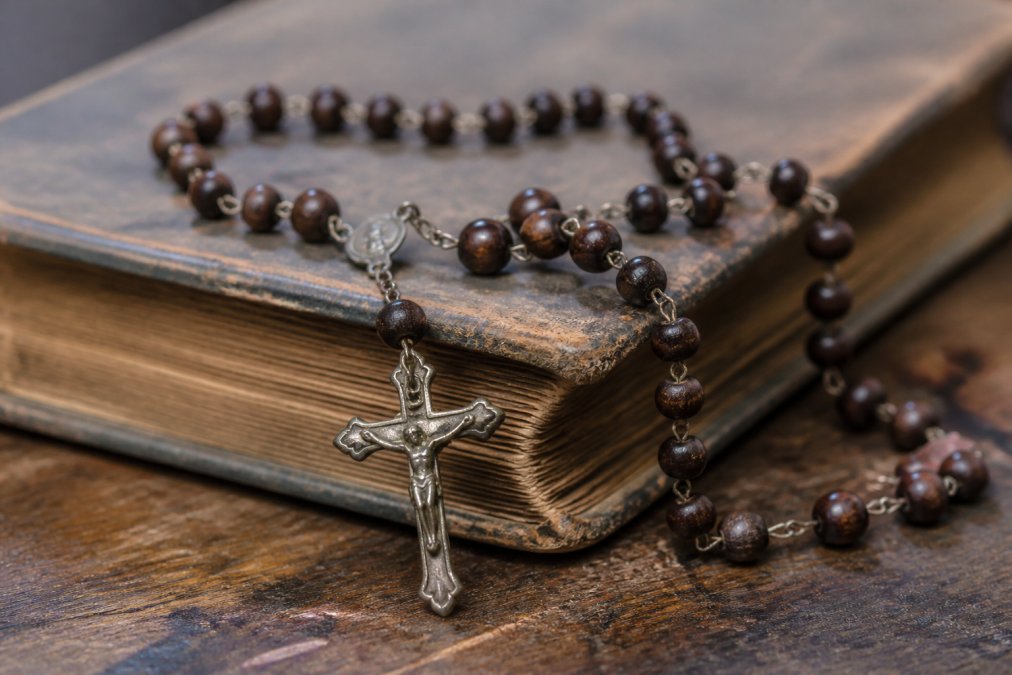
Pay attention to these points:
- Beads: old wood, bone, or glass is irregular in shape and color; new plastic is perfectly uniform.
- Connection: hand-knotted cord or chain with visible knots indicates an earlier date than machine-made wire.
- Cross: solid silver or brass with a soft, even patina; look for hallmarks.
- Wear: the beads immediately next to the crucifix are often the most worn, because that is where the fingers pass.
A common mistake is labeling a rosary as “antique” based solely on a dark color. That color may also come from a recent stain.
Determining the value of religious statues: appraisal and authenticity features
Determining the value of religious statues revolves around five factors: age, material, maker or workshop, condition, and provenance. No single factor carries the most weight on its own; it is the combination that determines the price. Below is a method you can follow yourself, along with the authenticity features that distinguish a valued piece from an anonymous example.
Step 1: determine the material
Material is the fastest way to make a rough estimate of age.
- Plaster: heavy, dull when tapped, feels cool (britannica.com). Dominant in serial production from the late 19th century through the 1960s.
- Wood: light to medium-heavy, feels warm, visible grain. Hand-carved examples are often older and more finely finished than machine-turned ones.
- Stone or marble: heavy, cold, no casting seam. Usually used for ecclesiastical or monumental purposes.
- Resin or plastic: strikingly light, feels warm, often glossy. Indicates recent production.
Step 2: read the production marks
- Seam: a visible seam indicates mass production from a mold; completely smooth surfaces indicate subsequent hand-finishing.
- Base plate: a felt pad, cork, or felt remnant under the foot is a good sign of old use. A bare, sharp edge indicates recent finishing.
- Polychromy: original paintwork has craquelure and wear on the raised points (nose, hands, folds). A recent repainting is too uniform and covers the original colors.
- Interior: with hollow statues, you can view the inside through an opening at the bottom. Residue from casting material or a mold seam inside reveals the method of production.
Step 3: assess condition and restoration
Condition carries significant weight, but not absolutely. An object with original patina and light signs of use is often worth more than a perfectly restored example in which the historical layer has been removed. Pay attention to:
- Cracks and breaks: a repaired arm or missing finger lowers the value, unless the repair itself is historical.
- Overpainting: often obscures original details and is difficult to reverse.
- Glue repairs: old glue residue may indicate an earlier restoration; always note this.
Step 4: identify the maker and provenance
Provenance is the documented origin of an object. A statue with a sticker, brand, or incised workshop mark is easier to place than an anonymous example. Look for:
- Workshop marks on the base or back.
- Church stickers or inventory numbers.
- Family notes or gift inscriptions.
- Auction or collector labels from the past.
Step 5: compare with references
Without market data, an appraisal remains a guess. Compare your piece with similar objects in public collections, museum databases, and auction catalogs. Pay attention to period, material, and condition, not just the subject. A Saint Anthony from 1900 belongs to a different market segment than a solid plaster example from 1965.

When should you call in a professional?
If there is any doubt about authenticity, a suspected rare workshop, or an object with a high expected value, an independent appraisal is advisable. An appraiser considers the same factors but can draw on market data and auction results that are not accessible to a layperson. Always ask for the reasoning: which comparable pieces, which period, and what condition.
Care of antique devotional objects: conservation and storage
The care of antique religious devotional objects calls for restraint: do as little as possible. Any intervention is irreversible.
Practical guidelines:
- Wood: keep out of direct sunlight; treat only with a dry cloth. Oil soaks into the wood and causes discoloration.
- Plaster and stone: dust with a soft brush; never submerge them, as plaster absorbs water and crumbles.
- Metal: leave the patina intact; remove only loose deposits with a soft cloth (si.edu).
- Memorial cards and paper: store in acid-free sleeves, away from moisture and light.
- Climate: a stable room with moderate humidity prevents cracks and mold.
Conservation is different from restoration. Restoration repairs the appearance; conservation stabilizes the current condition. For heritage objects with historical value, conservation is almost always the better choice.
Typology of devotional items: memorial cards, saint statues, and more
Devotional items fall into a handful of recognizable families. Knowledge of this typology helps with object identification and with assessing rarity.
| Type | Characteristic | Period | Collector's value |
|---|---|---|---|
| Memorial cards | Printed card for a funeral or First Communion | 19th–20th century | High for complete families |
| Rosaries | Beaded string with a cross | Middle Ages–present | High for old glass or silver |
| Saint statues | Plaster, wood, or stone | 17th–20th century | Very high for hand-carved wood |
| Medals | Cast metal with iconography | 19th–20th century | Medium, strongly dependent on the maker |
| Nativity sets | Painted or cast figures | 19th–20th century | High for complete sets |
| Holy water fonts | Wall- or tabletop model | 18th–20th century | Medium to high |
Angel statues and relics are separate categories with their own rules. For relics, authenticity plays a decisive role; without documentation, their value remains limited to the object itself.
The market shift: why devotional items are now more highly valued
The market for devotional items has changed in character in recent years. Whereas these objects once circulated mainly among believers and heritage enthusiasts, interior designers and antique collectors now buy them too. But the shift is not uniform: some segments are rising, while others are declining. Those who understand the mechanisms can collect more selectively.
Why supply is growing
When clearing out parents' homes, entire collections of devotional items disappear into thrift stores and the trade. This explains why a lot of antique and vintage material is now coming onto the market. At the same time, that same wave means the supply of everyday pieces is large, and therefore puts downward pressure on prices.
Why demand is shifting
Three movements are visible:
- From devotion to decoration: interior designers use statues of saints, holy-water fonts, and nativity scenes as decorative accents. This drives demand for visually striking, complete pieces.
- From anonymous to documented: collectors pay more for pieces with clear provenance, a maker's mark, or a documented history of origin.
- From mass production to craftsmanship: hand-carved wood and rare materials are rising in value, while mass-produced plaster and plastic are declining.
Which segments are declining and which are rising
- Declining: anonymous mass-produced items from the 1960s and 1970s, damaged pieces without provenance, and separate parts from larger sets.
- Stable: holy cards and medals in good condition, provided they are complete and documented.
- Rising: hand-carved wooden statues, complete nativity scenes, old glass and silver in rosaries, and pieces with verifiable church or family provenance.
The effect of secularization
Secularization has a dual effect. On the one hand, more objects become available as churches close and families clear out their belongings. On the other hand, the self-evident devotional context disappears, causing value to shift from religious meaning to cultural-historical and aesthetic significance. This makes devotional objects appealing to a broader audience, but also more sensitive to fashion and interior design trends.
What does this mean for collectors?
- Buy complete: a complete nativity scene or rosary with its original crucifix retains its value better than separate parts.
- Document: record the provenance, purchase date, and any restoration work.
- Be selective: mass-produced items from the 1960s and 1970s are widely available; rare handcrafted pieces are scarcer.
- Think long term: the market shifts with generations and interior design trends. What is popular now may be different in ten years.
Conclusion: cherishing devotional objects as cultural heritage
Every devotional object that is preserved keeps a piece of religious heritage alive that would otherwise quietly disappear. Whether you are religious, a collector, or simply enjoy vintage decor with character, these pieces deserve a second life.
Frequently Asked Questions
What exactly does the term devotionalia include?
Devotionalia encompasses all objects used in religious devotion, such as rosaries, statues of saints, prayer cards, medals, and holy water fonts. They are tangible expressions of popular devotion that were used both in churches and at home. In addition to their religious function, they also have cultural and historical value as material culture. Collectors consider factors such as age, craftsmanship, and provenance when determining the historical value of religious devotional objects.
How can you determine the age of a religious object?
When determining the age, consider stylistic features, the materials used, and production techniques. Plaster statues from the 1960s can often be recognized by their smooth finish, while hand-carved wooden statues from the 1930s–50s show finer carving. Marks or stamps from workshops, such as Schutt St. Anthonius Tegelen, can also provide guidance. Discoloration, patina, and wear patterns also tell a story about how the object was used over the years.
Are 19th-century religious statues worth a lot of money?
The value of 19th-century religious statues varies greatly. Factors such as rarity, condition, provenance, and craftsmanship play a major role. A simple plaster statue is generally worth less than a unique hand-carved wooden example. The degree of polychromy and any provenance from a well-known collection also influence the price.
What should you look for when buying antique devotional objects?
First and foremost, look for signs of authenticity: the material, technique, and style should match the stated period. Check for previous restorations or damage that may affect the value. Ask about the provenance if it is available. For online purchases, clear photography is essential. A reliable seller provides honest information about the condition. For fragile items, safe, sustainable packaging is important to prevent damage during transport.
At Chez Monique's 2nd Life, we select antique and vintage devotional objects with an eye for historical value and detail. From a solid plaster statue of Saint Anthony from the 1960s to a hand-carved wooden example from the 1930s: we carefully inspect every piece and ship it in reused packaging materials, without compromising the safety of your purchase. Browse our collection and give a special object a second life in your interior.