

How to Choose Gifts for Lovers of Antique Religious Art
Last updated: November 11, 2026
Quick Summary
Choose a gift that suits the recipient’s faith tradition and interests, because a serious collector pays attention to dating and provenance, while an interior design lover appreciates form and character. For under one hundred euros, you can already find a fine piece of history in our collection of antique religious art, such as a silk icon for €55,00.
- First ask about the recipient’s faith tradition before choosing a piece.
- An antique bronze crucifix from around 1800 costs €89,00 and is suitable for Christmas or an anniversary.
- Value depends on age, rarity, condition, and provenance.
- Wipe bronze and copper dry, without polish, to preserve the patina.
- A restored piece isn’t necessarily less valuable, but ask for before-and-after photos.
Table of Contents
- Why Antique Religious Art Makes a Special Gift
- Matching Gifts to the Recipient’s Interests and Faith Tradition
- Antique Religious Statues and Devotional Objects: Which Pieces Suit Which Occasion
- Gift ideas by budget: from modest devotional objects to rare showpieces
- The Value of Antique Religious Objects and How to Assess Them
- Buying Religious Art: What to Look For and How to Ship It Safely
- Condition, Care, and Safely Displaying Antique Devotional Items
- Your Next Step: Choosing a Gift from the Collection
- Frequently Asked Questions
Why Antique Religious Art Makes a Special Gift
Giving an antique religious object as a gift is different from ordering a new item from an online store. You’re giving an object that has lasted for generations, with a patina that can’t be recreated. That’s exactly why lovers of antique religious art are drawn to a piece with history: it’s not a decorative item, it’s a story you pass on.
An Object with a Story and a Second Life
Every piece in our collection has had a previous life. A bronze crucifix from around 1800 is a historical object with a long history. That story makes a gift personal. The recipient gets not just an object, but also the question: where did this come from, and who owned it before me?
That layered character is exactly what a mass-produced item lacks. Antique devotional objects have wear consistent with their age, a warm patina, and often a small maker’s mark. For a collector, that’s the difference between a purchase and a treasure.
Matching Gifts to the Recipient’s Interests and Faith Tradition
The best gift ideas for lovers of antique religious art start not with the object, but with the person. Someone with a Catholic background often appreciates different pieces than a lover who is mainly shopping for their interior.
From Collector to Interior Design Enthusiast: Who Gets What?
- The serious collector pays attention to dating, provenance and maker's mark. Choose a piece with clear provenance, such as the French Madonna and Child from our collection.
- The devout recipient often prefers devotional objects with a purpose: a rosary, an icon or a chalice.
- The interior design enthusiast wants character and form. A plaster angel as a wall console or an Art Deco Madonna from 1929 fits into a modern interior without any religious intent.
- The beginner collector benefits from an affordable piece in good condition with plenty left to discover.
What many buyers overlook: first ask about the recipient's religious tradition. An Eastern Orthodox icon has a different meaning from a Western saint's statue, and recipients notice the difference immediately.
Antique Religious Statues and Devotional Objects: Which Pieces Suit Which Occasion
The occasion determines not only the size, but also the symbolism and degree of personal significance. A christening gift calls for a different story than an anniversary piece for a collector, and the relationship between giver and recipient matters at least as much as the category of the object.
Christmas, Birthday, Anniversary or Housewarming
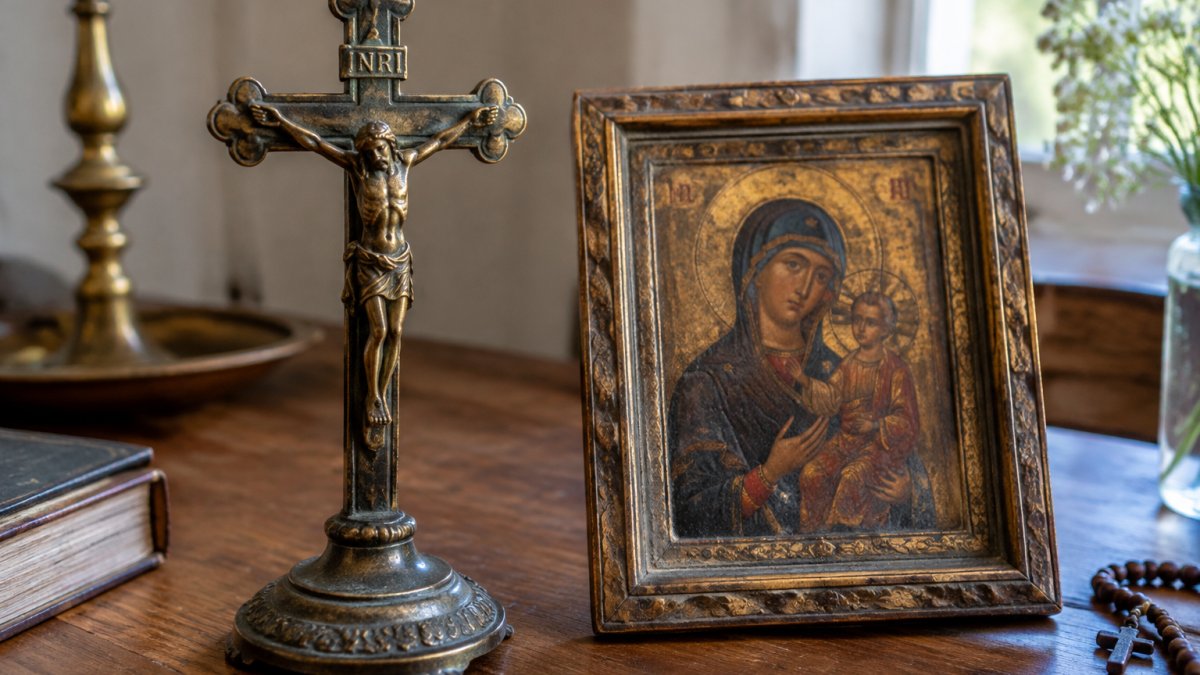
- Christmas: a Nativity scene or a small devotional piece suits the season. A bronze crucifix from around 1800 is a special gift for a collector. Keep the recipient's religious tradition in mind.
- Birthday: a silk icon or a modest statue of Mary is personal and affordable.
- Anniversary: you can go bigger here. A rare Madonna or an antiquarian Missale Romanum from 1920 can make a special gift. Ask beforehand whether the recipient wants to display the piece or would rather keep it in a display case; that determines whether a fragile missal or a sturdy bronze statue is the better choice.
- Housewarming: a wall console in the shape of an angel or a chalice with a ciborium immediately gives a new home a consecrated atmosphere. Measure the wall or console beforehand: a 40 cm plaster angel requires a different mounting than a small bronze cross.
- First Communion or Confirmation: a rosary with a relic holder or a small silver medallion is traditional, but an antique prayer book inscribed by its previous owner adds a personal story that a new item lacks.
A useful rule of thumb: the closer the relationship, the more the gift can be about the recipient rather than its value. For a business associate, a representative piece with clear provenance is more suitable; for a family member, a devotional object that reflects the faith tradition.
The Relationship Between Giver and Recipient as a Selection Criterion
The same occasion calls for a different gift depending on the relationship. A partner or parent who shares the faith tradition will appreciate a functional devotional item such as a chalice or rosary.
Please note: don't automatically assume someone's religious beliefs based on their background or family. An antique religious object can still be a treasured heirloom or work of art for a nonreligious recipient, but information about its origins and meaning then becomes more important than its devotional function.
Gift ideas by budget: from modest devotional objects to rare showpieces
A good gift doesn't have to be expensive. Our collection ranges from a small icon to a rare missal, and every price range includes pieces with a real story.
| Budget | Example from our collection | Price | Best for |
|---|---|---|---|
| Up to €75 | Antique O.L.V. of Perpetual Help silk icon | €55,00 | Starting a collection |
| Up to €75 | Antique crucifix with shells and mother-of-pearl | €63,50 | Folk art enthusiast |
| €75 - €200 | Antique bronze crucifix, ca. 1800 | €89,00 | Classic Christmas or anniversary gift |
| €75 - €200 | Antique French statue of the Virgin Mary with Child | €152,50 | French craft enthusiast |
| €200 - €400 | Large Madonna and Child, Steph Uiterwaal | €262,50 | Glass art collector |
| €200 - €400 | Antique plaster angel wall bracket from 1890 | €325,00 | Interior decor and house blessing |
| Over €400 | Antiquarian Missale Romanum 1920 | €990,00 | The serious collector |
For under one hundred euros, you can already find a beautiful piece with history here. Above three hundred euros, you can buy a rarity: an edition you won't come across again anytime soon.
Prices of antique religious objects by budget
The Value of Antique Religious Objects and How to Assess Them
The value of antique religious objects depends on four factors: age, rarity, condition, and provenance. A piece that scores highly in all four is worth more than an older item in poorer condition. But the reality is more complicated: a restored statue may look better at first glance than an intact original, and a reproduction from the seventies may look like an antique due to wear.
Checking Authenticity, Age, and Provenance
Start with the materials and finish. Bronze develops a warm patina over time; an artificial patina is often less uniform in color. Plaster develops hairline cracks consistent with its age, while a new cast usually has sharp edges and a smooth, matte surface.
A second check is the construction. Antique statues are often hollow and assembled from several parts; irregularities on the inside and signs of hand finishing indicate handcrafted work. For books, look at the paper: antique paper feels different from modern paper and discolors unevenly, while a reprint often has a uniform, light yellow tint.
Restoration, Original Condition, and Valuation
A restored piece is not necessarily worth less, but the type of restoration determines its effect on the price.
In our article about the difference between vintage and antique religious art, we explain exactly what to look for.
Would you like to learn how to assess pieces step by step? Then read our guide on determining the value of antique religious objects, with a checklist for materials, marks, and condition.
Please note: a missing maker’s mark does not automatically mean that a piece is worth less. Many handcrafted pieces from the nineteenth century were never marked, and a missing inscription sometimes says more about the age than the authenticity.
Buying Religious Art: What to Look For and How to Ship It Safely
When buying religious art, the seller matters just as much as the piece. Always ask for additional photos of the underside, the back, and any damage.
Pay extra attention to loose parts on devotional items. A rosary with a relic holder has a small, delicate screw. A plaster statue is hollow and can crack during rough transport. Wherever possible, we reuse packing materials and ensure careful packaging.
If you have your eye on a rare piece online, we’ve written a separate guide: buying rare religious statues online, with advice on payment, shipping, and what to expect from a seller.
Condition, Care, and Safely Displaying Antique Devotional Items
An antique piece will last longer if you leave it undisturbed. Dusting it with a soft, dry cloth is usually enough. Do not use damp wipes on plaster or gilded wood, as they can damage the patina.
- Bronze and copper: Wipe dry; do not use polish.
- Plaster and wood: Dust with a brush; keep them away from moisture and direct sunlight.
- Textiles and silk: Keep them behind glass and do not hang them in a damp room.
- Books: Support them upright or flat; never rest them on their spines.
When choosing a spot at home, a sturdy console table or a high shelf is safer than a narrow ledge. Find out where to display a gifted piece most beautifully and safely in our tips on the best places for antique devotional items at home.
Looking for inspiration for the recipient? Take a look at our unique gifts for collectors of religious objects.
Your Next Step: Choosing a Gift from the Collection
Finding a special gift starts with browsing and comparing, then choosing the piece that stays with you. Our collection includes antique crucifixes, statues of the Virgin Mary, icons, and liturgical objects, each with its own story and an honest description of its condition.
Choosing between two pieces? Compare their dimensions, age, and condition side by side, and choose the object that suits the person and the occasion. That way, a purchase becomes a meaningful gift.
A beautiful antique piece deserves a second life with someone who appreciates its story.
Frequently Asked Questions
What do you give as a gift to someone who collects antique religious art?
First consider the recipient’s faith tradition and interests. A Catholic collector will often appreciate an antique crucifix or a rosary with a relic holder, while someone interested in Dutch glass art might find a 1929 Madonna by Steph Uiterwaal especially distinctive. Also consider where the piece will be displayed: a wall console in the shape of an angel suits a larger interior, while a small framed icon suits a modest prayer space. When giving it as a gift, always mention the object’s provenance and story, as these are often just as important to collectors as the price when it comes to the value of antique religious objects.
How can you recognize an antique religious statue, and what should you look for in antique devotional objects?
Pay attention to the material, wear, and maker’s marks. Genuine antique pieces have a natural patina, such as the warm bronze color of a crucifix from around 1800 or the authentic plaster patina of a French Madonna statue bearing the maker’s mark. Check the underside for stamps, the finish on the corpus, and the proportions of the face. In antique devotional objects such as a rosary with a relic holder, the inscription also matters. Always ask about the provenance and any defects.
What determines the value of antique religious objects, and is vintage religious art a suitable gift?
The value depends on age, rarity, condition, provenance, and demand for that type of object. A solid bronze crucifix with a detailed corpus is worth a different amount than a common plaster statue, and a signed piece by a renowned maker such as Steph Uiterwaal for Leerdam has extra appeal. Vintage religious art makes a great gift precisely because each piece is unique and comes with a story. Be sure to check its condition and make sure it is the right size for the recipient, so the gift will truly be used and cherished.
How do you safely pack a fragile antique religious object, and where can you find special religious art as a gift?
Use multiple layers of protection: first wrap the object in acid-free tissue paper, then place it in foam or padded paper in a sturdy box, paying extra attention to protruding parts such as arms, cross arms, or a chalice foot. Fill any cavities so nothing can shift, and mark the box as fragile. Ask an antiques dealer about packaging and shipping before you order.
