

Determine the value of antique religious objects
Table of contents
- What determines the value of antique religious objects
- Types of religious objects and their collectors' value
- Identifying an antique rosary: signs of authenticity
- Appraising religious statues: methods and references
- Value of Catholic devotional items: market prices and trends
- Maintenance and conservation: impact on value
- Legal and ethical aspects of religious heritage objects
- Frequently Asked Questions
Last updated: September 26, 2026
What determines the value of antique religious objects
Determining the value of antique religious objects requires insight into historical context, art-historical significance, material, craftsmanship and market trends. At Chez Monique's 2e Leven, we help collectors better understand this value.
A crucifix from the 1920s, a glass statue of Mary, or devotional items such as medals and rosaries: each piece tells a story that determines its value.
Historical context and art-historical significance
A religious statue from the Art Deco period (1920s-1930s) may be worth significantly more than a comparable piece without art-historical provenance, because collectors and museums are interested in pieces that illustrate art-historical movements.
A Madonna statue by a renowned artist such as Steph Uiterwaal (Glasfabriek Leerdam) carries considerably higher value than an anonymous piece of the same age.

Material, craftsmanship and manufacture
The material determines durability and aesthetic value. A glass Madonna by Fostoria Glass Company with their characteristic "Silver Mist" finish is known for its quality and collectors' value.
Hand-carved wooden statues of saints demonstrate craftsmanship that mass production cannot replicate.
Types of religious objects and their collectors' value
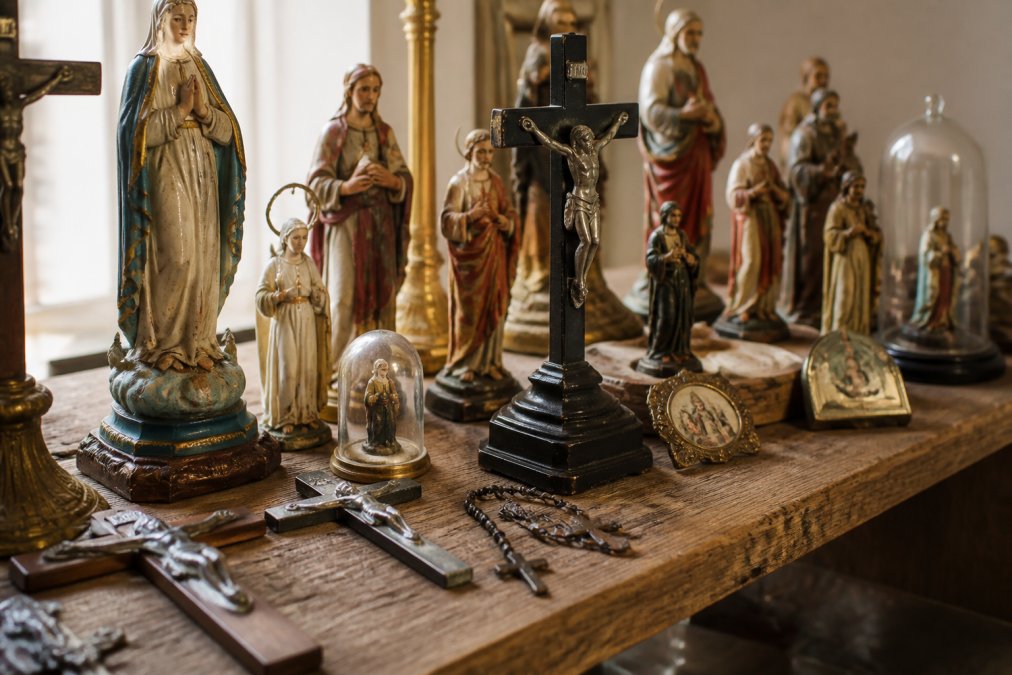
The value of antique religious objects varies greatly depending on the type of object. Some categories have a stronger collectors' market than others, and this directly affects what you can expect to pay for one or receive when selling a piece.
Statues of saints and depictions of Mary
Statues of Mary are among the most sought-after religious art objects because Mary is central to Catholic devotion and art history. A large, rare Madonna statue fetches considerably more than smaller devotional items.
Statues of Saint Joseph, Saint Francis and Saint Catherine have their own market, although depictions of Mary generally generate the most demand.
Crucifixes and corpus figures
Crucifixes have a stable collectors' market. An antique crucifix with a copper corpus, decorated with shells and mother-of-pearl from the 1920s-1930s can be a valuable collectible.

The corpus can determine the value; finely detailed work indicates craftsmanship.
Devotional items: medals, prints and rosaries
Devotional items (medals, holy cards, rosaries) vary greatly in value. An antique rosary made of ivory or silver can be a valuable collector's item.
Rosaries have an intimate history; they were carried and used in prayer. The choice of material (silver, gold, mother-of-pearl, wooden beads) largely determines the value.
Identifying an antique rosary: signs of authenticity
Recognizing an antique rosary requires knowledge of materials, manufacturing, and stylistic features. Many modern replicas circulate on the market, so identifying signs of authenticity is essential.
Material analysis: how to distinguish genuine from fake
Wooden beads from antique rosaries display characteristic features:
- Natural patina: Deep, even discoloration from decades of handling and exposure to light.
- Irregular wear: Microscopic scratches where the object was held, rather than uniform wear.
- Wood characteristics: Specific grain patterns for each type of wood (boxwood, elm, rosewood).
Silver components should bear hallmarks. Dutch silver may bear marks. Their absence may be a warning sign.
Wire and knot construction
The fastening reveals a great deal about authenticity:
- Natural fibers: Silk, linen, or hemp show characteristic deterioration after 100+ years.
- Knots between beads: Antique rosaries have small knots to prevent clacking; modern replicas omit this.
- Wire thickness: Antique wire may be thinner than modern synthetic material.
Bead shape and cutting
- Hand-cut facets: Antique beads may have irregularly cut facets; modern machines often produce identical facets.
- Bead size: Antique rosaries may have slightly varying sizes; modern ones may be identical.
- Holes: Antique holes may sometimes have microscopic cracks; modern ones are often smoother.
Practical checklist for collectors
Check in this order: (1) hallmarks on metal, (2) wire fragility, (3) knots between beads, (4) deep patina on wood, (5) natural wear. A genuine antique rosary may score positively on multiple points.
Appraising religious statues: methods and references
The appraisal of religious statues follows standard methods that also apply to other antique art objects. Appraisal follows a structured approach that collectors can learn to apply.
The appraisal framework: five steps
Professional appraisers use a structured approach. Here is the framework you can apply yourself:
Step 1: Identify the material and technique
First determine what the object is made of and how it was manufactured:
- Material: Glass, bronze, wood, plaster, pewter, ceramics, stone? Each material has a different market value. Glass and bronze are generally valuable; mass-produced plaster less so.
- Manufacturing: Hand-carved (wooden statues), cast (bronze, tin), blown (glass), wheel-thrown (ceramics)? Handcrafted work is valuable; mass production is less so.
- Finish: Polychrome (multiple colors), monochrome (one color), gilded? Polychrome work is rarer and more valuable.
This determines part of the value. A hand-carved wooden statue may be valued differently from a mass-produced plaster cast.
Step 2: Dating through style and material use
Dating is crucial: a statue from 1750 is much more valuable than the same statue from 1950. Use these indicators:
- Art-historical style: Art Deco elements (geometric shapes, simplified lines) indicate the 1920s-1930s. Romantic details (elaborate drapery, emotional facial expression) indicate the 19th century. Medieval references (Gothic arches, rigid posture) indicate the 18th-19th century or later revivals.
- Material use: Certain materials were popular in specific periods. Glass from Fostoria Glass Company dates from 1920-1970. Cast-tin statues were popular in the Netherlands in the 1920s-1940s. Mass-produced plaster usually dates from after 1900.
- Maker or manufacturer marks: Check the bottom and back for marks. Dutch manufacturers such as Leerdam, Gouda Pottery, or Delft used distinctive stamps.
Dating determines part of the value. A statue from 1750 may be worth considerably more than the same statue from 1950.

Step 3: Researching provenance and origin
Large rare Madonna with Child Steph →
Provenance (history of origin) is important:
- Documented provenance: Does the statue have a documented history? Did it come from a monastery, church, or well-known collection? This increases the value by 50-100%.
- Anonymous or unknown: No documents? This reduces the value by 30-50%, because potential buyers have less certainty.
- Ethical origin: Did it come from an active religious community? This may create legal complications and reduce its marketability.
When researching provenance, look for:
- Old labels or stickers on the back
- Handwriting or inscriptions
- Photos of the statue in a historical context
- Letters or certificates from previous owners
Provenance determines part of the value.
Step 4: Assessing condition
Physical condition has an impact:
- Perfect condition: No damage, original finish intact, natural patina. This is rare and increases the value by 50-100%.
- Good condition: Minimal wear, no major damage, finish largely intact. This is normal for antiques.
- Fair condition: Visible wear, small cracks or chips, finish partly faded. This reduces the value by 30-50%.
- Poor condition: Major damage, missing parts, severe deterioration. This reduces the value by 50-80%.
Check specifically for:
- Cracks in wood or plaster (serious)
- Chips or flaking (moderate)
- Faded paint or patina (light)
- Restoration (can reduce value if it is amateur work)
Condition accounts for part of the value.
Step 5: Comparing with market comparables
Finally, compare it with similar sold objects:
- Same maker/manufacturer: What have comparable pieces sold for?
- Same period: Prices vary greatly by decade.
- Comparable size and material: A small plaster statue is not comparable to a large bronze statue.
- Comparable condition: Perfect condition fetches more than fair condition.
Use online auction houses (Catawiki, Veilinghuis Assen), antique markets, and specialist dealers as references.
Formula for a preliminary appraisal
Here is a simplified formula you can use:
Base value (determined by material and craftsmanship):
- Hand-carved wood: €80-150
- Cast bronze: €100-200
- Glass (Fostoria, Leerdam): €50-120
- Mass-produced plaster: €10-30
Date multiplier:
- Before 1850: ×3-5
- 1850-1900: ×2-3
- 1900-1950: ×1-2
- After 1950: ×0.5-1
Provenance multiplier:
- Documented provenance: ×1.5-2
- Unknown: ×0.7-0.8
Condition multiplier:
- Perfect condition: ×1.5-2
- Good condition: ×1
- Fair condition: ×0.6-0.8
- Poor condition: ×0.2-0.4
Example: A hand-carved wooden Madonna from 1880 in good condition with documented provenance:
- Base value (wood): €100
- Date (1880): ×2.5 = €250
- Provenance (documented): ×1.5 = €375
- Condition (good): ×1 = €375
- Estimated value: €350-400
This formula can provide a starting point.
When to consult an expert
Consult a professional appraiser when:
- The statue is probably worth more than €500
- You have doubts about its authenticity
- You want to insure it
- You want to sell it through an auction house
- The statue is damaged and you want to know whether restoration is worthwhile
A professional appraisal can be valuable.
Value of Catholic devotional items: market prices and trends
The market value of Catholic devotional items fluctuates, but clear trends can be seen. Religious statues and devotional items are popular not only with Catholic collectors, but also with people who value these objects for their art-historical and aesthetic qualities.
Market prices vary considerably. A large, rare statue of the Virgin Mary may be worth a substantial amount, while smaller devotional items such as medals or rosaries and antique crucifixes vary in price depending on the material, condition, and art-historical value. At Chez Monique's 2e Leven, for example, we offer a large Madonna statue by Steph Uiterwaal for €262.50 and a Fostoria Glass Madonna for €72.00, illustrating the variation in market prices.
Maintenance and conservation: impact on value
The condition of a religious object has a major influence on its value. A perfect condition can significantly affect the price compared with a damaged example. This is why conservation and maintenance are essential for collectors.
Legal and ethical aspects of religious heritage objects
Religious objects can sometimes involve legal complications. Certain ecclesiastical objects may be protected heritage, especially if they come from active churches or monasteries. According to UNESCO guidelines for cultural heritage, certain religious art objects may need to be registered as protected heritage.
Frequently Asked Questions
How do I determine whether an antique religious object is authentic?
Check the material composition, dating, and manufacturing technique. Authentic antique religious objects show signs of use consistent with their age. Examine the polychrome (original paint layer), woodcarving details, and any maker's marks. When in doubt, consult an art historian. Signs of authenticity vary by object type, such as glass Madonnas by makers like Fostoria, which may have specific characteristics.
What are the most valuable religious collectibles?
Dutch glass art from Leerdam, such as works by Steph Uiterwaal from 1929, is among the most sought-after. Antique wooden religious statues, especially those with original polychrome, can be valuable. Rare devotional items such as 18th-century medals and prints, reliquaries, and valuable crucifixes with silver or copper corpus figures are highly sought-after. Rarity, provenance, and condition ultimately determine the market value.
Where can I have religious objects appraised?
Art historians and specialized antique dealers can conduct a professional appraisal. Many auction houses in the Netherlands offer free valuations. For insurance purposes, it is advisable to engage a certified appraiser. The appraisal is based on recent auction results, condition, provenance, and the object's art-historical significance.
Is a religious object more valuable if it is a relic?
Reliquaries with verified contents or historical significance can be valuable. However, many antique objects presented as relics can no longer be verified. Art-historical value, material quality, and condition remain decisive. Authenticity and provenance determine whether the relic claim is valid.