

Buy Rare Religious Statues Online: Guide 2026
Table of Contents
- Buying rare religious statues online: what makes a piece truly special?
- Statues of Mary and Jesus: the most sought-after religious statues
-
Religious statues in plaster, wood, and copper: material determines the ambiance
- Saint Anthony Abbot with pig - wooden carving, 1930s/50s - €155.00
- Antique French Saint Anthony Abbot religious statue in plaster - €170.00
- Antique French copper crucifix with corpus, approx. 1900 - €135.00
- Rare French Saint Joseph plaster statue, 1930s - €185.00
- Saint Donatus, patron saint against lightning, plaster 1930s - €150.00
- Determining the value of religious statues: authenticity features and iconography
- Maintenance of antique religious statues: how to keep them beautiful
- Buying religious statues for home devotion or interior decoration: what to look for
- Buying a rosary with a silver cross: what to look for in devotional items
- Frequently Asked Questions
Last updated: September 2, 2026
Buying rare religious statues online: what makes a piece truly special?
Buying rare religious statues online is preserving a piece of cultural history. At Chez Monique's 2e Leven, we carefully select each piece. Three factors determine whether a religious statue is special: rarity of the subject, quality of craftsmanship, and demonstrable authenticity.
Rarity is about more than age. A plaster Madonna statue from the 1930s that was mass-produced in large series is less rare than a hand-carved wooden statue of a lesser-known saint. Statues of figures like Saint Donatus or Saint Anthony Abbot are much less common than a standard Our Lady.

Craftsmanship is evident in the details: the finesse of the wood carving, the delicacy of hand-painted plaster, or the precision of a cast copper corpus. Artisanal pieces from the period 1880-1960 are particularly sought after, as machine mass production largely replaced handwork afterwards.
Authenticity is the third pillar. Signatures, stamps, patina, and provenance are concrete proofs that distinguish a truly antique piece from a later reproduction.
A piece is only truly special if it scores well on all three.
Statues of Mary and Jesus: the most sought-after religious statues
Statues of Mary and Jesus form the core of any collection of religious art. They are the most sought-after, but also the most varied in quality and rarity. The iconography, material, and period determine whether you are dealing with ordinary devotional production or a truly exceptional piece.
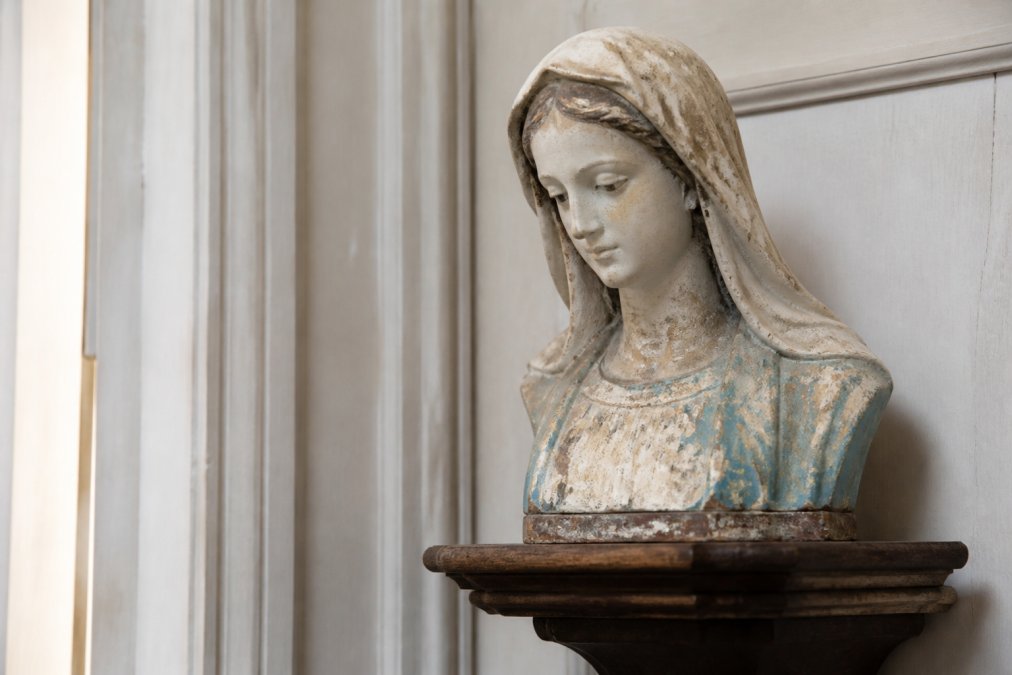
Large rare Madonna with Child - Steph Uiterwaal (1929) - €262.50
This is one of the most exceptional pieces in our collection. The Large Madonna with Child by Steph Uiterwaal was produced in 1929 by Glasfabriek Leerdam, one of the leading manufacturers of artistic glass in Europe. The sculpture measures 37 cm and combines religious iconography with modernist Art Deco design. It is immediately recognizable as authentic Uiterwaal, even without a monogram. Leerdam glass art from 1929 in this condition is extremely rare.

Material: Glass | Height: 37 cm | Period: 1929 | Price: €262.50
Fostoria Glass Madonna 'Silver Mist' - €72.00
The Fostoria Glass Madonna 'Silver Mist' was manufactured by the Fostoria Glass Company in the mid-20th century. This piece is characterized by sleek, serene lines and a satin-like frosted glass finish. Mary stands with folded arms in a contemplative posture. The original Fostoria sticker on the base confirms its authenticity. At 26 cm high, this is a more compact piece with elegant execution.

Material: Frosted Glass | Height: 26 cm | Price: €72.00
Belgian Madonna statue approx. 1900 with infant Jesus and lamb - €255.00
This Belgian Madonna statue from around 1900 shows Mary seated with the infant Jesus and a lamb, a combination rarely encountered. The lamb refers to the pastoral tradition and the innocence of Christ. The heavy plaster statue is signed "Depose 12" with a round stamp, which underscores its authenticity. Dimensions: 33 x 29 x 11 cm.
Material: Plaster | Period: circa 1900 | Price: €255.00
Our Lady of Fatima plaster statue, hand-painted, 1950s - €200.00
This Our Lady of Fatima statue from Portugal combines perfect condition with hand-painted craftsmanship. The glass eyes and elegant crown are details that disappeared in later productions. At 52 cm, this is the largest Madonna statue in our current collection. Originating from Portugal, the country of the Fatima apparitions, this piece has clear provenance.
Material: Plaster, hand-painted | Height: 52 cm | Period: 1950s | Price: €200.00
Infant Jesus on globe, 1920s, flawless - €75.00
The Infant Jesus standing on a globe symbolizes Christ's universal dominion. This plaster statue from the 1920s stands on a matching wooden console and is in exceptionally good condition. Height: 23 cm.
Material: Plaster on wooden console | Height: 23 cm | Period: 1920s | Price: €75.00
| Piece | Period | Material | Price |
|---|---|---|---|
| Madonna Steph Uiterwaal | 1929 | Glass (Leerdam) | €262.50 |
| Fostoria Silver Mist Madonna | mid-20th century | Frosted Glass | €72.00 |
| Belgian Madonna with lamb | approx. 1900 | Plaster | €255.00 |
| Our Lady of Fatima Portugal | 1950s | Plaster, hand-painted | €200.00 |
| Infant Jesus on globe | 1920s | Plaster | €75.00 |
Religious statues in plaster, wood, and copper: material determines the ambiance
Material determines the appearance, durability, and rarity of religious statues. Plaster was the most accessible material for religious folk art from the late 19th century well into the 20th century. Wood required skilled carving and was more expensive. Copper and bronze were reserved for crucifixes and higher-quality processional objects.
Saint Anthony Abbot with pig - wooden carving, 1930s/50s - €155.00
Wood carvings of this quality are increasingly difficult to find. This antique wooden statue of Saint Anthony Abbot dates from the 1930s/50s and depicts the saint with a pig at his feet, the traditional attribute referring to the Antonites. The carving shows beautifully detailed work in the cloak and face. Height: 21 cm.
Material: Wood (hand-carved) | Height: 21 cm | Price: €155.00
Antique French Saint Anthony Abbot religious statue in plaster - €170.00
This French plaster statue of Saint Anthony Abbot from the 1930s is heavier and more formal in character. The statue is signed on the back of the cloak. Height: 31 cm including base. Plaster and wood side-by-side create a beautiful contrast: wood exudes warmth and craftsmanship, plaster radiates serene tranquility.
Material: Plaster | Height: 31 cm | Price: €170.00
Antique French copper crucifix with corpus, approx. 1900 - €135.00
This French copper crucifix with corpus from around 1900 weighs 620 grams and is richly decorated with detailed ornaments. The patina gives the piece a warm, authentic look. Dimensions: 34 x 20.5 cm. Perfect as wall decoration or devotional object.
Material: Copper | Height: 34 cm | Period: approx. 1900 | Price: €135.00
Rare French Saint Joseph plaster statue, 1930s - €185.00
Saint Joseph is less common than Mary or Jesus, which immediately makes this French plaster Saint Joseph statue from the French Ardennes rarer. Height: 38 cm, base 14 x 12 cm. Excellently preserved with beautiful patina.
Material: Plaster | Height: 38 cm | Period: 1930s | Price: €185.00
Saint Donatus, patron saint against lightning, plaster 1930s - €150.00
The Saint Donatus is a patron saint barely known outside of Flanders and Northern France, which makes this statue a true collector's find. The plaster statue from the 1930s measures 43 cm and is beautifully preserved with subtle color tones.
Material: Plaster | Height: 43 cm | Period: 1930s | Price: €150.00
Determining the Value of Religious Statues: Authenticity Features and Iconography
Determining the value of an antique religious statue requires knowledge of signatures, material characteristics, and iconography. According to the guidelines of the Cultural Heritage Agency of the Netherlands, provenance, material analysis, and iconographic knowledge are the three pillars of authenticity research.
Signatures, Stamps, and Patina as Proof of Authenticity
Signatures are the most direct indication. A signed piece like the Belgian Madonna with "Depose 12" and a round stamp provides concrete clues. "Depose" is a Franco-Belgian designation indicating that the design was registered.
Patina is harder to fake. Real patina develops from decades of oxidation and dust accumulation. It resides in layers of paint and small irregularities. A reproduction has artificially applied aging that is always recognizable: too uniform, too superficial.
Weight is an underestimated characteristic. Authentic plaster statues from the early 20th century are heavier than modern reproductions due to different plaster compositions and casting methods.
Iconography: What the Image Tells About Origin and Period
Every attribute, every posture, and every garment in religious art has a fixed meaning. The pig with Saint Anthony the Abbot is inextricably linked to the Antonites. The sheep with the Belgian Madonna refers to the pastoral tradition. The globe beneath the Infant Jesus symbolizes universal dominion. Those who understand iconography can estimate period and origin much more accurately.
Maintenance of Antique Religious Statues: How to Keep Them Beautiful
Antique religious statues are delicate objects. Plaster is porous and sensitive to moisture, wood can warp with temperature changes, and copper oxidizes. Proper maintenance is essential.
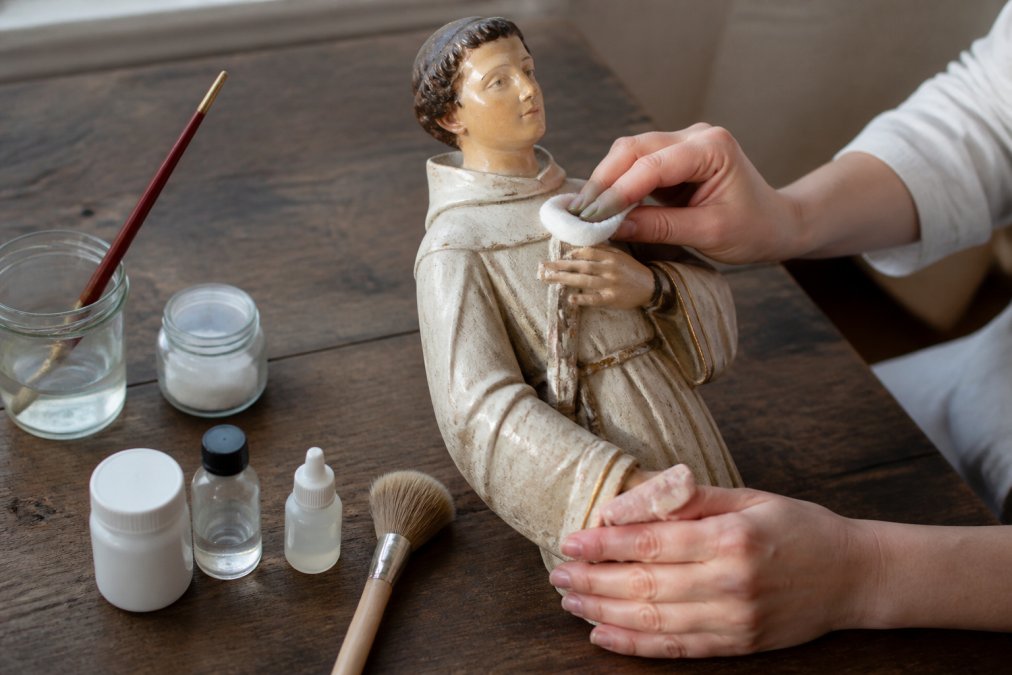
Cleaning plaster statues:
- Only use a dry, soft brush or a slightly damp cotton cloth
- Never immerse in water: plaster absorbs moisture and can crack
- No chemical cleaning agents: these damage the original paint layer
- Dust regularly to prevent accumulation
Wooden statues:
- Keep wood away from direct heat sources and drafts
- A slightly damp cloth is sufficient for superficial dust
- Do not use beeswax or silicone oil on painted wood
Copper and bronze objects:
- Patina is valuable: do not remove it without advice from a restorer
- Light oxidation can be carefully removed with a soft cloth and specialized copper polish
Placement and storage:
- Avoid direct sunlight: UV light fades pigments
- Stable humidity between 45-55% is ideal
- Do not place statues in areas where they can easily be knocked over
Restoration of damaged statues is specialist work. For valuable pieces, we refer to certified restorers affiliated with the Stichting Restauratie Atelier Limburg or similar recognized restoration institutions. Self-repair almost always leads to a decrease in value.
Buying Religious Statues for Home Devotion or Interior: What to Look For
Religious statues are not just for believers. Many customers are interior designers, collectors of antique and vintage decor, or people who love the serene atmosphere a well-chosen saint statue brings.
For home devotion: Iconographic correctness is important. A Madonna statue for a home altar must have the correct attributes. Our Lady of Fatima with a crown and glass eyes fits perfectly in a personal prayer space.
For interior enrichment: Scale, color, material, and appearance must match the surroundings. A large copper crucifix makes a statement in a classic interior. A frosted glass Fostoria Madonna fits into a more modern art deco setting.
Religious statues combine well with other vintage objects: candlesticks, rosaries, antique frames, and antique furniture.
| Purpose | Recommended Material | Recommended Scale | Example Piece |
|---|---|---|---|
| Home devotion / prayer corner | Plaster, hand-painted | 30-55 cm | Our Lady of Fatima, €200 |
| Classic interior | Copper, plaster with patina | 30-45 cm | French crucifix, €135 |
| Collection / display cabinet | Glass, porcelain | 20-30 cm | Fostoria Madonna, €72 |
| Eyecatcher / statement | Plaster, large format | 40+ cm | Saint Donatus, €150 |
According to research by the Meertens Institute on religious folk culture in the Netherlands, the tradition of home devotion with statues has a long history separate from active church attendance. Many people cherish a strong emotional bond with objects from the "Rijke Roomse Leven" (Rich Roman Catholic Life).
Buying a Rosary with a Silver Cross: What to Look For in Devotional Items
Buying a rosary with a silver cross is a different category than a saint statue, but points of attention overlap. Devotional items are more susceptible to counterfeiting precisely because they are smaller and less complex to replicate.
What to look for in a rosary:
- Material of the cross: Real silver has a 925 stamp or an older Dutch hallmark. Without a stamp, it is gilded metal or zamak.
- Age of the beads: Authentic antique rosaries have beads of glass, bone, or wood with an irregularity that machine production lacks. Plastic beads indicate production after the 1950s.
- Connections and links: Hand-made links are not perfectly uniform. Machine-made links are identical in shape.
- Patina on the metal: Real silver ages with a grayish tarnish. Gilded metal wears at the edges.
A genuine piece always has some imperfection. Perfection indicates recent production.
For more background on the iconographic meaning of rosaries, we refer to the collection database of the Catharijneconvent, the Dutch museum for Christian art and culture.
Frequently Asked Questions
Where can I reliably buy antique religious statues?
You can most safely buy antique religious statues from specialized sellers who individually describe each piece with its origin, period, material, and condition. Chez Monique's 2e Leven offers carefully selected saint statues with complete product information, signatures where present, and secure shipping with a tracking number. Each object is personally assessed for authenticity before being added to the collection.
How do I determine the value of a rare religious statue?
The value of a religious statue depends on its material (plaster, bronze, wood, glass), age, origin, condition, and rarity of the depiction. Signatures or stamps such as 'Depose' significantly increase the value. A Madonna statue by Steph Uiterwaal for Glasfabriek Leerdam from 1929 is rarer than a standard plaster statue from the same period. Special iconography, such as Mary with a sheep or a saint with his attribute, makes a piece more beloved by collectors.
How do I recognize an authentic antique religious statue?
Authentic antique saint statues show natural wear corresponding to their age: even patina on plaster or wood, slight color fading on hand-painted details, and a heavier weight for plaster pieces. Look for signatures, casting stamps, or maker's marks on the base or back. Glass eyes in plaster statues often indicate production before 1960. Modern reproductions lack the irregularities that characterize craftsmanship.
Are fragile religious statues safely shipped when purchased online?
Chez Monique's 2e Leven packages each statue individually with reused but carefully inspected packaging material. Fragile pieces are extra protected so they withstand transport without damage. Every package is sent with a tracking number. The sustainable packaging reduces waste without compromising the safety of your purchase.
Are antique religious statues also suitable as interior objects without religious meaning?
Absolutely. Antique saint statues and Madonna statues fit perfectly into an eclectic or vintage interior, regardless of their devotional origin. The serene appearance, the artisanal wood carving, or the Art Deco lines of a glass artwork add character to any interior. Many interior stylists deliberately choose antique religious art to create a warm, historical atmosphere.
Buying rare religious statues online requires knowledge, patience, and a reliable source. Those looking for authentic pieces with demonstrable provenance, manual craftsmanship, and a serene appearance will find a carefully curated collection at Chez Monique's 2e Leven, where each object is personally selected and sustainably shipped in reused packaging material. View the full collection and add your favorite piece to the shopping cart.
This article was written using GrandRanker