

How to choose cardboard shipping boxes for heavy religious statues
Last updated: November 18, 2026
Quick summary
Choose cardboard shipping boxes for heavy saint statues based on the corrugated cardboard layers, the bottom closure, and the interior dimensions, not the exterior. Double-wall is sufficient for statues weighing up to a few kilos with a reinforced base, but triple-wall is needed for heavier statues or those with a narrow base.
- Always weigh the statue yourself, including the base, and choose a box with a load capacity well above that weight.
- Make sure the bottom flaps overlap fully and tape them in both directions for extra strength.
- Measure the interior at the statue's widest point and add twice the thickness of the packing material.
- Place the statue upright with the base on the bottom so the center of gravity stays low.
- Gently shake the closed box back and forth; nothing should rattle before you ship it.
Table of contents
- Why a standard box isn't enough for a heavy saint statue
- A cardboard box for a heavy product: wall thickness and load capacity
- Double-wall cardboard box: when it is sufficient and when it is not
- Box size and internal dimensions for a figure with protruding parts
- Packing a religious statue safely: distributing its weight and immobilizing it
- Reusing a cardboard box for shipping without compromising safety
- Getting ready to ship: choosing a parcel service or pallet shipping and testing the packaging
- Ensuring your statue arrives safely: how Chez Monique's 2e Leven does it
- Frequently Asked Questions
Why a standard box isn't enough for a heavy saint statue
A standard box gives way under the weight of a heavy plaster saint statue.
Plaster statues are heavy and fragile, and a shipment's weak point is often the base construction and the fit.
A cardboard box for a heavy product is not just a matter of having a thicker wall.
Think of a heavy plaster statue with a protruding crown or an outstretched arm.
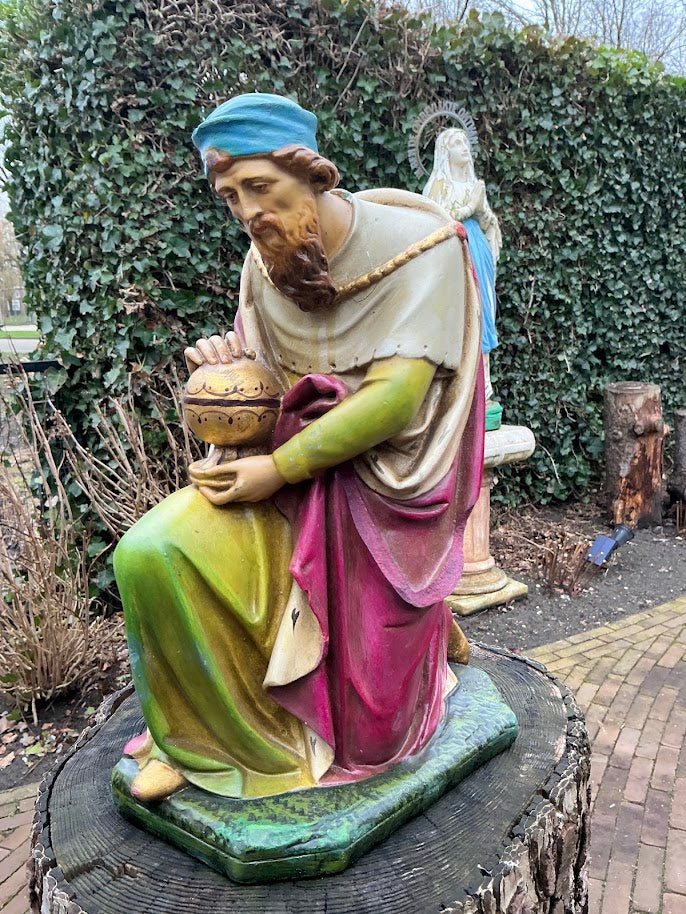
For example, see this heavy plaster figurine of a Wise Man from the 1930s by Gerard Linssen Venlo: 34 cm tall, 13 cm wide, and 23 cm deep.
A cardboard box for a heavy product: wall thickness and load capacity
Wall thickness determines how much weight a box can carry, but only in combination with the base. A box with three layers of corrugated cardboard and a weak base fails more quickly than a double-wall box with a reinforced base.
Single-wall, double-wall, and triple-wall side by side
Corrugated cardboard is classified by the number of layers. This classification says more about load capacity than the box's exterior dimensions.
| Type | Structure | Suitable for | Not suitable for |
|---|---|---|---|
| Single-wall | Two flat layers with one flute in between | Light, small figurines | Heavy saint statues |
| Double-wall | Three flat layers with two flutes | Figurines up to a few kilos | Point load on one corner |
| Triple-wall | Four flat layers with three flutes | Heavy plaster statues | Small, lightweight objects |
Single-wall is too weak for a plaster statue of any size. The cardboard flexes and the corners give way.
Double-wall is the practical middle ground.
Triple-wall is the heaviest option.
Our advice: never choose based on the outside of the box, but on what goes inside it.
The statue's weight and the bottom closure
The bottom closure is the weakest link when packing heavy statues. A standard four-flap folding bottom cannot withstand a lot of weight.
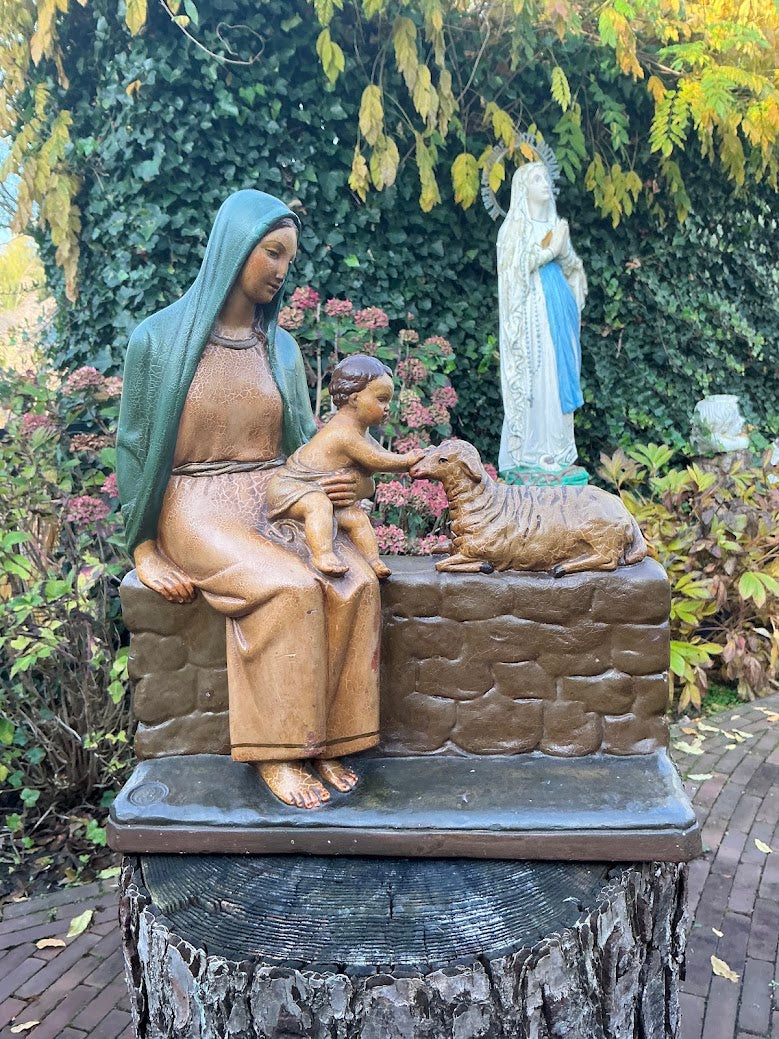
Take a look at a rare Belgian Virgin Mary statue with baby Jesus and a lamb, a heavy plaster statue dating from around 1900. Pieces like these require a box with fully overlapping bottom flaps secured with tape in both directions.
Three rules of thumb we follow:
- Always weigh the statue yourself, including the base.
- Choose a box with a load capacity well above that weight.
- Reinforce the bottom with an extra cardboard sheet or double tape.
A box that only just meets the weight requirement is too lightly chosen.
Double-wall cardboard box: when it is sufficient and when it is not
A double-wall cardboard box is sufficient for most religious statues weighing up to a few kilos, provided the inside dimensions are right and the bottom is reinforced. This strength is not enough for heavier or fragile pieces. The difference lies not in the outside of the box, but in the combination of flute direction, bottom construction, and how the weight sits in the box.
What double-wall cardboard can actually carry
Double-wall (BC flute, two flutes between three flat layers) is the standard for shipping boxes containing a few kilos of fragile products. The precise limits depend on the cardboard quality, the bottom, and handling. A common rule of thumb is that a double-wall box with fully overlapping bottom flaps and an extra cardboard sheet in the bottom can safely carry a statue weighing a few kilos, provided the weight stays low in the box and the statue cannot slide around.
Three factors shift that threshold:
- Flute direction. When the flutes run vertically along the walls, the box withstands more top-down pressure. When they run horizontally, the walls bend more easily. For a heavy statue, you want the flutes to run vertically along the side walls.
- Bottom closure. A four-flap folding bottom with fully overlapping flaps taped in both directions distributes the weight across the entire bottom. A bottom where the flaps just meet bears the weight along a single line.
- Internal dimensions. A box that's too large lets the figure slide around; every shift means a knock against the wall. A box that's too small puts pressure on protruding parts. The internal dimensions must fit the figure and packing material snugly.
When double-wall cardboard does work
- Small religious figurines with a compact pedestal that keeps the center of gravity low.
- Figures without protruding, fragile parts that could break at the slightest contact.
- Shipments that aren't stacked and are handled only a limited number of times by a parcel carrier.
When double-wall cardboard doesn't work
- Large plaster figures with a lot of weight or a narrow pedestal supporting all the weight.
- Items with loose or protruding parts, such as an outstretched arm, crown, or cross, that create pressure at a single point.
- Shipments transported on pallets and stacked, where the weight above presses down on the box.
A double-wall cardboard box is therefore not a default choice, but a deliberate choice for each item. We assess each figure individually before choosing a box: first the weight and center of gravity, then the fragile parts, and only after that the cardboard strength and base construction.
Box size and internal dimensions for a figure with protruding parts
The internal dimensions are what count, not the external dimensions.
A custom-sized box works better here than a standard size. Here's how to measure:
- Measure the height from the base of the pedestal to the highest point.
- Measure the width at the widest point, not the average.
- Measure the depth, including any protruding parts.
- For each dimension, add twice the thickness of your packing material.
The difference between internal dimensions and external dimensions is exactly where things go wrong. A box that fits on the outside may be too small on the inside once the figure is wrapped.
Don't be tempted to use a box that's too large. Too much empty space means the figure can slide around, which is disastrous for plaster.
Packing a religious statue safely: distributing its weight and immobilizing it
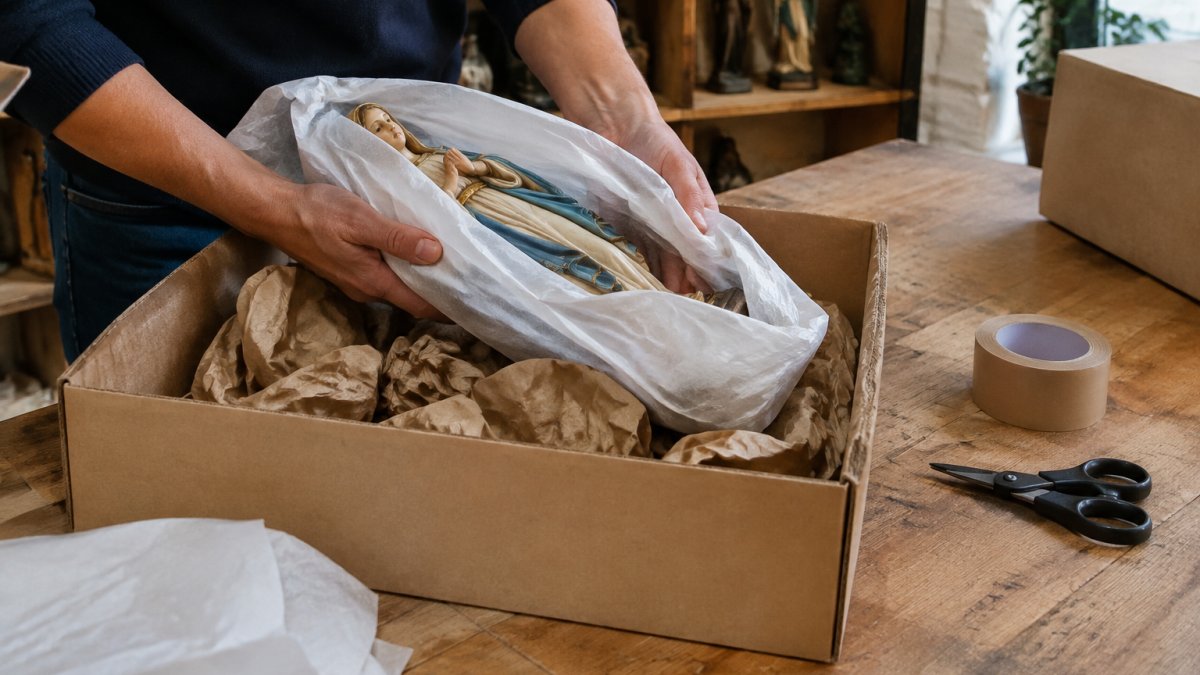
Packing a religious statue safely means distributing its weight and immobilizing it completely so it cannot slide or tip over. Protection starts with keeping it still, not with bubble wrap.
Distributing the weight: keeping the center of gravity low
A plaster figure is heavy and brittle. Most of its weight is in the pedestal and torso. So always place the figure upright, with the pedestal on the bottom of the box, to keep its center of gravity low.
Distribute the weight across the base by placing the pedestal on a sturdy piece of cardboard or foam cut to fit its shape.
Building an insert that immobilizes the figure
Immobilizing means that the figure cannot move in any direction. You achieve this not by stuffing the box full, but with an insert that follows the shape of the figure.
- Bottom layer. A cardboard or foam sheet on the bottom, with the base resting on it.
- Secure the base. Fill the space around the base with cardboard inserts or crumpled paper so the base cannot slide.
- Protect protruding parts separately. Wrap arms, hands, fingers, a crown, or a cross separately in acid-free tissue paper and foam, and secure them to the torso with a soft strap or tape. This prevents protruding parts from breaking off if the statue moves.
Note: a statue with padding only underneath can still slide upward when you lift the box and hit the lid.
Testing whether the statue is really secure
Before closing the box, test whether the statue is immobilized:
- Lift the box by one corner and listen for anything shifting.
- Gently shake the box from side to side; nothing should rattle.
- Carefully tilt the box forward and backward; the statue must not move toward the lid or the side.
- Gently lower the box a few centimeters onto a hard floor; the bottom must not sag.
If everything stays still and secure, the statue is immobilized. If anything moves, repack it. A statue that rattles when you shake the box is not packed properly.
We’ve written a separate guide to packing religious statues with delicate details: how to pack and ship religious statues safely.
Reusing a cardboard box for shipping without compromising safety
Reusing a cardboard box for shipping can be safe, as long as you check its structure first.
Always check a used box for these things:
- No tears or dents in the corners
- Bottom flaps still fully intact
- No damp spots or weakened cardboard
- Old labels and tape completely removed
A box that arrived safely once is not automatically suitable for a second shipment. Cardboard loses strength when folded and exposed to moisture.
Would you like to use sustainable packaging without compromising on protection? We have a practical step-by-step guide for you: sustainable packaging for fragile objects in 7 steps.
Getting ready to ship: choosing a parcel service or pallet shipping and testing the packaging
The shipping method determines how much stress the packaging will be subjected to. A parcel service sorts packages mechanically and stacks crates; pallet shipping distributes the weight over a larger surface.
Choose a parcel service for lighter statues that are securely immobilized.
Always test the packaging before shipping:
- Lift the box by one corner and listen for anything shifting.
- Gently shake the box from side to side.
- Gently lower the box a few centimeters onto a hard floor.
If everything stays still, the packaging is ready. If anything moves, repack it.
Finally, take photos of the wrapped statue and the sealed box. That way, if damage occurs, you have proof that it was carefully packaged.
Ensuring your statue arrives safely: how Chez Monique's 2e Leven does it
Our approach is based on carefully checking packaging for safe transport and sustainable shipping through the reuse of packaging materials.
Want to see what that looks like in practice? Browse our selection of vintage religious statues for your home and discover which pieces we have ready to ship now.
A heavy plaster religious statue deserves more than a standard box. We choose the right box construction for each statue, reinforce the bottom, and fully immobilize the piece for shipping.
Frequently Asked Questions
What box quality is suitable for a heavy religious statue?
For a heavy plaster or stone statue, choose a sturdy box with sufficient load capacity for its weight. Also check the bottom closure: a box with a double bottom or cross-bottom can hold more weight than a simple folding box. If in doubt, choose one wall thickness sturdier than you think you need.
How do you prevent a heavy statue from shifting inside the box?
Fill all the empty space around the statue with packing material so it cannot move. First wrap the statue in soft protective material, place it in the center of the box, and firmly fill the corners and sides with crumpled paper or cardboard inserts. Check by gently shaking the box: if you can't hear anything moving, the statue is secured properly. This prevents its weight from hitting the sides at every stage of transit.
How do you protect protruding parts like hands or a crown during shipping?
Wrap protruding parts separately in soft tissue paper or bubble wrap before placing the statue in the box. Use strips of cardboard to make a small tube or cover around delicate parts so they are not under direct pressure. Make sure there is at least two centimeters of packing material between the protruding part and the box wall. If a statue has a crown or fine details at the top, do not place it upside down; keep it upright or on its side with extra support.
How can you reuse a cardboard box without compromising shipping safety?
Use only a box that is still sturdy: no tears, crushed corners, or damp spots. Remove old labels and tape, check that the bottom is still intact, and reinforce it with extra tape. For a heavy statue, avoid reusing a box that has already been crushed, as its load-bearing capacity will have decreased. Reused packing material is perfectly fine as long as it is clean and dry. This way, you can be sustainable without compromising on safety.
