

Safely shipping religious statues: how to pack them
Table of contents
- Why shipping religious statues requires extra care
- Supplies needed for safely packing fragile statues
- Step-by-step guide: protecting religious statues from moisture and impacts
- The double-box method for extra-fragile objects
- Insured shipping of art objects: what is it worth?
- Common mistakes when shipping religious statues
- Conclusion: with the right preparation, your statue will arrive safely
- Frequently Asked Questions
Last updated: September 6, 2026
Why shipping religious statues requires extra care
Shipping religious statues is not a standard shipping task. A wooden saint statue from the 1980s, a plaster statue of Mary with authentic patina, or a fragile Christ Child on a globe: these objects are often decades old and made of materials that do not tolerate shocks and temperature fluctuations well. Plaster cracks under a hard impact, wood can split, and paint flakes can come loose due to vibrations.

Most shipping damage is caused by insufficient cushioning or an unsuitable choice of outer packaging. This article is a practical guide to safely packing and shipping these vulnerable objects, whether you are sending a family heirloom to a relative or receiving a new addition to your interior. You will learn which materials you need, how to proceed step by step, and why the double-box method is the safest option for extra-fragile pieces.
Supplies needed for safely packing fragile statues
Before you start packing, it is wise to lay out all the materials. Good preparation prevents you from having to improvise halfway through with material that does not provide sufficient protection. Religious statues, however, have specific vulnerabilities that you should consider when choosing materials.
Choosing the right box
The outer packaging is your first line of defense. Choose a sturdy box that is large enough to leave at least 5 centimeters of space around the object for packing material. A box that is too small provides insufficient shock absorption, while one that is too large allows the statue to shift. For heavy plaster statues weighing more than 2 kilograms, a double-wall corrugated box is recommended.
When choosing the box, also consider the statue's height. Many religious statues, such as a processional Madonna or a saint statue on a pedestal, are taller than they are wide. Choose a box that allows the statue to stand upright without the upper part, often the head or a halo, touching the box. For example, a box measuring 60 by 40 by 40 centimeters is suitable for a 50-centimeter-tall statue, provided you place sufficient padding around it.
Special protection for protruding parts
Religious statues often have protruding parts that are not found on any other type of object: outstretched blessing hands, a cross extending above the head, a globe beneath the foot of a statue of Mary, or a fragile halo made of metal wire. These parts break off first because they are thin and far from the statue's center of gravity.
For these parts, use not only bubble wrap but also an extra protective layer of cardboard or foam rubber shaped around the protrusion. A common technique is to make a “collar” from rolled cardboard around an outstretched arm or a cross. This distributes pressure over a larger surface and prevents a pointed protrusion from piercing through the bubble wrap.
Cushioning materials and protective film
Bubble wrap is the most commonly used material for protecting delicate surfaces. For religious statues with painted or gilded details, it is important to first wrap a layer of acid-free paper around the statue. Acid-free paper prevents chemical reactions that can damage paint. You will also need cushioning materials such as air pillows, packing peanuts, or crumpled paper to fill the space between the statue and the box.
For plaster statues, choose cushioning material that cannot become damp. Polystyrene packing peanuts do not absorb moisture but provide less cushioning for heavy statues. An alternative is biodegradable corn-starch packing material, which is sturdier and conforms better to the contours of the statue. Avoid newspaper: the ink can transfer onto the surface, especially on light-colored plaster or wooden statues.
Materials for climate protection
One aspect often overlooked with religious statues is their sensitivity to moisture and temperature. Plaster is hygroscopic: it absorbs moisture from the air and can therefore expand and crack (peer-reviewed research). Wood responds to temperature fluctuations by shrinking or swelling, which can lead to cracks in the paint layer.
When packing a statue that will be in transit for an extended period or transported in an unconditioned truck, consider placing a moisture-absorbing sachet (silica gel) in the box. However, do not place the sachet directly against the statue; put it between the cushioning materials instead. Alternatively, first wrap the statue in a layer of polyethylene film before packing it in acid-free paper and bubble wrap. This creates a moisture barrier without the film touching the surface.
Step-by-step guide: protecting religious statues from moisture and impacts
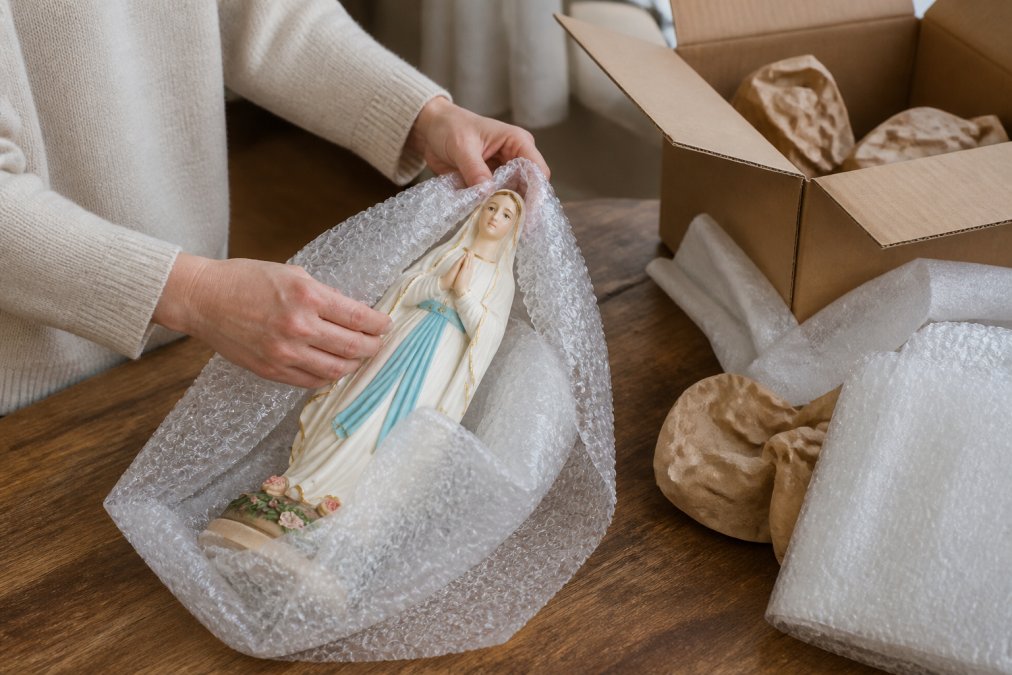
Protecting religious statues from moisture and impacts starts with a careful, layer-by-layer approach. Follow these steps for safe shipping:
- Inspect the statue for loose parts, hairline cracks, or flaking paint. If necessary, take a photo for reference.
- First wrap the statue in a layer of acid-free paper to protect the surface from direct contact with plastic.
- Then wrap the statue completely in bubble wrap, with the bubbles facing inward. Make sure the seams overlap.
- Secure fragile parts such as outstretched arms or a globe with extra bubble wrap and packing tape.
- Place the statue upright in the box, never on its side. Heavy statues belong at the bottom.
- Fill all the space around the statue with packing material. Gently shake the box: if you hear anything moving, add more padding.
- Close the box with sturdy packing tape, both across the center seam and over all corners.
- Place a fragile sticker on at least two sides and write “fragile” on the top.
The double-box method for extra-fragile objects
For antique plaster statues or objects with a fragile finish, the double-box method is the safest choice. This technique is widely used by professional art transporters and provides double protection against shocks.
With this method, you place the carefully packed statue in inner packaging: a sturdy box filled with packing material all around. You then place this inner box inside a larger outer package, again with at least 5 centimeters of packing material on all sides. The air layer between the two boxes absorbs shocks and vibrations during transport.
For very heavy or large statues, such as a large plaster statue of Mary more than 60 centimeters high, a wooden crate or a box reinforced with cardboard sheets may be worth considering.

Insured shipping of art objects: what is it worth?
Shipping religious statues always entails a shipping risk, no matter how carefully you pack. Transport insurance is therefore certainly worthwhile, especially for higher-value objects. The question is not whether you should take out insurance, but what your statue is actually worth.
Value is more than the purchase price
With religious statues, emotional or religious value plays a role alongside financial value. A statue that has been in the family for generations or has stood in a specific place may be irreplaceable to you. However, this value cannot be insured. Insurers only compensate the rebuilding or market value, not the sentimental significance (europa.eu).
The market value of an antique religious statue is determined by factors such as age, provenance, material, and condition. A signed French Madonna statue from the 1920s with authentic patina has a different value from a more recent wooden devotional statue. Have an appraiser or specialized antique dealer determine the value in writing before taking out insurance. An appraisal report is also necessary if you later file a claim.
Limitations of standard courier insurance
Most courier services offer basic coverage up to a certain amount, often around 500 euros, but this coverage has important exclusions (europa.eu). For example, many carriers do not cover damage to objects that have been inadequately packaged, and they assess this afterward based on photos of the damaged packaging. In addition, objects with a fragile finish, such as gold leaf or patina, are often excluded from standard coverage.
For statues worth more than 500 euros, separate art transport insurance or an extension of your home contents insurance is necessary. Several insurers offer continuous coverage for works of art during transport, including objects shipped privately. Compare the terms carefully: pay attention to the maximum coverage per shipment, the deductibles, and the packaging requirements.
Packaging requirements as a condition
A common mistake is taking out insurance without reading the packaging requirements. Insurers often set specific packaging requirements before they will compensate for damage. A common condition is the use of a double box for objects above a certain value, or the mandatory use of bubble wrap with a minimum thickness of 3 millimeters.
Document your packaging before shipping: take photos of the wrapped statue, the materials used, and the sealed box. These photos may later prove that you complied with the packaging requirements. Also keep the shipping receipt and tracking number, because without these documents, a claim will almost always be rejected.
Specific coverage for religious objects
Some specialized insurers for church or religious art offer coverage that takes the unique characteristics of these objects into account. Ask your insurer whether they have experience appraising and insuring religious art, and whether they can recommend a restorer in the event of damage.
For individuals who want to ship a family heirloom, an alternative is to use a specialized art transport company that is insured itself. These companies often offer all-risk coverage for the duration of transport, including packing and unpacking.
Common mistakes when shipping religious statues
Even with the best intentions, something regularly goes wrong when shipping religious statues. The most common mistake is using too little packing material, causing the statue to shift during transport and bump against the walls of the box.
A second common mistake is placing the statue on its side instead of upright. Plaster statues are strongest in a vertical position; when placed on their side, all the pressure falls on the most vulnerable parts. In addition, the importance of climate control during transport is often underestimated. Extreme temperatures and humidity can cause cracks in plaster and wood, especially during long-distance transport or storage in an unconditioned truck.
A third mistake is using unsuitable packaging material. Newspaper can transfer ink onto the statue, while polystyrene foam does not provide sufficient shock absorption for heavy objects. Forgetting a fragile sticker and failing to complete the correct customs forms for international shipping also regularly lead to problems.
| Mistake | Consequence | Solution |
|---|---|---|
| Too little packing material | The statue slides and hits the box wall | Fill the space completely; shake the box as a test |
| Place the statue on its side | Breakage of fragile protrusions | Always ship upright |
| Newspaper as protection | Ink stains on the surface | Use acid-free paper or bubble wrap |
| No fragile sticker | The statue is not treated as fragile | Apply stickers to at least two sides |
| No shipping insurance | Financial loss in the event of damage | Determining the value and taking out insurance |
Conclusion: with the right preparation, your statue will arrive safely
The essentials of safely shipping religious statues are simple: invest in good materials, take the time to package everything carefully, and use the double-box method for fragile objects. Protecting religious statues from moisture and impact requires attention to detail, but it is easy to do with the right step-by-step plan.
At Chez Monique's 2nd Life, careful shipping is central to our approach. We reuse packaging materials wherever possible without compromising the safety of your purchase. Every statue, such as a hand-carved wooden statue of Saint Clare of Assisi or an antique French statue of the Virgin Mary and Child, is inspected before shipping and carefully packaged according to the methods in this guide. This way, you help protect the environment and receive your unique object in perfect condition.
Frequently Asked Questions
Which packaging materials are best for fragile statues?
For safely shipping fragile statues, bubble wrap, acid-free paper, and sturdy cardboard sheets are essential. First wrap the statue in acid-free paper to protect the paint, then in bubble wrap with the bubbles facing inward. Use sufficient cushioning material, such as foam rubber or crumpled paper, to prevent movement inside the box. A wooden crate or double box is recommended for heavy or fragile plaster or ceramic statues.
How do I protect religious statues from moisture during shipping?
To protect religious statues from moisture, first wrap the object in acid-free paper or tissue paper. This absorbs any condensation. Then add a layer of bubble wrap and, optionally, a plastic bag as an additional moisture barrier. Place silica gel packets in the box to absorb excess moisture. Make sure the outer packaging is securely closed and avoid shipping during extreme weather conditions. This is especially important for plaster statues, which are sensitive to moisture and mold.
Is insured shipping of art objects necessary?
For valuable religious statues, insured shipping is strongly recommended. Carriers’ standard liability often does not sufficiently cover the actual value of antique objects. Transport insurance covers damage or loss during transit. Insurance provides extra peace of mind in unforeseen circumstances. Ask your parcel service in advance about the options and costs of shipping insurance.
How do I know whether my plaster statue will withstand shipping without damage?
Careful packaging is the best guarantee that your plaster statue will withstand shipping. Use the double-box method: place the wrapped statue in an inner box with sufficient cushioning material, then place it inside a larger outer box. Fill the space between the two boxes with at least 5 cm of cushioning material. Mark the box “fragile” and “breakable.” Also choose a shipping method with tracking, so you can follow its route and report any damage quickly.
Whether you are an experienced collector or a lover of vintage decor with character, shipping religious statues safely is an art in itself. With the right materials and a careful approach, your statue will arrive undamaged. Discover the carefully curated collection from Chez Monique's 2e Leven and give these special objects a second life in your interior.