

How to read the meaning of iconography in religious art
Last updated: October 31, 2026
Quick Summary
To understand the meaning of iconography in religious art, first identify what is depicted, then ask why that particular element was chosen. Iconography is the study of visual language in art: the system of symbols, attributes, and scenes artists use to depict faith, stories, and people.
- A religious artwork can be read in five steps: subject, attributes, scene, style and period, and interpretation.
- Iconography describes what is depicted; iconology examines why it is there.
- You can recognize saints by their established attributes, such as the wheel associated with Catherine of Alexandria.
- In Orthodox icons, the gold background behind the figure represents divine light.
- The form of an image follows its function in liturgy or devotion, not the other way around.
Table of contents
- What is iconography, and how do you read a religious artwork?
- The difference between iconography and iconology
- The meaning of Christian symbols in the visual tradition
- Identifying saints by their attributes
- The meaning of Orthodox icons and their place in the tradition
- Catholic, Orthodox, and Protestant visual traditions compared
- Choosing a religious statue for your interior at Chez Monique's 2e Leven
- Frequently Asked Questions
What is iconography, and how do you read a religious artwork?
Understanding the meaning of iconography in religious art is the key to every religious image you encounter. Iconography is the study of visual language in art: the system of symbols, attributes, and scenes artists use to depict faith, stories, and people.
A religious artwork can be read in layers. First, identify what is depicted. Then ask why that particular element was chosen. That second question leads to its meaning.
From visual language to meaning: a practical method for reading
A reliable method takes five steps. Start with the whole and only then zoom in on the details.
- Identify the subject. Who or what is at the center: Christ, Mary, a saint, a biblical scene?
- List the attributes. Note every object, animal, or gesture associated with the central figure.
- Read the scene. Which moment from the Gospel or tradition is depicted?
- Look at the style and period. Gothic, Baroque, and Art Deco each have their own visual language.
- Interpret, don't guess. Connect each detail to a known tradition before drawing conclusions.
This sequence prevents the most common mistake: immediately assigning an emotion or intention without first reading the visual language.
The difference between iconography and iconology
Iconography describes what is depicted; iconology examines why it is there. The two terms are often confused, but they call for different kinds of attention.
Iconography is the reference guide: which symbol belongs to which saint, which scene to which feast. Iconology goes a layer deeper and asks about culture, the spirit of the age, and theological intent. Why did a particular saint receive a particular attribute in the seventeenth century? What does that say about the devotion of that period?
In practice, you need both. Without iconography, you miss the facts; without iconology, it remains just a list of symbols without any connection between them.
The meaning of Christian symbols in the visual tradition
Christian symbols form a compact visual language passed down through generations. A circle refers to eternity and divine perfection. The cross embodies the Passion and redemption. The dove represents the Holy Spirit, and the lamb represents Christ as a sacrifice. But to interpret a religious work of art, you need more than a handful of examples: an overview of the most common attributes and their meanings makes the difference between looking and recognizing.
Common attributes and symbols in a reference overview
The table below brings together the symbols most often found in Dutch churches, museums, and devotional objects. The meanings are common within the Christian tradition; regional and historical differences exist, but these core associations remain.
| Symbol or attribute | Meaning | Often seen with |
|---|---|---|
| Cross | Passion, redemption, victory over death | Christ, altar, tomb monuments |
| Lamb (Agnus Dei) | Christ as the sacrificial lamb | John the Baptist, liturgical art |
| Dove | Holy Spirit, peace, soul | Baptism scenes, Annunciation, funerary art |
| Lily | Purity, virginity | Mary, Joseph, holy virgins |
| Rose | Love, martyrdom, heavenly beauty | Mary, saints with rosaries |
| Palm branch | Martyrdom, victory | Martyrs, processions |
| Keys | Authority over the Church, gate of heaven | Peter, papal symbolism |
| Sword | Martyrdom, the Word | Paul, martyrs |
| Wheel | Martyrdom by breaking on the wheel | Catherine of Alexandria |
| Pig and staff | Protection against skin diseases, hermit life | Anthony the Abbot |
| Infant Jesus | Devotion, protection, purity | Anthony of Padua |
| Triple crown | Papal authority, threefold power | Pope, papal saints |
| Chalice | Eucharist, sacrifice | Mass, saints with chalices |
| Anchor | Hope, steadfastness | Saint Nicholas, sailors |
| Flames or fire | Holy Spirit, purgatory, martyrdom | Pentecost, saints |
This table is not an endpoint but a starting point. Some motifs are so old that they existed before Christianity and later took on a new meaning. The Rijksmuseum’s explanation of Christian symbolism shows how artists deliberately layered these meanings.
How symbols tell a story together
For the viewer, this means that no symbol stands alone. The five wounds, the crown of thorns, and the cross together refer to the same mystery of suffering and resurrection. Those who see this connection can read an image more quickly and accurately. A concrete example: on a crucifix with a chalice at its base, the chalice does not refer to the Mass in general, but to the Eucharist as a sacrifice that repeats Christ’s sacrifice on the cross. Without this connection, the chalice remains an isolated object.
Limits of symbolic interpretation
Symbols are not puzzle pieces with one fixed solution. The meaning of an attribute can shift with time, place, and patron. A lily with Mary points to purity, but in a seventeenth-century Protestant setting, a flower may be primarily decorative. Context determines how much weight a symbol carries. Recognizing this helps you avoid the simplistic interpretation that every detail must carry a theological message.
Identifying saints by their attributes
You can identify saints by their attributes: a distinctive object associated with a particular person. Anthony of Padua carries the baby Jesus, Catherine of Alexandria the wheel, and Saint Anthony the Abbot a pig and a staff. Once you spot the attribute, you know who is depicted.
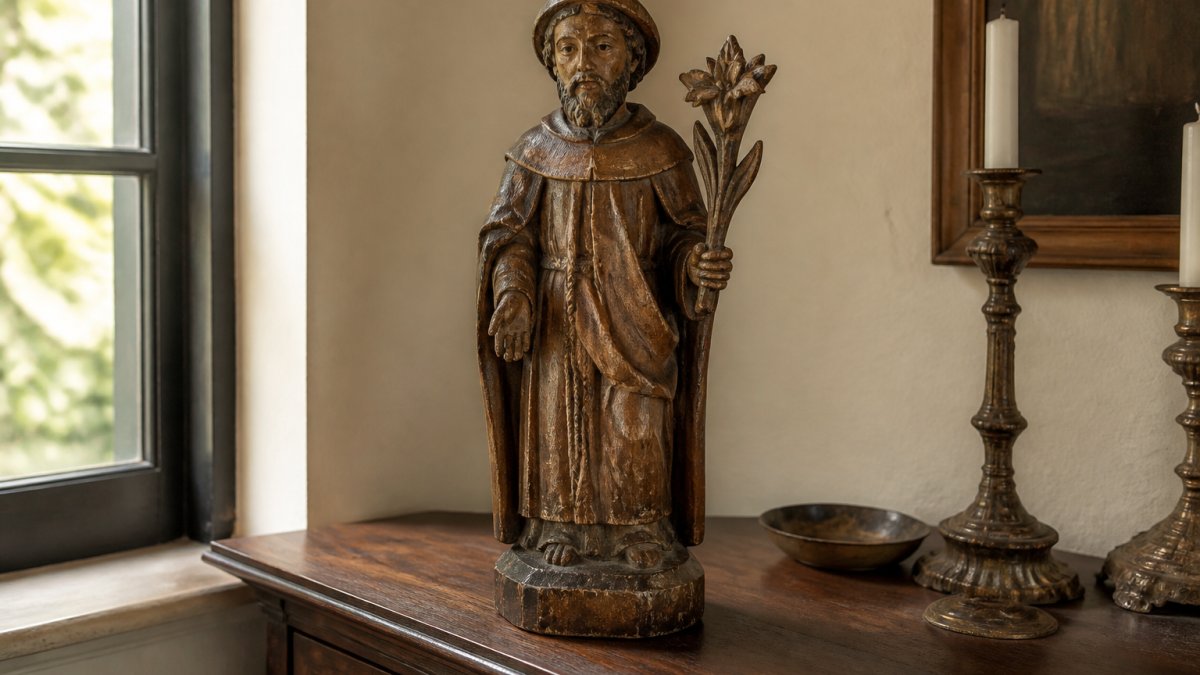
A concrete example makes this immediately applicable: in an image of Saint Anthony the Abbot, the pig is the decisive identifying attribute. For more examples of saints and their traditional attributes, see which Catholic saint statues there are. If you have a statue without an identifying mark, this guide to identifying saint statues without an identifying mark can help.
A common mistake is to confuse an attribute with decoration. The animal, book, or lily is never chosen by chance; it sums up the identity of the person depicted in a single image.
Antique O.L.V. of Perpetual Help icon on silk →
The meaning of Orthodox icons and their place in the tradition
Orthodox icons are not illustrations but windows onto the sacred. The icon painter follows strict rules for composition, color, and proportions, because the icon carries the message itself rather than merely depicting it.
A gold field behind the figure is characteristic: it represents divine light. Mary's posture, the position of Christ's hands, and the Greek letters beside the figures are established visual motifs, each with its own meaning. An icon is therefore read differently from a Western painting: not as a snapshot, but as a timeless reference to the mystery.
In the Orthodox Church, the icon plays a central role in devotion and veneration. It is an image to pray before, not an object to look at.
Catholic, Orthodox, and Protestant visual traditions compared
The three traditions treat religious images very differently. While the Catholic and Orthodox churches give images a fixed place in devotion and liturgy, the Protestant tradition often opted for austerity and the spoken word. These differences are not only theological but also developed historically, and they still shape how you interpret an image in a church, museum, or living room.
| Tradition | Role of the image | Characteristic form | Emphasis |
|---|---|---|---|
| Catholic | Supports devotion and veneration | Image, relief, painting | Saints and stories |
| Orthodox | Window onto the sacred | Icon with a gold background | Mystery and liturgy |
| Protestant | Restrained, often absent | Few images in the church | Word and preaching |
Why the traditions diverged
The differences have a concrete historical basis. In the Catholic Church, the importance of religious art has a long history that goes much further back: medieval churches were filled with images that made the faith accessible to the illiterate. From the iconoclastic controversy (eighth and ninth centuries) onward, the Orthodox tradition developed a strict visual program in which the icon is not merely an illustration but a participation in the sacred. The sixteenth-century Protestant Reformation led to iconoclasm in many regions and a deliberate choice of the spoken word over images.
That history explains why Catholic and Orthodox regions have much richer visual traditions, while Protestant churches often remain austere. It is not a matter of taste, but of what a tradition allows images to do.
Differences in interpretation in practice
The same scene can be interpreted differently in each tradition.
For the viewer, this means that a statue's meaning partly depends on the tradition in which it was made. An attribute with devotional significance in Catholic art may be absent or interpreted differently in a Protestant context. Knowing this helps you read a statue not as a timeless symbol, but as an expression of a specific faith community.
Curious about which religious statues are collected most and why? Read our overview of the top 10 most collected religious statues.
Choosing a religious statue for your interior at Chez Monique's 2e Leven
A religious statue isn't just for believers or collectors. Many people choose a vintage piece purely for its character, history, and imagery. Understanding the iconography helps you make a more informed choice: you know what a statue conveys before it becomes part of your interior.
At Chez Monique's 2e Leven, you'll find antique and vintage devotional objects with a story. An antique icon of Our Lady of Perpetual Help in silk depicts Mary with the infant Jesus, flanked by the archangels Michael and Gabriel. An antique crucifix with shells, mother-of-pearl, and a copper corpus is a well-preserved piece of folk art.


We strive to reuse packaging materials as much as possible without compromising the safety of your purchase. This gives a special object a second life, with respect for people and the environment. Read our tips on styling religious statues in a modern interior.
Frequently Asked Questions
What does iconography mean in religious art?
Iconography is the visual language through which religious art depicts figures, stories, and articles of faith. You can recognize a saint by an attribute, a martyr by a palm branch, or a biblical scene by familiar visual motifs. By reading these signs, you can see what the artist wanted to convey: not just a beautiful image, but a reference to faith, devotion, and tradition. In this way, a painting or icon becomes a text that you can interpret step by step.
What is the difference between iconography and iconology?
Iconography describes what is depicted: the figures, symbols, and attributes that appear in an image. Iconology goes a layer deeper and explores why those motifs were chosen, what cultural or theological meaning lies behind them, and how the work functioned in its time. In short: iconography identifies, iconology interprets. For beginners, it is helpful to first get to grips with iconography before moving on to broader interpretation.
How can you recognize saints by their attributes?
Each saint has distinctive attributes that serve as identifying marks. Peter carries the keys, Catherine the wheel, Sebastian the arrows, and Barbara the tower. These attributes often refer to their lives, martyrdom, or role as protectors. When in doubt, look at combinations: a book, a lily, and a crown, for example, point to a royal virgin. An attribute alone may not tell you much, but together with clothing, posture, and context, it usually makes the figure clear.
What role do icons play in the Orthodox Church?
In the Orthodox Church, an icon is not decoration but a window onto the divine. Icons are venerated, not worshipped, and support prayer and contemplation. The icon painter follows established rules for color, composition, and symbolism, so the image reminds the faithful of Christ, Mary, or a saint. This visual tradition remained virtually unchanged for centuries, while Catholic art, by contrast, gained more room for contemporary forms after the Second Vatican Council.
The visual language of religious art only becomes truly accessible when you learn how to read it. At Chez Monique's 2e Leven, we combine that knowledge with a carefully curated collection of antique devotional objects, sustainable shipping using reused packaging materials, and a thorough inspection of every package. This helps you choose a piece that suits your interior and its history. Browse our collection and add your favorite image to your shopping cart.
