

Which Catholic saint statues are there? 2026 guide
Table of contents
- What kinds of Catholic statues of saints are there? An overview by saint and depiction
- Famous Catholic saints and symbols in art
- Recognizing saint statues by their attributes: lamp, tower, lily, and book
- The meaning of Catholic saint statues: devotion, prayer, and protection
- Identifying antique religious statues: age, material, and provenance
- Indoor and outdoor use: where to place a saint figure
- Conclusion: Which saint figure is right for your collection or interior?
- Frequently Asked Questions
Last updated: October 14, 2026
What kinds of Catholic statues of saints are there? An overview by saint and depiction
Catholic statues of saints come in many forms, and that very variety makes it hard to see the forest for the trees. Those looking for an overview of Catholic statues of saints often find only individual product photos, with no explanation of who is actually depicted.
The Catholic Encyclopedia entry on the veneration of saints describes how images have served for centuries as aids to prayer and devotion, not as ends in themselves. This distinction is important: an image is a tool, not an idol.
Images of Christ, Mary, and the saints: the differences
The difference lies in who is depicted and for what purpose. An image of Christ depicts Jesus himself, often on the cross or with the Sacred Heart. An image of Mary depicts the Virgin Mary, alone or with the Child. An image of a saint depicts a specific saint with their own attributes.
- Images of Christ: crucifixion, resurrection, Sacred Heart
- Statues of Mary: Madonna and Child, Miraculous Virgin Mary
- Statues of saints: always recognizable by a personal attribute
- Icons: two-dimensional, painted according to established church rules
This distinction helps you identify any religious image you come across.
Famous Catholic saints and symbols in art
Famous Catholic saints and symbols are easiest to recognize by their customary attributes. These attributes are not mere decoration: at a glance, they tell the saint's story, refer to an event or quality, and make it possible to identify an image without a nameplate. Below is a clear overview organized by saint and depiction, with the features most commonly found in practice.
Archangels and patron saints
Saint Michael is almost always depicted as an archangel, often fighting a dragon or serpent. He carries a sword and sometimes holds a set of scales, the symbol of the weighing of souls. Sometimes he stands on a pedestal bearing the text Quis ut Deus ("Who is like God?"), a reference to his name. Saint Gabriel can be recognized by a lily or a trumpet and is associated with the Annunciation to Mary. Saint Raphael carries a pilgrim's staff and often has a fish or a dog with him, referring to the story of Tobias.
Apostles and evangelists
Each of the twelve apostles has their own attributes. Saint Peter carries the keys to heaven and is sometimes depicted with a rooster, referring to his denial of Jesus. Saint Paul has a sword, the instrument of his martyrdom. Saint Andrew is recognizable by an X-shaped cross. The four evangelists have established symbols: Matthew, an angel or a man; Mark, a lion; Luke, an ox; and John, an eagle.
Martyrs and their attributes
Many statues of saints depict martyrs, and their attributes refer to the way they died. Saint Barbara carries a tower and a miner’s lamp or chalice because, according to tradition, she was imprisoned in a tower. Saint Catherine of Alexandria has a wheel and a sword. Saint Lawrence carries a gridiron, the instrument of his martyrdom. Saint Sebastian is recognizable by his arrows. Saint Agnes has a lamb, a reference to her name and purity.
Saints in everyday life
Some saints are best known as patrons of a profession, stage of life, or particular need. Saint Nicholas wears a bishop’s miter and carries three golden balls or loaves; he is the patron saint of sailors, children, and merchants. Saint Anthony of Padua carries a lily and the Christ Child, and is the patron saint of lost things. Saint Joseph has a lily and carpentry tools, or carries the Christ Child in his arms. Saint-Therese of Lisieux wears a Carmelite habit and carries a crucifix and roses. Saint Benedict wears his order’s habit and carries a book containing its rule, and sometimes a raven or a chalice with a snake.

Attributes as a key to identification
The more attributes you recognize, the more confident your identification will be. An image with a tower and a miner’s lamp is almost certainly Saint Barbara. An image with a lily and a book could be Saint Anthony or Saint Joseph; in that case, look for the Christ Child or carpentry tools. An image with a sword and scales is Saint Michael. An image with a bishop’s miter and three balls is Saint Nicholas.
Recognizing saint statues by their attributes: lamp, tower, lily, and book
Recognizing saint statues by their attributes is central to identifying them. Each attribute refers to an event or characteristic from the saint’s life. A lamp is associated with Saint Barbara, as is a tower.
- Miner’s lamp and tower: Saint Barbara of Nicomedia
- Lily: Saint Anthony, Saint Joseph
- Book: Saint Benedict, the Evangelists
- Sword and scales: Saint Michael
- Bishop’s staff and mitre: Saint Nicholas
The more attributes you recognize, the more confident your identification will be.

The meaning of Catholic saint statues: devotion, prayer, and protection
The meaning of Catholic saint statues lies in devotion, prayer, and protection. Believers place a statue of their patron saint on a prayer altar or in a niche as a reminder to pray. Some saints are regarded as protectors of a particular profession or stage of life.
Saint Barbara is the patron saint of miners, Saint Nicholas of sailors and children, and Saint Anthony of lost things. This protective role explains why such statues remained in homes for generations.
Beautiful copper/bronze statue of St. Anthony →
Identifying antique religious statues: age, material, and provenance
Identifying antique religious statues starts with the material and provenance. The finish, weight, and wear together reveal how old a piece is. The Cultural Heritage Agency of the Netherlands on preserving religious heritage emphasizes that knowledge of materials is essential for reliable dating. Below is a neutral comparison of the materials you are most likely to encounter, with attention to weight, characteristics, typical period, durability, and care.
Plaster, gypsum, composite, and bronze: how to tell what you have
Each material has its own characteristics. Resin is light and feels warm, but lacks the sharpness of carved wood. Plaster is heavy and dull, with fine mold seams. Composite imitates wood carving but is smoother. Bronze has a patina and feels cold. In addition, wood is found, especially in carved statues from the 18th and 19th centuries, as are earthenware or bisque in smaller devotional pieces.
| Material | Weight | Characteristic | Typical period | Durability | Care |
|---|---|---|---|---|---|
| Resin | Light | Warm to the touch, moderate detailing | 1950s-1970s | Moderate | Keep out of direct sunlight; dust with a soft brush |
| Plaster | Heavy | Mold seams, dull surface | 1930s-1950s | Fair | Dust with a dry cloth; do not wipe with a wet cloth |
| Composite | Medium | Hand-painted, imitates wood | 1940s-1960s | Fair | Remove dust carefully; no solvents |
| Bronze | Heavy | Patina, feels cold | 1920s-1930s | High | Do not polish away the patina; store in a dry place |
| Wood | Light to heavy | Visible grain, tool marks | 18th-19th century | High | Keep dry; do not store in a damp room |
| Earthenware/bisque | Medium | Smooth, sometimes glazed | 19th-20th century | Fair | Avoid knocks; dust with a soft cloth |
Reading age and origin from details
In addition to the material, there are other clues to age and origin. Look at the finish on the back: older statues are often more roughly finished or hollow, while later production is smoother and solid. Mold seams indicate mass production; hand-carved statues have no seams but do show tool marks. Paintwork may be original or a later repaint; craquelure and discoloration are typical of older pieces, while an even, glossy coat often indicates a later restoration. Stamps or seals under the base, such as those from workshops from the 1930s to the 1960s, provide an indication of the maker and period. Wear on the base, hands, and face points to prolonged use in a home or church.
Styles and periods
The design often reveals the period. Neo-Gothic (19th century) is characterized by slender vertical lines and rich detailing. Art Deco (1920s-1930s) features cleaner, geometric shapes. Postwar (1950s-1960s) styles are simpler and often made of resin or composite. Devotional pieces from the 19th century are often smaller and intended for home use, while church statues are larger and heavier.
Practical identification in steps
- Determine the material by feeling, weighing, and examining the finish.
- Look for stamps or seals under the base.
- Identify the saint's attributes (see the overview above).
- Assess the style and compare it with well-known periods.
- Look for signs of wear and examine the paint to determine whether the piece is original.
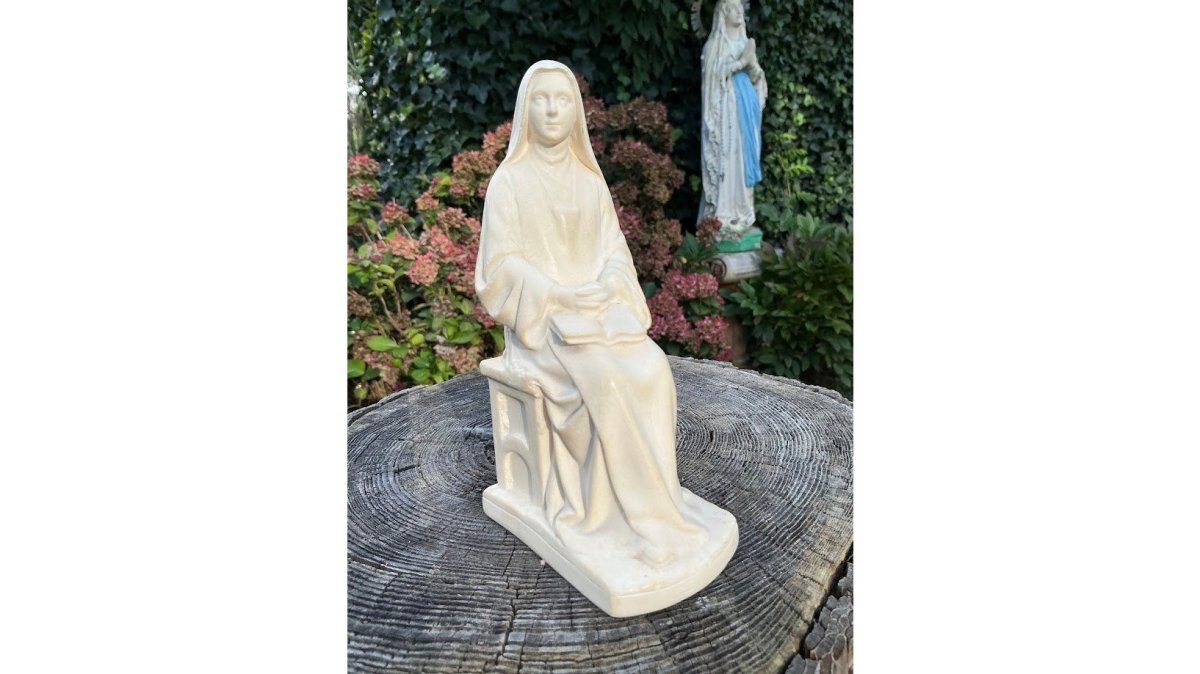
For example, take a look at our Beautiful copper/bronze St. Anthony figurine, a rare piece from the 1920s-1930s featuring the Christ Child and measuring 10 cm tall. For a larger piece, our Rare St. Barbara of Nicomedia Statue is a plaster figure, 40 cm tall, dating from the 1930s. It features a miner’s lamp and a tower, is in pristine condition, and is suitable for a sheltered spot indoors. For a smaller devotional piece, the 17 cm Seated St. Thérèse of Lisieux is ideal for a prayer altar.

Indoor and outdoor use: where to place a saint figure
Indoor and outdoor use place different demands on a figure. Indoors, you can choose almost any material, from plaster to composite. Outdoors, a sheltered spot is important, as moisture and frost damage softer materials.
- Indoors: plaster, composite, resin, bronze
- Sheltered outdoors: bronze and stone-like materials
- Avoid outdoors: uncoated plaster and resin
Our Rare St. Barbara of Nicomedia Statue is a plaster piece, 40 cm tall, dating from the 1930s. It features a miner’s lamp and a tower, is in pristine condition, and is suitable for a sheltered spot indoors. For a smaller devotional piece, the 17 cm Seated St. Thérèse of Lisieux is ideal for a prayer altar.
Conclusion: Which saint figure is right for your collection or interior?
The question of which figure is right comes down to three things: which saint you’re drawn to, which material you like, and where it will go. Once you recognize the attributes, you can make a more informed choice. At Chez Monique's 2e Leven, you’ll find a carefully curated collection of antique and vintage religious figures, each with its own history.
Our sustainable shipping reuses packaging materials, while each fragile sculpture is carefully inspected to ensure safe transport. Give a special object a second life in your home.
Frequently Asked Questions
How can you recognize a saint by their attributes?
Each saint has specific attributes that refer to their life or martyrdom. St Barbara carries a miner's lamp and a tower, St Anthony is depicted with the Christ Child, and St Thérèse of Lisieux with roses. Compare your statue with a reliable guide to saints or ask an expert to take a look. These attributes are usually chosen deliberately and appear on almost every traditional statue of that saint.
What is the difference between a statue of Mary and a saint statue?
A statue of Mary depicts the Virgin Mary specifically, often with the Christ Child in her arms or as Our Lady of the Miraculous Medal. A saint statue depicts another saint, such as St Michael, St Nicholas or St Rita. Both are Catholic saint statues, but Mary holds a unique place in the Roman Catholic Church. Statues of Mary often feature a crown, mantle or halo; for other saints, attributes such as a book, tower or lily point to the person depicted.
What materials are Catholic saint statues made of?
Traditional statues are made of wood, plaster, bronze, copper, composite materials or resin. Plaster was widely used in Belgian and Dutch workshops from the 1920s to the 1960s, often with a seal or sticker on the underside. Bronze and copper are found in smaller devotional objects. Composite materials and hand-painted statues sometimes imitate carved wood. A piece's material tells you a lot about its age and provenance, and also determines how to clean and care for it.
How can I tell if an antique religious statue is authentic?
Look for patina, wear in the right places, signs of age, and any maker's marks or stickers on the underside. A sticker from an art dealer or a workshop seal is a strong indication. Compare the dimensions and finish with documented examples from the same period. If in doubt, ask about the piece's provenance and background; a careful seller can usually tell you something about it.
Finding the right saint statue requires knowledge of its attributes, materials and provenance. At Chez Monique's Second Life, we combine that knowledge with a collection in which every piece is carefully inspected and sustainably packaged. Browse our selection and add your favourite saint statue to your cart.