

How do you determine the value of rare 19th-century memorial cards?
Quick Summary
The value of rare nineteenth-century prayer cards depends mainly on their condition, the rarity of the edition, completeness, and collector demand at the time. The religious motif itself rarely determines the price. So ask four questions: how old is it, how rare is it, what condition is it in, and is it complete?
- Condition is often the biggest price factor, outweighing the motif itself.
- A card with its original envelope or accompanying card is more interesting to collectors.
- Asking prices say little; compare them with auction prices realized over the past two years.
- An intact example with its original envelope is at the upper end of the price range.
- Never try to repair it yourself with tape, glue, or plastic wrap, and store the card flat and dry.
Table of Contents
- Why nineteenth-century prayer cards vary in value
- History of memorial cards: from parchment to printed paper
- Identifying rare memorial cards by design, text, and printing technique
- Condition, completeness, and restoration as factors affecting value
- Estimating value step by step: from asking price to realized auction price
- Having prayer cards appraised: when and by whom
- Selling and preserving prayer cards: practical choices for your prayer card
- Your next step: have a memorial card appraised
- Frequently Asked Questions
Why nineteenth-century prayer cards vary in value
Nineteenth-century prayer cards can vary widely in value. The difference rarely lies in the religious motif itself. It comes down to the card’s condition, the rarity of the edition, and collector demand at the time. Even two cards with the same motif can differ greatly in price, usually depending on the details.
That makes it difficult to sum up the value of rare nineteenth-century prayer cards in a single figure. A useful approach is to ask four questions: how old is it, how rare is it, what condition is it in, and is it complete? Beginners who want a broader understanding of what makes rare religious collectibles valuable will find a good introduction in Collecting Rare Religious Memorabilia for Beginners.
- Age: An older image is not automatically more valuable, but it does attract more attention.
- Rarity: A small print run or a local publisher makes an image scarcer.
- Condition: Tears, stains, and discoloration significantly reduce the price.
- Completeness: An image with its original accompanying card or envelope is generally more interesting to collectors.
Anyone who carefully evaluates these four points will already have a realistic idea of their value.
History of memorial cards: from parchment to printed paper
Memorial cards have a long history. In the past, prayers and images were often handwritten or drawn on parchment. The printing press came later, making cards cheaper to produce in larger quantities. This matters for their value, because handwritten examples are generally rarer than printed ones.
In the nineteenth century, memorial cards became a regular part of mourning culture. Families had them printed in memory of the deceased, and they were often distributed among family, friends, and the parish. As a result, many examples still exist, but not every type.
For collectors, this means paying attention to the transition from handcraft to printing. An early printed card on thick paper is of interest to collectors, as is an example from a small local printing shop.
Identifying rare memorial cards by design, text, and printing technique
Identifying a rare memorial card starts with its design. Pay attention to the image, font, border decoration, and size. Nineteenth-century cards often have a distinctive style associated with a particular period or printer.
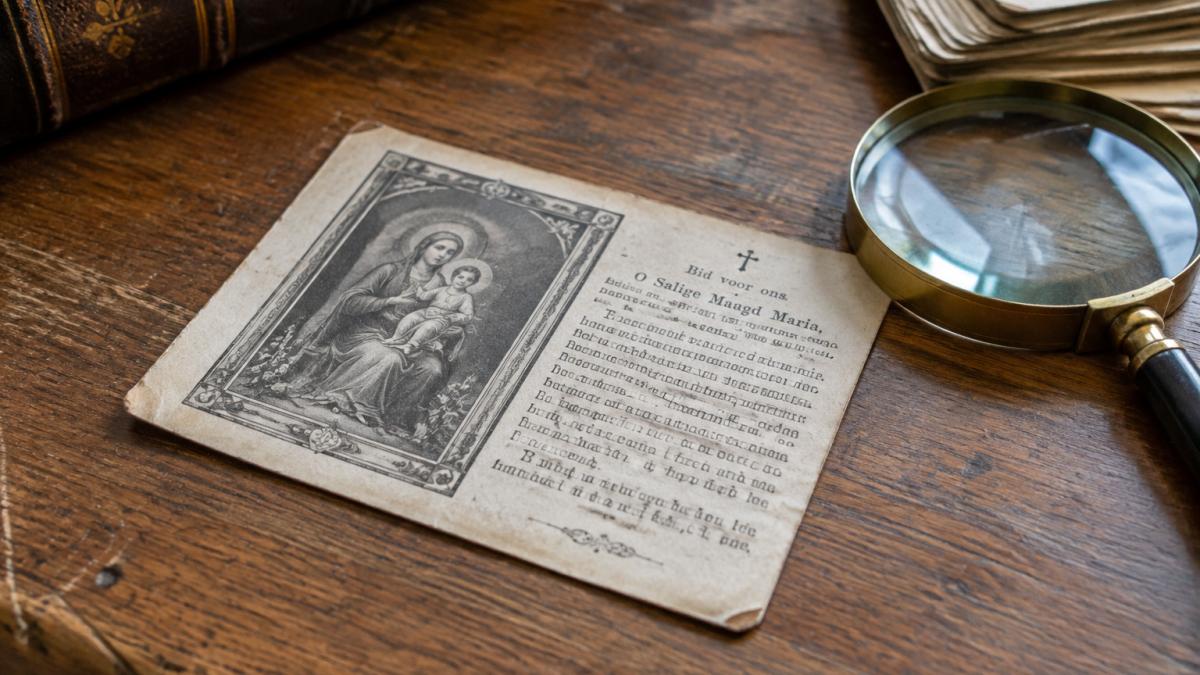
The text also provides a lot of information. Does the card mention the deceased's name, the dates, a prayer, or a Bible quotation? The printer or publisher is sometimes listed too. This information can help with dating and finding comparable examples.
Printing technique is the third factor. Lithography, copper engraving, and woodcut each create a different appearance. Use a magnifying glass to inspect the lines: fine, sharp lines often indicate engraving, while a slightly softer edge may indicate lithography.
Watch out: Don't rely blindly on a single feature. A card may look old and still have been made later.
Authenticity, dating, and identifying reproductions
Reproductions are a common problem. Many later copies look old at first glance, especially if they are printed on yellowed paper. Compare the paper, ink, and edges with known original examples. How to identify authentic religious devotional items: tips and features offers practical tips for distinguishing genuine devotional items from reproductions. A reproduction often has a print that looks too uniform or too clean.
A practical tip: if the text looks perfect but the paper feels new, be wary. Also ask about its provenance. A card with a clear family history is often more trustworthy.
Condition, completeness, and restoration as factors affecting value
Condition is often the biggest price factor for nineteenth-century memorial cards, outweighing the subject. An intact example of a common print can fetch more than a damaged example of a rare print. That is why it pays to assess the condition systematically rather than at a glance.
A practical condition guide with four grades:
- Very good: no tears, no stains, no creases, corners intact, paper not discolored. This is rare for cards more than a hundred years old.
- Good: slight discoloration along the edges, a small crease, or a pencil note on the back. No visible damage to the image.
- Reasonable: a tear up to about one centimeter, a moisture stain that does not touch the image, or a missing corner. The card is still legible and presentable.
- Fair: multiple tears, obvious moisture or mold stains, missing parts of the text or image, or a previous poor repair with adhesive tape.
Watch out: A card that appears intact at first glance may have adhesive tape residue on the back or trimmed edges. Always check both sides against the light.
Completeness also affects the assessment. A memorial card with its original envelope, matching card, or funeral invitation is more interesting to collectors than a loose card.
There are misconceptions about restoration. Professional, reversible restoration, such as flattening a crease or placing acid-free paper behind a tear, can improve the presentation without destroying its historical value. Poor restoration using adhesive tape, glue, or non-original paper actually makes the print less valuable, because the intervention cannot be undone. Therefore, always have restoration carried out by a paper conservation specialist and ask for a description of the materials used. If you are considering having a damaged object restored or leaving it as it is, the Restoring or Leaving Saint Statues As They Are: A Guide can help you weigh your options.
- Never repair it yourself with tape, glue, or plastic wrap.
- Keep the card flat, dry, and out of direct sunlight.
- Photograph the front and back before and after restoration.
For valuation, this means establishing the condition first and only then looking at comparable sales. A card in “fair” condition should be placed at the lower end of the range, even if its motif is rare.
Estimating value step by step: from asking price to realized auction price
Most listed prices for nineteenth-century memorial cards are asking prices, not completed sales. An asking price on an online marketplace does not always indicate the final selling price. So, to estimate the value, you need to distinguish between three figures: the asking price (what someone hopes to get), the appraisal (an expert's estimate, often for insurance or sale), and the realized auction price (what was actually paid). Only the last gives a reliable picture of the market.
A method you can follow yourself:
- Describe the item using consistent terms. Note the period (for example, 1850-1870 or 1880-1900), motif (saint's image, cross, floral motif, memorial card with photo), printing method (lithography, copper engraving, woodcut), size, and whether the text is fully legible. Also note whether the original envelope or accompanying card is included.
- Find three to five comparable completed sales. Use auction houses that publish results online and specialist collector resources. Pay attention to the sale date: results more than two years old say less about current demand.
- Quote prices as a range. In practice, a well-preserved, printed card from the second half of the nineteenth century with no special provenance often sells for between €10 and €40. An example with an early lithograph, a local printer, or an unusual image may fetch more, but prices above €100 are exceptions, not the norm.
- Adjust for condition. A card with a tear longer than a centimeter, a damp stain, or a missing corner is at the lower end of the range. An intact example with its original envelope is at the upper end.
- Adjust for completeness and provenance. A memorial card with a handwritten family name, date, and place is easier to date and therefore more interesting to genealogy collectors than an identical card without that information.
- Choose a realistic range, not an exact amount. For example, write “€15-€30, depending on condition” instead of “€22.” This prevents an exceptional auction result from distorting expectations.
Watch out: A high asking price on a sales site is no proof of value. Always compare with completed sales, not the asking prices of other sellers.
For nineteenth-century prayer cards, print runs were usually large: families had dozens or hundreds of copies printed for family, friends, and the parish. As a result, rarity is seldom absolute. A card is only scarce if the printer had a small operation, the print run was limited, or the item relates to a specific local event or person. Recognizing this distinction prevents an ordinary mass-produced item from being treated as unique.
The table below summarizes the three price measures that need to be distinguished in this process.
| Measure | What it means | Reliable for determining value |
|---|---|---|
| Asking price | What a seller hopes to get | No |
| Appraisal | Expert estimate, often for insurance or sale | Yes, with a report |
| Realized auction price | What was actually paid | Yes, most accurate |
Having prayer cards appraised: when and by whom
An appraisal is worthwhile if the card may be rare, has been passed down in the family, or you want to insure or sell it.
When requesting an appraisal, ask for a written report. Make sure the appraiser clearly states whether it is an insurance value or a sale value. These often differ significantly.
Ask about an appraiser’s fee in advance.
Selling and preserving prayer cards: practical choices for your prayer card
If you want to sell, there are several options. An auction reaches collectors, but the proceeds depend on demand and condition. Specialized dealers often offer a quicker sale, but at a lower price. Selling online may bring in more, but takes more time and requires good photos.
Proper storage is just as important. Use acid-free folders or sleeves, keep the card in a dry place with a stable temperature, and avoid direct sunlight. This preserves its condition and, in turn, its value.
Anyone wishing to keep a prayer card for the family would do well to photograph it and record its provenance. That makes it easier to have it appraised or pass it on later.
Your next step: have a memorial card appraised
Do you have a nineteenth-century memorial card and want to know what it is worth? Start with the four questions at the beginning of this article. Then take good photos of the front and back, and make a note of what you know about its provenance. With that information, you can look for comparable examples or contact an appraiser.
Chez Monique's 2nd Life invites you to browse our selection of antique and vintage devotional items. For current prices or advice about a specific item, visit our website or contact us directly.
Frequently Asked Questions
What is a nineteenth-century memorial card worth?
The value varies considerably. An ordinary printed example in good condition often has only modest collectible value, while rare examples with a distinctive image, handwritten text, or notable provenance can fetch considerably more. Since there are no fixed catalog prices, an appraisal or comparison with recent auction results is the most reliable way to get an estimate. Asking prices and auction prices often differ, so always look at the realized price.
How can you identify a rare 19th-century memorial card?
Pay attention to the printing technique, paper type, and design. Older examples are often printed on thicker paper, sometimes with handwritten elements or lithographic images. Check the text for dates, names, and printer’s marks, and compare it with dated examples. Reproductions can often be identified by their overly uniform color, modern typography, or smooth, recently produced paper.
Where can you get old memorial cards appraised?
For a reliable appraisal, consult a specialist appraiser of paper collectibles, an auction house with a religious objects department, or a collectors’ association. Ask about the appraiser’s experience with nineteenth-century devotional items and how they arrived at the valuation. A written appraisal is useful when selling or insuring an item.
Where can you sell rare memorial cards?
Rare memorial cards are usually sold through a specialist auction house, a collectors’ fair, or a reputable dealer in antique devotional items. Online platforms can also be an option. Compare commissions and appraisal fees before deciding. In the meantime, store the memorial card carefully to preserve its condition.
