

How do you frame a vintage devotional print?
Last updated: November 9, 2026
Quick summary
It’s best to frame a devotional print behind an acid-free mat, which keeps the paper away from the glass and prevents discoloration. Measure the paper in millimeters and have a mat cut to size, as devotional prints rarely come in standard sizes. Never hang the framed print in direct sunlight.
- Acidic cardboard causes brown spots and brittle paper; an acid-free mat interrupts this process.
- Never stick anything directly onto the paper; even acid-free tape leaves marks and reduces its value.
- An 8 by 12 cm print with a 4 cm mat border on all sides requires a visible opening of 16 by 20 cm.
- Measure the inside dimensions of a standard frame yourself, as sizes vary by manufacturer.
- Never cut an antique print; even trimming off a millimeter can significantly reduce its value.
Table of contents
- Why framing a devotional print involves more than just choosing a frame
- Method 1: Framing an old devotional print behind an acid-free mat
- Method 2: Preserving a devotional print with the right backing and spacer
- Method 3: Glass and protection from light exposure and fading
- Method 4: A standard frame or box frame for those who want to switch prints
- Method 5: Size, non-standard dimensions, and custom framing for small prints
- Method 6: Assemble and hang a gallery wall with vintage frames
- Method 7: Style choices for religious and historical prints
- Frequently Asked Questions
Why framing a devotional print involves more than just choosing a frame
Framing a devotional print means protecting a treasure that has often been passed down through generations: the paper is thin, the image is fragile, and its value lies mainly in its history. A well-framed print stays better protected over time. The approach varies from print to print, and that’s exactly where many people go wrong.
The biggest misconception is that a frame is mainly decorative. In reality, the frame determines how long the paper stays in good condition. Acidic paper, direct light, and a poor backing cause more damage than the wrong color could ever make up for. Below, we explain seven ways to frame an old print, from using an acid-free mat to creating a gallery wall.
Looking for an example of an already framed antique print? Take a look at the antique religious print H. Communion in our collection. You can immediately see how a classic wooden frame complements the image.

Method 1: Framing an old devotional print behind an acid-free mat
The best way to preserve a devotional print is with an acid-free mat: it keeps the paper away from the glass and prevents the print from fading. Acidic board is the silent culprit behind brown spots and brittle paper. The acids in ordinary board and paper seep into the print over time, causing it to yellow, develop spots, and eventually crumble. An acid-free mat interrupts this process, making it the cheapest insurance you can get for an old print.
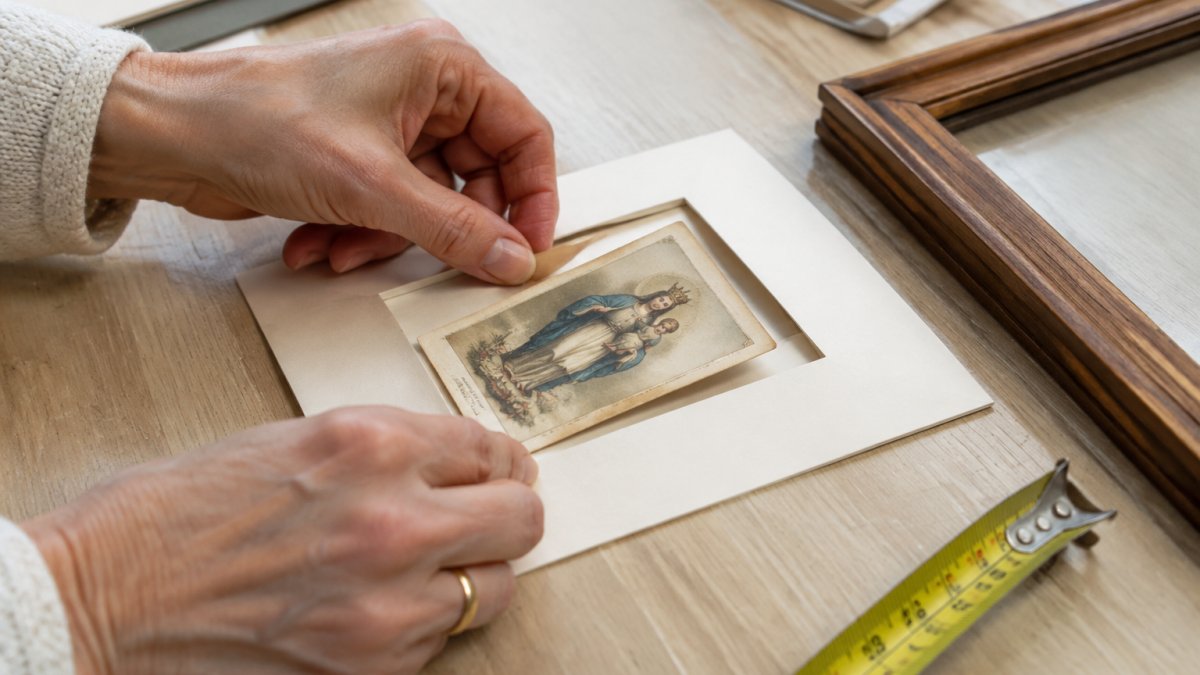
Preserving a devotional print starts with the inside of the frame. Use acid-free board and never place the print directly against the glass. This keeps condensation away and the image sharp. A good arrangement, from inside to outside, is: the print, an acid-free backing behind it, and optionally a moisture-resistant layer behind that. The mat goes at the front and touches the image only along the edges.
Choosing a mat for a small print
For a small print, a mat with a wide border can give the image room to breathe. It offsets the small format and keeps the paper away from the glass. If you choose a wider mat, a print only a few centimeters across can look lost in the opening. Always measure the visible border from the edge of the image, not from the edge of the paper: with a devotional print that has text printed below the image, you’ll often want to show that text too.
Keep in mind: a mat that fits too tightly around the image can pinch the paper in places, causing creases or pressure marks. Leave at least a few millimeters of clearance between the opening and the visible image.
Method 2: Preserving a devotional print with the right backing and spacer
A sturdy backing and a spacer protect the paper from moisture, dust, and pressure from behind. Many standard frames have a thin backing that bends over time.
Never stick anything to the paper itself: even acid-free tape leaves marks and reduces the value of an antique print.
Method 3: Glass and protection from light exposure and fading
Glass protects against dust and handling, but not automatically against light.
Never hang a framed print in direct sunlight, even behind UV glass. Light remains the biggest silent killer of old paper.
Method 4: A standard frame or box frame for those who want to switch prints
A box frame also adds depth to an old print, which suits a vintage look. Keep in mind: in a standard frame, the paper is often less securely held, so always use an acid-free backing and handle the print as little as possible.
Method 5: Size, non-standard dimensions, and custom framing for small prints
Devotional prints rarely come in standard sizes. So measuring is the first step: measure the paper itself, not the image, and include the edge you want to show. Note the width and height in millimeters, since that’s the unit framers and mat cutters use. Measure in two places, because old paper isn’t always square, and a difference of half a millimeter can be enough to make a standard frame not fit.
An 8 by 12 cm print won’t fit in a standard frame without a huge white border or trimming. Never cut into an antique print: taking off even one millimeter can significantly reduce its value. Have a framer cut a custom mat so the original remains intact.
How to calculate the frame size for a non-standard print
The formula is simple: add the mat border twice to the width and height of the visible image, plus any edge of the paper itself that you want to show. So, an 8 by 12 cm print with a 4 cm mat all around needs a visible opening of 16 by 20 cm. If you choose a standard frame, measure its inner size, not its outer size. A frame with an outer size of 20 by 25 cm often has an inner size that’s a few centimeters smaller.
Note: Always measure the frame’s inner size yourself with a tape measure. Manufacturers’ dimensions vary by brand, and a few millimeters can make the difference between a print that fits and one that gets squeezed.
Here’s how to measure and calculate the right frame size for a devotional print with non-standard dimensions.
| Item | Value | Note |
|---|---|---|
| Measuring | The paper itself, not the image | Note the width and height in millimeters |
| Measuring method | Measure in two places | Old paper isn’t always square |
| Sample print | 8 by 12 cm | Won’t fit in a standard frame without a large border |
| Mat | 4 cm all around | Provides a visible opening of 16 by 20 cm |
| Frame size formula | Image plus twice the mat border | Include any visible paper edge |
| Standard frame | Measure the inner size, not the outer size | A 20 by 25 cm outer size has a smaller inner size |
| Inner size | Measure it yourself with a tape measure | Manufacturers’ dimensions vary by brand |
| Cutting | Never cut into an antique print | One millimeter off can reduce its value |
Method 6: Assemble and hang a gallery wall with vintage frames
A gallery wall with vintage frames looks best when you lay out the arrangement on the floor first. Measure the wall, find the center of the arrangement, and leave at least 5 cm between the frames.
Measure, align, and plan the layout
Work from largest to smallest, alternating between landscape and portrait.
Looking for inspiration on where to display it at home? Read our tips on the 5 best places for antique devotional items in your home. If you have limited space, these tips for vintage decor in small spaces can help you put together your wall.
Method 7: Style choices for religious and historical prints
The frame style should reflect the character of the print. A historical print with a devotional feel calls for an understated wooden frame, not a modern metal border.
- Patinated wood: suits antique prints and enhances their vintage look.
- Dark wood: adds contrast to a light-colored print.
- Gold or bronze: classic, but can quickly feel too heavy for a small print.
Match the frame color to the colors in the image and keep the overall look understated. Want to learn more about combining style and care? Read our article about religious statues as interior decor.
Are your readers looking for an original gift? Then take a look at our unique gifts for collectors of religious objects.
A vintage devotional print deserves a frame that protects the paper and showcases its history. At Chez Monique's 2e Leven, we carefully select antique prints and devotional items, safely package fragile pieces, and reuse packaging materials whenever possible. That way, every object gets a second life in your home. Explore our collection and add your favorite piece to your cart.
Frequently Asked Questions
How do you frame a vintage devotional print without damaging it?
Never place the print directly against the glass, and don't use glue, tape or staples.
Which mat is right for a small devotional print?
For a small print, a 5 to 8 cm mat border all around often works best: it gives the eye a place to rest and makes the print look larger. Choose acid-free board that is at least 1.5 mm thick and match its color to the paper, not the frame. A cream or off-white mat goes with almost any old print.
Is glass necessary when framing a devotional print?
Glass protects against dust, fingerprints and light, but also keeps the print away from the frame. Keep a framed print out of direct sunlight, as light can cause the paper to fade.
How do you hang multiple devotional prints as a gallery wall?
First measure the overall wall layout and arrange the frames on the floor before drilling.
