

5 best books on Christian iconography for beginners
Last updated: November 5, 2026
Quick Summary
The five best books on Christian iconography for beginners are Introduction to Christian Iconography (approx. €25) for absolute beginners, Christian Symbols from A to Z (approx. €30) as a reference book, Visual Language and Iconography Explained (approx. €28) as a visual guide, Guides to Art History and Religion (approx. €35) as a context book, and Interpreting Religious Artworks (approx. €32) as an advanced book. Start with one book, not five: choose the introduction if you’re just starting out, and get the reference book only once you have an icon or statue in hand.
- Christian iconography is the study of the fixed visual language through which religious art depicts saints and matters of faith.
- An encyclopedia of symbols is a reference book to use alongside your first introductory book, not instead of it.
- When choosing a visual guide, pay attention to the quality of the reproductions: small, dark photos won’t teach you much.
- You can recognize saints by their attributes, such as Anthony the Abbot with a pig and bell, and Catherine with a wheel.
- The methodology of iconographic analysis is the same in Eastern and Western traditions: first the type, then the attributes, then the source.
Table of Contents
- Why Understand Christian Iconography Before Buying a Book
- Five Books on Christian Iconography for Beginners Compared
- The Meaning of Christian Symbols: What You’ll Find in Every Book
- Recognizing saints in iconography: attributes and visual exegesis
- Comparing wooden or plaster religious statues after your first book
- Eastern and Western iconography side by side: what books often miss
- Choosing Your First Book at Chez Monique's Second Life
- Frequently Asked Questions
Why Understand Christian Iconography Before Buying a Book
Christian iconography is the study of the fixed visual language through which religious art depicts saints, biblical stories, and matters of faith. Once you recognize that language, you see an icon or saint’s statue differently: not as decoration, but as a story told in symbols. At Chez Monique's 2e Leven, we notice that customers truly enjoy an antique statue once they know what they’re looking at.
That’s why this overview starts with the basics. Below, we compare five books on Christian iconography for beginners, including their price, level, and how each book can help you progress.
The key question for each book is: does it help you identify an object at home? An icon of Mary with the infant Jesus, a statue of Joseph with a lily branch, a panel from the Stations of the Cross: every detail has a reason. A good book teaches you to see that reason.
Five Books on Christian Iconography for Beginners Compared
Together, the five titles below cover the entire learning journey: from a first introduction to independent analysis.
| Book | Type | Price (approx.) | Best for |
|---|---|---|---|
| Introduction to Christian Iconography | Beginner’s Book | €25 | Absolute Beginner |
| Christian Symbols from A to Z | Reference Book | €30 | Quick Reference |
| Visual Language and Iconography Explained | Visual Guide | €28 | Visually Oriented Reader |
| Guides to Art History and Religion | Context Book | €35 | Art History Student |
| Interpreting Religious Artworks | Advanced Book | €32 | After the First Book |
Introduction to Christian Iconography: The Beginner’s Book
Start here if you’ve never heard of attributes. A good introduction explains in its first chapters how Christian iconography developed, which sources artists used, and why its visual language is so fixed. You’ll learn the basics: type, attribute, iconographic program.
Ideal for: readers who want structure and an overview. Skip it if: you already know what an attribute is.
Christian Symbols from A to Z: The Reference Book
An encyclopedia of symbols isn’t a book to read but a reference book, and that’s exactly the point. You pick it up as soon as you spot an unfamiliar detail: a chalice, a palm branch, a fish, a lamb. Arranged alphabetically, it lets you quickly find the meaning.
In practice, you use a reference book like this alongside your first book. It doesn’t replace the introduction, because it doesn’t explain the connections. It supplements it.
Ideal for: collectors who often come across things whose meaning they don’t know. Skip it if: you don’t yet have a basic knowledge of the Christian tradition.
Visual Language and Iconography Explained: The Visual Guide
For those who prefer looking to reading, a visual guide is the best place to start. Good ones use full-page images and arrows or numbers to point out every detail. You can immediately see which element tells which story.
When buying, pay attention to the quality of the reproductions. A guide with small, dark photos won’t teach you much, no matter how good the text is.
Ideal for: beginners who prefer images to text. Skip it if: you’re looking for a compact book to read on the train.
Art History and Religion Guides: The Context Book
Iconography is never separate from time and place. A context book situates visual language within art history: from medieval art and the Renaissance to nineteenth-century sacred art. You’ll then understand why the same motif is depicted differently in each period.
These books are often a little more substantial and expensive, but they give you the framework the other four lack.
Ideal for: art history students and serious collectors. Skip it if: you just want to look up a symbol quickly.
Interpreting Religious Artworks: The In-Depth Guide
This is the book to buy if the first book has made you curious. It teaches you to look methodically: first identify the subject, then name the attributes, then look up the source in biblical exegesis or hagiography, and only then interpret it.
Ideal for: readers who want to learn to analyze independently. Skip it if: you haven’t built up any basic knowledge yet.
The Meaning of Christian Symbols: What You’ll Find in Every Book
The same core symbols appear in almost every book, but the best guides teach you not only what a symbol means, but also how to read it in a work of art. Below are the symbols you’re sure to encounter, each with a question to ask yourself to interpret it.
- The lamb refers to Christ as the sacrificial lamb. Note whether it appears with a cross staff or a book with seven seals: that determines whether it represents the Paschal Lamb or the vision from Revelation.
- The dove represents the Holy Spirit. See whether the dove descends in a beam of light or hovers above a baptism; the context changes its meaning.
- The lily is associated with Joseph and Mary and symbolizes purity. A lily in the hand of a saint without other attributes often indicates a virgin martyr.
- The chalice refers to the Eucharist and the liturgy. Is the chalice on an altar or being held? That distinction separates a liturgical scene from an allegory.
- The palm branch is the sign of martyrs. Usually, the palm branch together with an instrument (sword, wheel, gridiron) indicates martyrdom.
- The keys belong to Peter and the Church. Two keys (one gold and one silver) refer to heaven and earth; a single key is often a later simplification.
A symbol rarely stands alone: the lamb beside a book with seals, the dove above a baptism, the lily with a female martyr. Pay attention to which attributes appear together.
Antique O.L.V. of Perpetual Help icon in silk →
If you want to learn how to apply these symbols to a real work of art, a step-by-step guide to reading iconography in religious art can help, from identifying the subject to interpreting it.
Recognizing saints in iconography: attributes and visual exegesis
You can recognize saints by their attributes, and those attributes are the quickest way to understand the meaning of an image. Anthony the Abbot carries a pig and a bell, Catherine a wheel, and Lawrence a gridiron. If you see the attribute, you know who is depicted.
This visual exegesis works just like biblical exegesis: you read the image as you would a text, using established signs and references. A maker’s mark is often missing, especially on older pieces. The attribute is then your only clue.
If you want to learn this step by step, see how to identify statues of saints without a maker’s mark. If you first want a complete overview of the Catholic tradition of religious statues, our guide to Catholic statues of saints gives you the broader map on which to place their attributes.
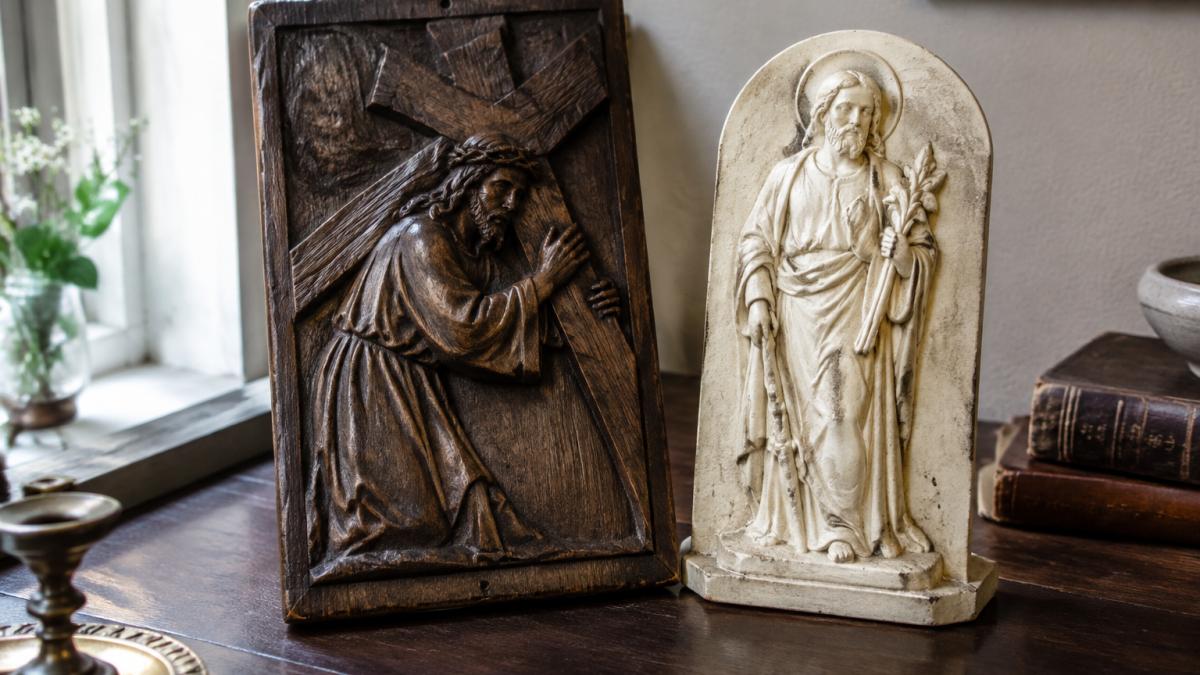
Comparing wooden or plaster religious statues after your first book
Once you've finished a book, you'll look at objects differently. You'll pay attention to the material, technique, and condition, because these determine how well a statue preserves its visual language. A plaster icon from the 1930s is cast and then painted; a wooden panel is carved, with all the marks of the knife left in.
For a first comparison, it's best to see the same saint's statue in two different materials side by side. Our plaster icon of Saint Joseph with the Christ Child from the 1930s and 1950s shows the Baroque, softly painted style. The hand-carved wooden statue of Saint Anthony the Abbot showcases the wood carving and warm wood finish. Side by side, you can immediately see what the book means by execution and style.


A practical tip: with wooden pieces, always check the back and edges for cracks, and with plaster, check weak points such as fingers and edges. This will teach you more than any illustration in a book.
Eastern and Western iconography side by side: what books often miss
Most beginner books cover only the Western tradition, while Orthodox iconography has its own rules that are explained in almost no introductory guide. That difference determines which book suits your collection, and it's worth knowing in advance.
In the East, the emphasis is on the painted icon, following a strict canon. Traditionally, an icon is painted on wood with egg tempera and gold leaf, and the proportions and poses are fixed.
In the West, you see many more freestanding statues, reliefs, and devotional items in wood and plaster. The Western tradition allows greater freedom in execution: a statue of Joseph with a lily branch can have a different pose in one century than in the next.
The methodology of iconographic analysis is the same in both traditions: first identify the type, then the attributes, then the source. Only the execution and the degree of freedom differ.
If you collect religious items and statues of saints, a Western-oriented guide will be more useful. If you have a silk-woven icon, such as our icon of Our Lady of Perpetual Help from the 1920s to 1950s, it's worth taking a close look at the image of Mary and the child.

Choosing Your First Book at Chez Monique's Second Life
Start with one book, not five. Choose the introduction if you're just starting out, and only buy the reference book once you have a first icon or image to compare it with.
At Chez Monique's 2nd Life, we like to combine this approach with the objects themselves. Our collection of antique and vintage devotional objects is carefully curated, and we reuse packaging materials without compromising the safety of your purchase. This gives a fragile plaster statue a second life in your home.
Browse our latest arrivals, choose the book that suits you, and pick an object to study right away. That way, reading becomes looking, and looking becomes understanding.
Frequently Asked Questions
What exactly is Christian iconography?
Christian iconography is the study of the visual language of religious art: which figures, attributes, and scenes are depicted, and why. For example, you learn that a key is associated with Peter and a lily with Mary. A good beginner’s book explains this vocabulary step by step, so that when you see an icon or statue, you can immediately recognize which saint or biblical story it represents.
How can I recognize saints by their attributes?
Each saint has traditional attributes rooted in Christian tradition. Saint Joseph often carries a lily or a carpenter’s tool, Mary is depicted with the infant Jesus, and a crucifix directly refers to the Passion of Christ. A reference book with an A-to-Z list of symbols can help you match those attributes to the right person, even on older devotional objects where the details are subtle.
Why is iconography important when collecting religious images?
Knowing the language of images helps you recognize not only the saint, but also the period and purpose of an object. A plaster icon in the Baroque style tells a different story from a carved wooden panel from the 1920s. This knowledge helps you assess quality and provenance, and makes it easier to make an informed choice between, for example, wood and plaster.
Are there books that specifically discuss the meaning of religious images made of wood or plaster?
Most beginner books cover iconography broadly, but some visual guides focus separately on materials and techniques. Look for chapters on devotional objects and folk art that cover wooden panels and plaster icons. This way, you learn not only what an image represents, but also why wood or plaster was chosen for that type of object.
How can I learn to understand the language of religious art without studying art history?
Start with one accessible introductory book, then use a reference work to look up symbols. Pair that with observation: visit a church or look at your own devotional objects and name what you see. The methodology of iconographic analysis may sound daunting, but in practice it comes down to three questions: who is depicted, how can you tell, and what source underlies the image?
