

Tips for beginners at online antique auctions
Quick summary
Online antiques auctions are an accessible way to find unique old objects without leaving home, and beginners would do well to read the auction terms and conditions first. Always factor the buyer's premium and shipping costs into your budget before deciding on a maximum bid.
- Read the auction terms and conditions in full, including the payment deadline, return rules, and whether the lot is sold as is.
- Factor in the buyer's premium and shipping costs: a lot priced at 150 EUR with a 20% buyer's premium costs 180 EUR.
- Compare the lot with similar objects sold recently to estimate its market value realistically.
- Ask for extra photos of the back, bottom, and markings if these are missing.
- Start with one or two lots in a category you already know, and stick to a budget set in advance.
Table of contents
How online antiques auctions work
Online antiques auctions are one of the most accessible ways to find unique, old objects without leaving home. Many buyers choose them deliberately because they can browse and bid at their own pace. So beginners don't need to be experts to make a good purchase.
An online auction usually follows a set sequence. The seller lists a lot with photos and a description, and sets a starting price. Buyers place bids until the auction closes, and the highest bid wins.
Another important difference is the role of the auction platform itself. In many online auctions, the platform handles payment and communication. So it's a good idea to find out which party handles what before you get started.
Read the auction terms and conditions before you bid
The auction terms and conditions are the document you can learn the most from, and the one most often skipped. They determine what happens if you win, how long you have to pay, and whether returns are possible. Read them in full, even if it takes a little time.
Pay particular attention to these points:
- The payment deadline and accepted payment methods
- Whether the lot is sold "as is", meaning with no guarantee as to its condition
- The return policy and who pays the return shipping costs
- How extensions and closing times work
Please note: a lot sold "as is" often means that later complaints about damage won't be compensated. Always check this before you bid.
Online auction costs: factor the buyer's premium into your budget
The winning bid is rarely the total amount you pay. Many online auctions charge a buyer's premium, either a percentage or a fixed amount charged by the auctioneer or platform. There may also be shipping costs.
So always calculate the total cost before deciding on a maximum bid. A lot priced at 150 EUR with a 20% buyer's premium will actually cost you 180 EUR, and then you still have to add any shipping costs. Decide in advance how much you want to spend at most, including all those extra costs, and stick to it.
Determining an antique's value: authenticity, age, and condition
Before you bid, it's a good idea to know what an item is worth. An antique's value is largely determined by its authenticity, age, and condition. An item that looks older than it is, or a reproduction, may be worth much less than the seller suggests.
Compare the lot with similar items that have sold recently. This gives you a realistic picture of its market value. Pay attention to details such as materials, maker's marks, wear, and restoration, as these can significantly affect the price.
Evaluating photos, condition reports, and descriptions
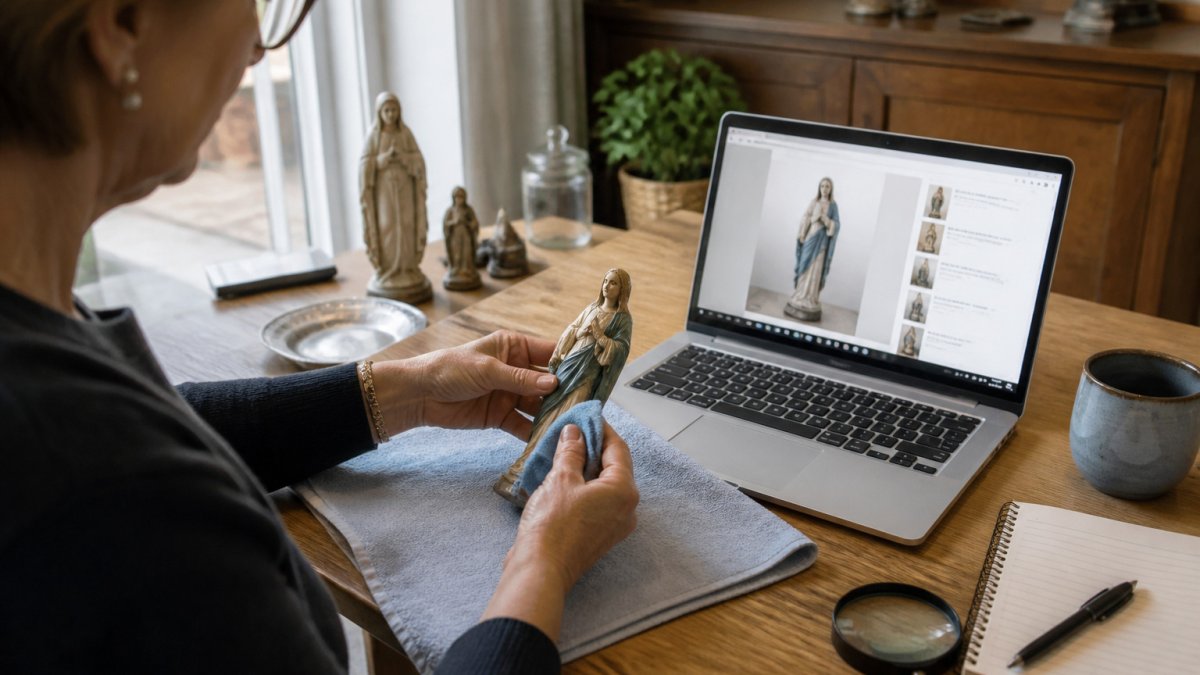
With online auctions, you depend on what you can see on the screen. Examine the photos carefully: ask for additional photos of the back, the underside, and any maker's marks if these are missing.
A vague description, such as "beautiful antique figurine" without any details, is a sign to be cautious. Look for specific information about the material, dimensions, provenance, and any damage. If there's a condition report, read it carefully.
Buying antiques online: what to look out for when bidding
It's tempting to get swept up in the excitement of an auction, especially when several people are bidding on the same item. Stick to your predetermined maximum bid. In a guide to reliable online antique stores, you can find out which platforms you can trust before you start bidding. Beginners sometimes pay more than they intended because they only decide at the last minute.
It's best not to bid in the final seconds without a reason. Check how the auction platform handles extensions, and plan your bids so you won't be caught off guard. A calm, prepared approach helps you stay within budget.
Payment, shipping, and disputes after winning
Once you've won, the process of completing the sale begins. Pay within the specified time frame using a method accepted by the platform. Don't pay until you're sure what you'll receive, and check whether the seller arranges shipping or whether you need to organize it yourself.
If items are damaged in transit, it's important to act quickly. Take photos of the packaging and the item as soon as they arrive, and contact the platform according to the procedure in its terms and conditions. Keep all communications and evidence.
Your first auction: make a plan and start small
Start with one or two lots in a category you already know a little about. If you're looking for an alternative to major auction platforms, that page explains where you can safely buy collectibles. Set a budget beforehand, including buyer's premium and shipping, and stick to it. Make a short note of what you want to achieve, such as collecting one particular type of item.
As you gain experience, you'll learn more quickly which descriptions are reliable and which lots are best avoided. Start small, learn from each auction, and steadily build your knowledge.
Frequently Asked Questions
How does an online antiques auction work?
At an online antiques auction, the auctioneer lists items on a platform with photos and descriptions, usually with a closing time for each lot. Anyone can bid while the auction is open, and the highest bid when it closes wins. After winning, you pay the hammer price plus any buyer's premium. Always read the auction terms beforehand, as they explain how payment, collection, and returns work. Start with small lots to learn the process.
How much is the buyer's premium at an online auction?
The buyer's premium is a percentage of the hammer price charged by the auction house on top of the winning bid. The percentage varies by auction house and is stated in the auction terms. So always calculate the total amount: hammer price plus buyer's premium, plus any shipping costs. For example, if you win a lot for 100 euros with a 20 percent buyer's premium, you'll pay 120 euros for the item before shipping is added. Factor this into your budget before you start bidding.
How do you determine what an antique is worth?
Compare the lot with similar recent sales, and consider its condition, provenance, and authenticity. Pay attention to the auction house's description and photos, and ask for a condition report or additional photos if you're unsure. For valuable objects, an independent appraisal can provide extra peace of mind. Set a maximum bid based on that comparison, and don't bid above it.
How can you avoid overbidding at an auction?
Set your maximum bid in advance, including the buyer's premium and shipping costs, and write it down. Don't bid emotionally in the final minutes, as that's when most overbidding happens. Set a fixed budget for the entire auction so you don't spend more than you want on any lot.
At Chez Monique's 2nd Life, we believe every antique deserves a good second chance. If you want to take your first step, you can browse our carefully curated collection of antique and vintage objects, with a special focus on religious statues and devotional items. Feel free to add an item to your cart and discover the history behind each piece.
