

Reliable online shop for antiques: 10 top choices
Table of contents
- What makes a trustworthy online antique store reliable?
- Our curated collection: Religious statues and devotional items
- How to recognize a reliable webshop: checklist for buying antiques safely online
- Sustainable antique webshop: safety without waste
- Authenticity and certification: what you need to know
- Comparison: what sets a reliable antique webshop apart
- Frequently asked questions about buying antiques online
- Conclusion: your next antique find is waiting
- Frequently Asked Questions
Last updated: September 29, 2026
Trustworthy online antique store: 10 top choices
A trustworthy online antique store does not stand out by chance. It is about authenticity, safety, and careful selection that deserves your trust. At Chez Monique's 2e Leven, we understand that buying antique objects online requires more than beautiful photos and low prices. It is about provenance, quality, and the assurance that what you receive is exactly what you expect.
In this guide, we cover what truly makes an online antique store trustworthy and how to distinguish it from platforms that merely resell inventory. We show you which questions to ask, which warning signs to recognize, and how to buy antiques safely online without the risk of disappointment or damage.
What makes a trustworthy online antique store reliable?
A trustworthy online antique store distinguishes itself through three key points: authenticity, safety, and transparency. These are not just words; they are concrete practices that you can verify before you buy.
Authenticity means that the store can explain what you are buying. Not just “antique” or “vintage,” but specific information about the period, maker, material, and provenance. A trustworthy online store leaves no gaps in an object's story. If a statue is from the 1930s, the seller can tell you why: stylistic features, production techniques, or documentation.
Shipping safety is where many stores fail. A trustworthy online antique store understands that fragile religious statues and devotional items cannot be packed with standard bubble wrap and hope. Sustainable packaging does not have to be weak; what matters is that the object arrives as it left. At Chez Monique's 2e Leven, we reuse packaging materials as much as possible, but never at the expense of protection.
Transparency goes beyond photos. It means honest descriptions of wear, restoration work, or signs of use. An object from the 1920s will not look brand new, and it should not. A trustworthy store tells you what you are seeing and why that is precisely evidence of authenticity.
Our curated collection: Religious statues and devotional items
Chez Monique's 2nd Life focuses on religious statues and devotional objects, objects with history and meaning. These are not random purchases. Each piece is chosen because it has quality, authenticity and a story.
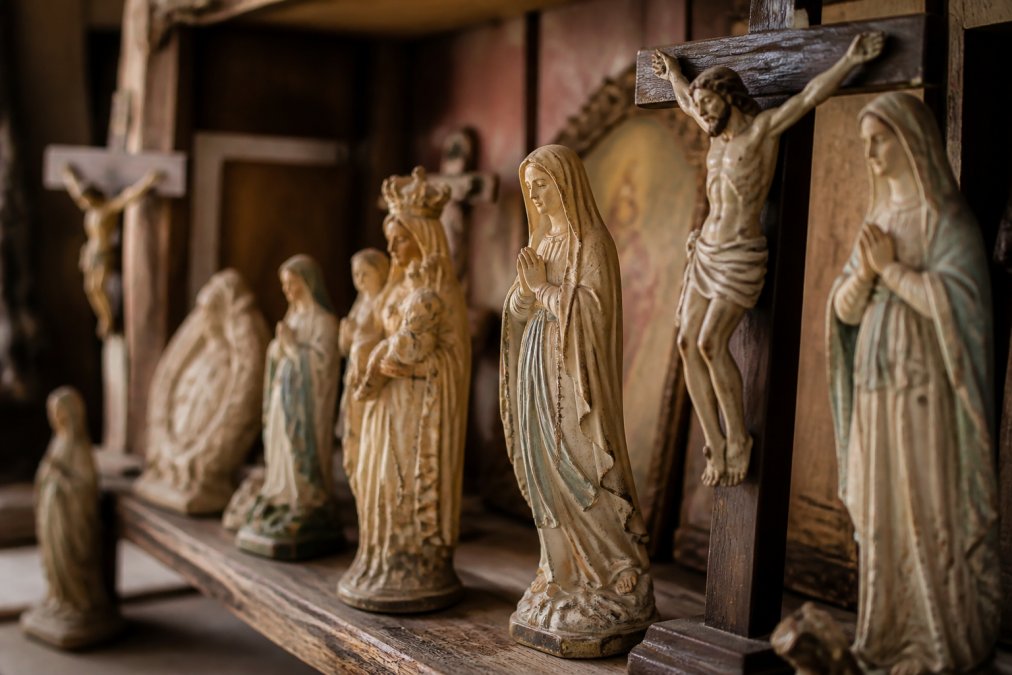
Large Madonnas and statues of the Virgin Mary
Statues of the Virgin Mary are among the most sought-after religious art objects. They vary greatly in size, material and period style, from French plasterwork from the 1920s to German porcelain pieces from the 1950s.
Our Large rare Madonna with Child by Steph Uiterwaal, 37 cm is a perfect illustration of what authenticity means. This artwork was made in 1929 by Glasfabriek Leerdam, an internationally recognized art glass studio. It combines religious iconography with Art Deco style, a rare combination. Its height of 37 centimeters makes it an impressive piece, suitable for collectors of Dutch glass art. Price: €262,50.

Another example is our Antique French standing statue of the Virgin Mary with Child, wall statue from the 1920s to 1940s. This French plasterwork bears the mark of J Spery from Marseille, a signature of artisan quality. It can stand or hang, offering flexibility in how you display it. Price: €152,50.

For those looking for a smaller, more affordable piece, the Miraculous Mary from the 1950s is a good choice. This porcelain figurine (16 centimeters high) is in perfect condition and showcases classic craftsmanship. Price: €40,00.
Antique crucifixes and religious art objects
Crucifixes are just as diverse as statues of the Virgin Mary, and equally valuable to collectors. They can be made of tin, wood, plaster or even shells; each material tells us something about the period and origin.
Our Antique crucifix with shells, mother-of-pearl and copper corpus is a folk-art object, probably from the 1920s or 1930s. It was likely made in coastal areas or monasteries. The shell and mother-of-pearl details give it a unique charm. It is in excellent condition, which is rare for an object of this age. Dimensions: 23 centimeters high. Price: €63,50.

The Religious freestanding crucifix with Jesus corpus is a tin piece from the 1920s, 32 centimetres high. It has signs of use, which you would expect from an object more than a hundred years old. This is not a problem; it proves its authenticity. Price: €39.50.
A larger, more impressive piece is the Large Antique Nativity Scene Three Kings Figure by Gerard Linssen Venlo, from the 1930s. This heavy plaster work (34 centimetres high) depicts one of the three Wise Men in a kneeling position. It has had a small repair to the cloak, neatly retouched. This is exactly the kind of transparency a reliable antique webshop provides. Price: €157.50.
Rosaries and devotional items with provenance
Rosaries are personal objects with spiritual significance. An antique rosary may have been held for decades, which increases its value.
Our antique rosary with reliquary holder dates from the 1930s to the 1950s. It has wooden beads and a cross-shaped reliquary holder that opens with a tiny screw. It contains authentic relics from the Holy Land. The inscription "T.T Trappist, 3 fountains from Rome" tells you exactly where it comes from. This is the kind of provenance collectors appreciate. Total length: 57 centimetres. Price: €185.00.
How to recognize a reliable webshop: checklist for buying antiques safely online
Buying antiques online can feel risky because you cannot hold the object in your hands before paying. A reliable antique webshop minimizes those risks through transparency and standards.
Here is what you should check:
Large rare Madonna with Child Steph →
- Detailed descriptions: Not just "beautiful antique statue," but specific information about the period, maker, material, and dimensions.
- Multiple photos: At least four photos from different angles, including close-ups of details, wear, and any restoration work.
- Honest condition: Description of signs of use, cracks, or previous repairs. No hidden defects.
- Provenance: Where does the object come from? Who made it? What is the dating based on?
- Shipping method: How is it packaged? What insurance is included? How long does shipping take?
- Returns policy: Can you return it if it does not meet your expectations? Under what conditions?
- Communication: Does the shop respond quickly to questions? Can they provide detailed information about specific objects?
A reliable antique webshop will be happy to answer these questions. If a shop remains vague or does not respond, that is a warning sign.
Sustainable antique webshop: safety without waste
Sustainability and safety do not have to be opposites. A sustainable antique webshop protects your purchase without creating unnecessary waste.
Many shops use standard bubble wrap and disposable packaging. It works, but it is not sustainable. At Chez Monique's 2e Leven, we reuse packaging materials as much as possible - old newspapers, paper, and cardboard that have already been used. This reduces waste and costs without compromising protection.
How do we do that? By packing carefully. Religious statues and devotional items are wrapped in layers of paper and supported with reused packaging materials. Fragile objects receive extra protection. Everything is insured against damage during transport.
This is what distinguishes a sustainable antique webshop: it is not about being cheap, but about being responsible. The objects you buy already have a long history. It makes sense to handle and ship them carefully in a way that not only respects the environment, but also protects your purchase.
Authenticity and certification: what you need to know
Authenticity is the most frequently asked question from customers who buy antiques online. How can you be sure that what you are buying is genuine?
There are several ways to establish authenticity. The first is research: the object itself tells a story. Material, production technique, stylistic features - these things cannot lie. A genuine antique plaster work from the 1930s has a specific patina, a particular way in which it was glazed, details that modern manufacturers would not imitate.
The second is provenance. Where does the object come from? Who made it? Can you trace it? Many of our objects have marks or signatures, the name of the maker or workshop. This is a strong indicator of authenticity.
The third is certification and appraisal. For very valuable objects, a professional appraisal may be worthwhile.
Comparison: what sets a reliable antique webshop apart
Not all antique webshops are the same. Some are inventory managers who resell everything they can find. Others, such as Chez Monique's 2e Leven, are curators who personally select each piece.
| Aspect | Inventory manager | Curator (Chez Monique's 2e Leven) |
|---|---|---|
| Selection process | Fast, volume-focused | Careful, quality-focused |
| Descriptions | Basic, often copied | Detailed, research-based |
| Provenance | Often unknown | Always researched |
| Packaging | Standard, fast | Customized, sustainable |
| Communication | Minimal | Personal, responsive |
| Return policy | Strict | Flexible, customer-focused |
| Price | Low | Honest, not cheap |
Frequently asked questions about buying antiques online
How do you ensure that my fragile religious statue does not break?
How exactly do you check the quality?
How long does shipping take, and does sustainable packaging cost extra?
Conclusion: your next antique find is waiting
A reliable antique webshop is not simply a platform where objects are sold. It is a curator who knows, understands and respects every piece. At Chez Monique's 2e Leven, we do this through careful selection, sustainable shipping and complete transparency about provenance and authenticity.
Frequently Asked Questions
How can I recognize a reliable antique webshop?
Check whether the webshop provides clear product descriptions with dimensions and materials, shows photos of all sides, and gives information about provenance and condition. A reliable antique webshop also has a clear return policy. Look for reviews from previous customers.
What is the difference between antiques, vintage and brocante?
Antiques are objects more than 100 years old with historical value. Vintage refers to items from the 1920s-1980s with retro appeal. Brocante is a broader term for second-hand, characterful objects from different eras. A reliable antique webshop makes these distinctions clear so you know exactly what you are buying.
How is fragile antique safely shipped?
Many sustainable webshops reuse materials such as newspapers and paper instead of new plastic. The packaging must be sturdy and shock-absorbent.
Are there quality marks for antique dealers in the webshop sector?
Many reputable antique webshops mention their membership and have a clear privacy policy.