

Relimarkt Alternative for Collectors: Where to Buy?
Table of Contents
- What a Relimarkt Alternative Should Offer Collectors
- Buying Religious Statues: What Should You Look For?
- Second-Hand Religious Art: Online Versus In Person
- Valuing Antique Saint Statues: How to Determine Their Worth
- Care and Restoration of Devotional Objects
- Legal Aspects of Religious Heritage
- Sustainable Packaging and Shipping of Fragile Objects
- Conclusion: The Right Choice for Your Collection
- Frequently Asked Questions
Last updated: September 13, 2026
What a Relimarkt Alternative Should Offer Collectors
A good relimarkt alternative for collectors offers three things: transparent provenance, fair prices, and a shipping method that keeps fragile objects intact. At Chez Monique's 2e Leven, our entire approach revolves around these three pillars, and in this guide we explain what to look for before buying a religious statue anywhere.
The religious art market is fragmented. You can find devotional items on online platforms, in thrift stores, at brocantes, and from specialized sellers. What is missing is an independent overview that looks beyond a single seller. This article fills that gap: from assessing a Madonna with Child to appraising antique saint statues and sustainably packing delicate porcelain.

A relimarkt alternative is simply any channel where you can view, buy, or rent religious objects outside the platforms you already know. It is not about one shop, but about a way of evaluating provenance, condition, and price.
Buying Religious Statues: What Should You Look For?
Buying religious statues starts with recognizing the material and maker. A porcelain statue from the 1940s requires a different assessment than glass art or a wooden saint statue.
Pay attention to these points before making a purchase:
- Marks and monograms on the base or underside
- Material choice, from frosted glass and porcelain to earthenware
- Surface condition, with attention to hairline cracks and restorations
- Documentation of provenance, where available
An example from our own collection: the Large Rare Madonna with Child by Steph Uiterwaal, made by Glasfabriek Leerdam in 1929. This 37 cm piece can be identified as an authentic creation by Uiterwaal, even without a monogram. That is precisely the kind of detail a collector should be able to verify.
Assessing Quality and Provenance
You assess the quality of a religious object based on four characteristics: its mark, condition, finish, and provenance. An early crown mark, such as TMK-1 on Goebel pieces, places an item in a specific production period. That is more valuable than a general description such as “old.”
Always ask for photos of the underside, the edges, and any damage. A seller who shares those images without hesitation is usually trustworthy.
Second-Hand Religious Art: Online Versus In Person
Buying second-hand religious art online is becoming increasingly popular, but viewing more expensive pieces in person remains valuable. The difference lies not in convenience, but in what you can verify through each channel and which channels are available at all. Most overviews mention only one shop or one platform. Below are the channels actually available to a collector, along with their associated trade-offs.
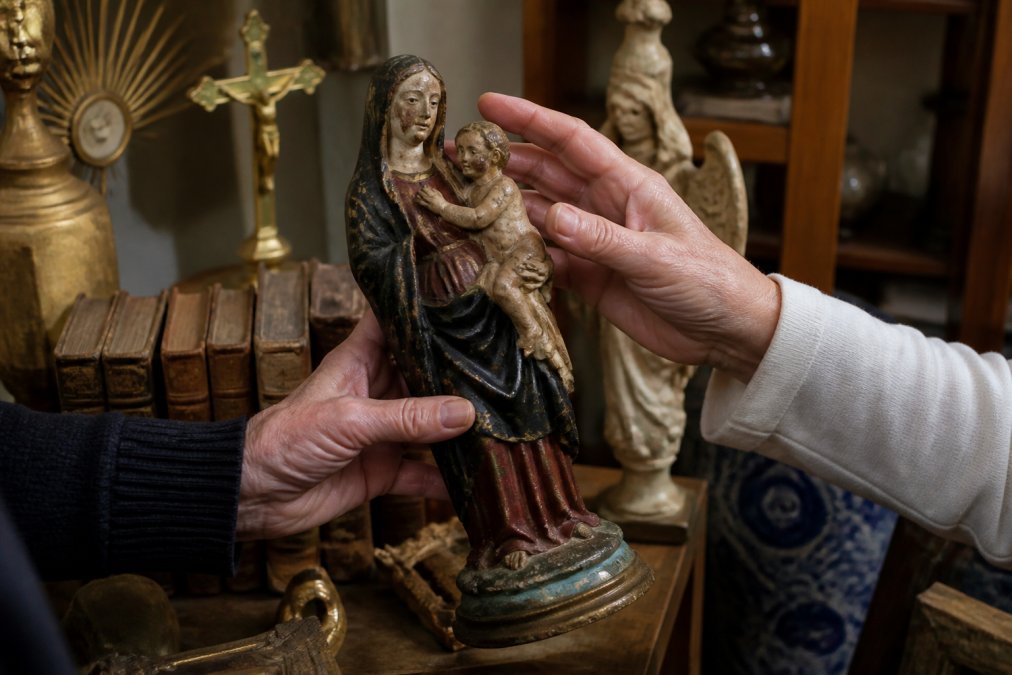
The channels compared
- Specialized online sellers, often a single curator, a small selection, and many detailed photos available on request. Advantage: expertise. Disadvantage: limited stock and shipping risk for fragile work.
- General online platforms, broad reach, but descriptions vary in quality and provenance is rarely documented. Suitable for common pieces, risky for rare ones.
- Auction houses, often offer a viewing day and an auction order with a condition description. Costs on top of the hammer price (buyer’s premium and sometimes auction fees) make this especially worthwhile for pieces you cannot find elsewhere.
- Antique fairs and flea markets, you see the object in person, but price comparison is difficult because each stall sets its own asking price.
- Thrift stores and estates, lowest prices, highest uncertainty. Sometimes a bargain, more often a piece without documentation.
| Aspect | Buy online | View in person |
|---|---|---|
| Reach | Large nationwide selection | Limited to local markets |
| Condition assessment | Via photos and description | Directly, in person |
| Price comparison | Easy to compare side by side | More difficult, per stall |
| Shipping risk | Present when handling fragile work | None, you take it with you |
| Checking provenance | By message | Direct conversation |
| Additional costs | Shipping costs | Travel costs, admission |
Where online purchases go wrong
The most common disappointment is not a forgery, but an incorrect expectation. A photo of a piece of matte glass under warm light makes it look warmer in tone than it is in daylight. A description such as "in good condition" says nothing about hairline cracks that only become visible in backlighting. Therefore, always ask for:
- A photo of the underside (mark, model number, factory stamp)
- A photo in daylight, without flash
- A photo of the edges, corners, and any restorations
- A brief description of its provenance, even if provided verbally
A seller who provides these four without hesitation is usually trustworthy. Anyone who sends only an atmospheric photo probably does not know the piece well enough.
The practical middle ground
Research online, but use physical channels to build your frame of reference. Visit an antiques fair or viewing day before buying an expensive piece online: you can learn about the material, weight, and finish without having to buy anything. You can take that knowledge into every subsequent online purchase.
For fragile objects, the higher the value, the more you want the sales channel to offer an opportunity to view the item or a return policy. A seller who offers a return option assumes part of the risk, which says something about how confident they are in their piece.
Valuing Antique Saint Statues: How to Determine Their Worth
Valuing antique saint statues revolves around five factors: markings, condition, rarity, finish, and provenance. No single factor determines the price; it is the combination that makes the difference.
A flawless figurine from a rare production series carries more weight than a common model with signs of use. That explains why two seemingly comparable Madonna and Child figurines can still differ greatly in price.
Characteristics of Authentic Pieces
Authentic pieces are identified by a combination of signals, not by a single feature. Look for:
- A consistent mark matching the stated period
- A finish consistent with the manufacturer and period
- Model numbers that correspond to documented series
- Wear patterns that make sense for its age
A Goebel Hummel figurine with model number HM 35 and the early TMK-1 crown mark from the 1945–1949 period immediately tells you three things: the maker, the model, and the production window. That is the basis of every valuation.

Care and Restoration of Devotional Objects
Caring for devotional objects requires more restraint than action. Most damage to religious objects is caused by well-intentioned cleaning, not neglect. The approach you choose depends heavily on the material, and most maintenance guides fail to make that distinction.
Per material: what to do and what not to do
Porcelain and glaze, Dust with a soft, dry brush. You can carefully treat stains on glaze with lukewarm water and a drop of mild dish soap on a cotton swab, then immediately pat dry. Never scrub, never use a scouring pad, and never use an aggressive degreaser: glaze is hard but brittle, and scratches are irreparable.
Frosted glass and glass art, Frosted glass is more sensitive to fingerprints than clear glass because its surface has microscopic pits. Touch it as little as possible and use cotton gloves when moving it. Clean with a soft, dry cloth; avoid ammonia-based glass cleaner, as it can dull frosted glass (conservation-wiki.com).
Wood, Wood responds to humidity. Do not store it next to a radiator or in a damp basement, as this can cause cracks or mold. Dust with a soft brush; do not use a wet cloth, because moisture penetrates the wood and leaves stains. A dry room with stable humidity is more important than any product.
Textiles, Paraments, chasubles, and other religious textiles are the most fragile. Do not fold them sharply, because over time the fold line becomes a tear. Store them rolled or flat, in acid-free paper, away from direct light (canada.ca). Never wash them yourself: old silk and embroidery can bleed or disintegrate.
Plaster and earthenware, Plaster is porous and absorbs moisture and grease. Clean only when dry, with a soft brush. Do not submerge earthenware with crackle glaze, because water can penetrate through the hairline cracks.
What you should never do
- No vinegar, no bleach, no all-purpose cleaner—not even “a little”
- No ultrasonic cleaning bath for painted or glued pieces
- No adhesive tape or superglue for a detached arm or foot
- Never attempt restoration yourself if the piece has any value
When to hire a restorer
When in doubt: doing nothing is often better than trying it yourself. A professional can assess whether conservation (stabilizing, not making it look better) is the right choice, or whether restoration makes sense. For pieces with documentation and a clear provenance, professional conservation usually outweighs the cost. For common pieces without documentation, the calculation is often different: restoration costs may exceed the value of the object.
The rule of thumb followed by most collectors: it is better to leave an object in its current condition than to have it “refurbished” by someone with no experience in religious heritage. A good restorer will tell you beforehand what they can and cannot do, and what effect it will have on the value.
Legal Aspects of Religious Heritage
Legal aspects of religious heritage are not a daily concern for most buyers, but they do matter for older and unusual pieces. The rule is simple: the older and rarer the object, the more important the question of provenance.
When purchasing religious art, it is wise to ask about its provenance history. An object demonstrably from an estate or private collection is usually unproblematic. If all documentation is missing, you take a greater risk.
For special ecclesiastical interior pieces, such as altars, monstrances, or confessionals, additional regulations may apply. Check with the Rijksdienst voor het Cultureel Erfgoed) to determine an object's status before making a purchase.
Sustainable Packaging and Shipping of Fragile Objects
Sustainable packaging and shipping of fragile objects may seem contradictory, but they are not. Reused packaging materials protect just as well as new materials, as long as you take the construction seriously.
At Chez Monique's 2nd Life, we inspect every package before an object sets off on its journey. The approach:
- Multiple layers of protection around the object itself
- Padding that secures the piece so it cannot shift
- A sturdy outer layer that absorbs impacts
- Reuse materials wherever it is safe to do so
That last point often raises a question among buyers: isn't reused material less safe? In practice, it isn't. What matters is the construction of the layers, not whether the cardboard is new. In this way, every shipment contributes to less waste without compromising the safety of your purchase.
Conclusion: The Right Choice for Your Collection
The biggest challenge for collectors is not finding an object, but finding a seller who takes provenance, condition, and shipping seriously. A relimarkt alternative is therefore less about one platform and more about the questions you ask before buying.
At Chez Monique's 2nd Life, we combine a carefully curated collection of antique and vintage religious objects with sustainable shipping through the reuse of packaging materials. Each piece is inspected before it leaves, from a Madonna and Child to an antique dinnerware set. Looking for a Goebel Hummel or a Leerdam glass art piece for your collection? Add your favorite to the shopping cart and give a special object a second life in your interior.
Frequently Asked Questions
Where can I sell my saint statues?
You can sell your saint statues through online platforms, specialized auction houses, or a physical antiques market. For devotional items and religious objects, online collectors’ shops are often the best option because they give you access to a targeted audience. Make sure you clearly describe the condition, provenance, and any restorations. When setting an asking price, it helps to look at comparable pieces and have the value appraised if you are unsure.
Where can I find reliable online shops for antique devotional items?
You can recognize reliable online shops for antique devotional items by their clear product descriptions, detailed photos, and information about marks, provenance, and condition. Check whether the seller provides background information about the material and period. A specialized shop focusing on religious art and collectibles often offers more certainty than a general platform. Also read the return and shipping policies so you know what to expect.
How do I determine the value of an antique religious statue?
The value of an antique religious statue depends on factors such as rarity, condition, provenance, material, and demand among collectors. A statue from a well-known workshop or with a clear maker’s or factory mark is often worth more. Have an expert appraise a piece if you want certainty. Online, you can view similar objects to get an indication of its value. Keep in mind that the price also depends on the sales method and the audience.
What is the difference between a physical market and an online collectors’ shop?
A physical market gives you the opportunity to view and handle objects directly, which is useful when assessing details. Online collectors’ shops often have a larger and more specialized selection, with extensive photos and descriptions. The reach is greater, but you have to rely on the seller’s information. For online purchases, a clear return policy is important. Both options have advantages; your choice depends on your preference for certainty or convenience.
How can I tell whether an antique religious object is authentic?
You can assess authenticity based on brands, materials, stylistic features, and wear patterns. A factory stamp or signature can be an indication, but it is sometimes absent from older pieces. Ask about the provenance and any documentation. If in doubt, you can consult an expert. A reliable seller is transparent about the condition and any restorations. Be cautious with pieces that seem “too good” for their age.