

How to recognize and value porcelain holy water fonts
Last updated: October 30, 2026
Quick Summary
Porcelain holy water fonts are so popular because they are three things at once: a devotional object, a piece of artisan porcelain, and a collectible with a story. Buyers aren't just collectors; they also include people styling a vintage interior and looking for an object with character. Porcelain is also moisture-resistant, keeps fine painted details crisp, and ages more evenly than porous earthenware.
- You can recognize porcelain by its smooth glaze, clear tone when tapped gently, and relatively low weight.
- Porcelain is fired at a high temperature, causing the body to vitrify and become dense.
- Collectible value comes from the rarity of the design, the condition of the glaze, completeness, and provenance.
- Clean a holy water font with lukewarm water, a soft cloth, and a drop of mild soap.
- Choose a font based on condition, design, and size, in that order.
Table of Contents
- Why Porcelain Holy Water Fonts Are So Popular
- How to Recognize Porcelain by Its Glaze, Sound, and Weight
- The Difference Between Porcelain and Ceramics in Devotional Objects
- Antique Holy Water Fonts: Origins, Motifs, and Collectible Value
- Craftsmanship and handiwork behind bisque and hand-painted porcelain
- Cleaning a holy water font without damaging the glaze
- What to look for when choosing a porcelain holy water font
- Giving a vintage holy water font a second life
- Frequently Asked Questions
Why Porcelain Holy Water Fonts Are So Popular
A porcelain holy water font is a small porcelain vessel for holy water that believers hang by the door or on a wall shelf so they can bless themselves with holy water when they come in. Why are porcelain holy water fonts so popular? Because they are three things at once: a devotional object, a piece of artisan porcelain, and a collectible with a story. More and more people are looking for exactly that blend of history and style.
Interest in religious devotional items seems to be growing. Buyers aren't just collectors. They also include people styling a vintage interior and looking for an object with character. A small holy water font delivers that in a compact size: it stands out without shouting.
Below, we explain how to recognize porcelain, how it differs from ceramic, where its collectible value comes from, and how to care for a small holy water font. Knowing the basics helps you avoid a bad purchase.
How to Recognize Porcelain by Its Glaze, Sound, and Weight
You can recognize porcelain by its smooth, glossy glaze, clear tone when tapped gently, and relatively low weight for its thickness. Consider these three signs together, never in isolation.
The glaze feels cool and dense, almost like glass. Tap the rim with a fingernail: genuine porcelain gives off a high, clear tone, while terracotta and earthenware sound dull. The weight is often surprising. A porcelain piece about four inches tall weighs less than you might expect based on its wall thickness.
A common mistake is judging porcelain by color alone. White says nothing about the type of material. Look at the broken edge or the unpainted underside: porcelain is fine and dense there, while ceramic is coarser and sometimes grainy.
The Difference Between Porcelain and Ceramic at a Glance
Porcelain is fired at a high temperature, causing the body to vitrify and become dense. Ceramic and stoneware are fired at lower temperatures and remain more porous. This difference affects hardness, sound, glaze, and how heat-resistant a piece is.
For devotional objects, this difference is practical: porcelain allows for finer painting, keeping faces and folds sharper. Ceramics are better suited to larger, sturdier forms with relief.
| Property | Porcelain | Ceramics / stoneware |
|---|---|---|
| Firing temperature | High, shard vitrifies | Lower, shard remains more porous |
| Sound when tapped | High-pitched and clear | Dull and short |
| Glaze | Smooth and nonporous | More variation, sometimes more matte |
| Painting detail | Very fine | Coarser, more relief |
| Suitable for | Fine devotional objects, tableware | Decorative objects, garden and utility pottery |
The Difference Between Porcelain and Ceramics in Devotional Objects
With devotional objects, the material determines how a piece ages and how it feels in use. Porcelain from the 1940s and 1950s often retains its luster and fine lines well, while softer-fired ceramics chip more readily at the edges. This makes porcelain popular with collectors who value detail.
Still, porcelain is not automatically better. Hand-painted Italian ceramics from the 1950s can be richer in color and relief, with little angels or an oval niche rarely seen in bisque porcelain. The choice depends on what you’re looking for: delicate serenity or exuberant craftsmanship.
The difference becomes truly clear when you consider what a holy water font had to withstand. A font hangs by the door, often in a spot where moisture, dust, and temperature fluctuations come together.
There is also a difference in detail that matters religiously. Porcelain allows for finer painting, keeping faces, folds, and little halos crisp. With a motif such as the Sacred Heart or the Praying Virgin Mary, you can see the expression in the eyes and the position of the fingers on porcelain, whereas on coarser ceramics they blur into spots.
If you want to clearly understand the difference between vintage and antique religious art, see our article on the distinction. It’s useful before assessing a piece’s age.
Antique Holy Water Fonts: Origins, Motifs, and Collectible Value
Antique holy water fonts often come from France and Italy, where they were produced on a small scale for households in the nineteenth and twentieth centuries. The motifs reveal their origin: the Sacred Heart and the Praying Virgin Mary are classically French, while Mary with the Infant Jesus in a niche more often points to Italian craftsmanship.
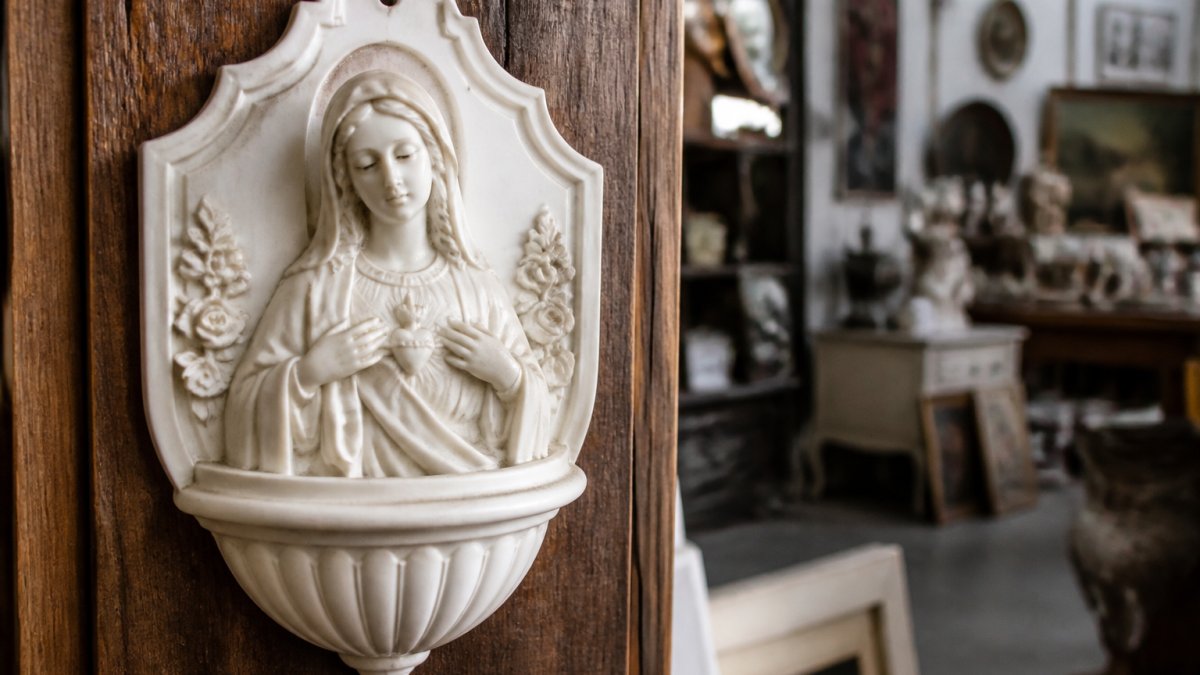
Collectible value comes down to four things: the rarity of the motif, the condition of the glaze, completeness, and provenance. A pristine example with a recognizable motif and traceable history is worth more than an intact but anonymous piece. Damage to the nose, fingers, or rim directly reduces its value.
A Sacred Heart of Mary in fine bisque porcelain from the 1940s and 1950s, found at an antique market in Paris, tells its own story. If you want to learn to assess what a piece is worth, it helps to know how to determine the value of antique religious objects.
Craftsmanship and handiwork behind bisque and hand-painted porcelain
Handcraft is evident in the irregularities. With bisque porcelain, the clay remains unglazed and matte, giving the surface the feel of powdery marble. On hand-painted porcelain, you can see brushstrokes that differ slightly from one another, and sometimes a small loss of paint precisely where the painter made their last pass.
Antique French Sacred Heart of Mary Holy Water Font →
That is not a flaw. It is proof that a piece was handmade in small batches, long before machines took over. A decal or transfer print looks more uniform and reveals itself through a fine grid pattern under magnification.
Production was labor-intensive and involved six stages that did not tolerate one another. First, the piece was molded or thrown, then finished with a sponge and a small knife. Next came the first firing, or biscuit firing, which gave the clay its final shape. Only then could the glaze be applied, followed by a second firing at a high temperature. Painting was sometimes done before and sometimes after the second firing, depending on whether the paint could withstand the heat. Any stage could go wrong: an air bubble in the clay, a crack during cooling, or paint shifting during firing.
Devotional objects involved an additional layer of complexity. A holy water font is not a flat plate but a hollow form with a niche, a rim, and often a hanging hole. This meant the molding process was more complex, and the wall thickness around the niche had to be even; otherwise, the piece would warp during firing. Hand-painted faces were also produced in small batches by painters specializing in religious motifs: one artist handled the folds of the robe, another the face.
Cleaning a holy water font without damaging the glaze
Clean gently with lukewarm water, a soft cloth, and a drop of mild soap. Avoid harsh cleaning products, scouring pads, and the dishwasher, as they can damage the glaze and painted decoration. Never leave a piece to soak in water.
- Dust with a dry, soft brush
- Dab stains with a damp cloth and mild soap
- Blot dry immediately; do not leave it to air-dry
- Do not use vinegar, lemon, or bleach
- Do not put it in the dishwasher, even on a low setting
Note: Never leave an antique font to soak in soapy water. Moisture seeps into the unglazed back and can permanently discolor or crack the porcelain.
After cleaning, you'll want to put the piece back safely. For how to do so without damaging the porcelain, read our guide to safely hanging old porcelain holy water fonts.
What to look for when choosing a porcelain holy water font
Choose based on condition, motif, and size, in that order. Condition determines whether you can hang the piece without damaging it further. The motif determines whether it suits your taste. Size determines whether it fits on your wall shelf or altar.
Keep these points in mind before you buy:
- Check the rim for hairline cracks, including on the back
- Check that the hanging holes or hook are still intact
- Check whether the painted decoration is original or has been touched up later
- Ask about its provenance if known
- Compare the dimensions with the spot where it will hang
A specific example can help you choose. Our antique French Holy Water Font with the Sacred Heart of Mary is 17 cm high and 6 cm deep, in flawless bisque porcelain. If you're looking for a smaller, more compact piece, our antique French Holy Water Font with Praying Madonna, at 12.5 cm high, is an option.


Ideal for: anyone starting a collection with a beautiful, recognizable French motif. Skip it if: you're looking for a large wall piece; a larger Italian example would be a better fit.
Giving a vintage holy water font a second life
A vintage holy water font doesn't need to be kept in a display case. It also works as a quiet, characterful decorative object in a hallway, on a bookshelf, or beside a mirror. If you're not religious, you can hang it purely for its design and refined appearance.
Place it somewhere with moderate light. Direct sunlight will eventually fade the painted decoration, and damp rooms such as an unventilated bathroom are not good for the glaze. A dry wall with indirect light is ideal.
This gives an old piece a new life without diminishing its history. That’s exactly what Chez Monique's 2e Leven stands for: giving objects a second home, carefully packed and shipped, with packaging materials reused wherever possible and every package checked to ensure safe transit.
Frequently Asked Questions
How can you tell if a holy water font is made of porcelain?
Porcelain holy water fonts are usually thinner and smoother than ceramic ones, with an even, glossy glaze. Gently tap one with a fingernail: porcelain makes a clear, high-pitched sound, while terracotta or earthenware sounds duller. Also consider the weight; at the same size, porcelain often feels slightly heavier and cooler. Bisque porcelain, as found on some French pieces, is matte and unglazed, which sets it apart from common ceramics.
Why do people collect antique holy water fonts?
Antique holy water fonts combine religious significance with craftsmanship. Collectors look at the provenance, design (the Virgin Mary and Child Jesus, the Sacred Heart, or the praying Virgin Mary), and the condition of the glaze. Pieces made in France or Italy from the 1930s to the 1950s are prized for their hand-painted details and refined appearance. Non-religious buyers also use them as decorative objects on an altar, wall shelf, or in a display cabinet.
How do you safely clean a porcelain holy water font?
Use lukewarm water with a drop of mild dish soap and a soft cloth. Avoid abrasive cleaners, vinegar, and harsh descalers, as these can damage the glaze and painted decoration. For unglazed bisque porcelain, dusting with a soft brush is safer than submerging it. Always let the font dry completely before putting it back, and check for cracks first; a dishwasher is never recommended for antique devotional items.
Are porcelain holy water fonts only for the religious, or are they decorative too?
Both. Holy water fonts were originally used as devotional objects by the door or in the bedroom, but many buyers choose them purely for their aesthetic appeal and history. The refined look of bisque porcelain and the hand-painted details suit classic or eclectic interiors. It’s perfectly fine to use the object purely as decoration; just choose one that stands securely and keep it out of direct sunlight to prevent the glaze from discoloring.
Choosing a porcelain holy water font that’s right for you requires a keen eye for its condition, design, and provenance. We’re happy to help with our carefully curated collection of devotional items, sustainable shipping using reused packaging materials, and a thorough check of every package to ensure safe transit. Discover the latest arrivals at Chez Monique's 2e Leven and give a special object a second life in your home.
