

Attic trunk alternative: compare vintage decor
Table of contents
- What is vintage decor, and why choose second-hand?
- Dekofferzolder alternative: where can you find authentic brocante items?
- Buying vintage religious objects: religious statues as interior accents
- Sustainable interior decoration: why second-hand is better
- Relimarkt vs deKofferzolder comparison: which platform should you choose?
- Recognizing authenticity and checking quality
- Styling tips: combining vintage and modern interior styles
- Conclusion
- Frequently Asked Questions
Last updated: September 27, 2026
What is vintage decor, and why choose second-hand?
Vintage decor values objects with character and history. Second-hand items have a story and patina that factory production cannot provide. By choosing second-hand, you give objects a second life and prevent waste.
Second-hand brocante items as a vintage Dekofferzolder alternative offer authenticity that new production lacks. An original French plaster statue of Mary or Dutch glass artwork has patina and signs of use that factory-made products do not. For many people, it is about the aesthetics: vintage religious objects work perfectly as interior pieces.
Every purchase of second-hand home accessories means less production, transport, and packaging waste. Chez Monique's 2e Leven gives antique and vintage objects a second life, which fits perfectly with sustainable living.
Dekofferzolder alternative: where can you find authentic brocante items?
A vintage Dekofferzolder alternative does not have to be complicated. It is about knowing where to look and what you are looking for.
Online platforms let you search from home and examine details. Chez Monique's 2e Leven carefully curates each piece, so you receive thoughtfully selected items, not random old things.
Local thrift stores have a permanent collection, and you can physically feel what you are buying, but they offer less specialization and focus on authenticity.
A good Dekofferzolder alternative offers selection, authenticity, and safe shipping.
Buying vintage religious objects: religious statues as interior accents
Buying vintage religious objects is more popular than ever. Religious statues are art objects, decorative elements, and pieces of history, not just for practicing Catholics.
A large plaster statue of Mary from the 1920s-1930s adds atmosphere to a room. It is about texture, form, and story. A French freestanding statue of Mary with the mark 'Aux Santons D'Art' speaks of craftsmanship and European history.

Chez Monique's 2e Leven offers, among other things, an antique French freestanding statue of Mary with Child, suitable as a wall decoration for €152.50. This piece combines two display options: you can place it on a surface or hang it on the wall. Its authenticity lies in the details, the maker's mark, the patina, and the period (1920s-1940s).
Always check the condition of the object. A reliable seller will clearly disclose any damage. Ask for photos from multiple angles and inquire about the shipping method, as religious statues are fragile.
Sustainable interior decoration: why second-hand is better
Sustainable interior decoration starts with a simple choice: new or used? Second-hand is always more sustainable, but how do you determine whether a vintage object is truly better than a new copy?
Price-quality ratio guide to brocante
Three factors determine the value of vintage decor: rarity, condition, and historical value.
Determining rarity: French plaster Madonna statues by 'Aux Santons D'Art' are rarer than Dutch glassware from the same period. Check whether the same maker or style has recently sold on other platforms and at what price.
Assessing condition: An object in excellent condition may be worth 30-50% more. Small hairline cracks in plaster are normal; large cracks or missing parts are not. Ask for photos from multiple angles and close-ups of damaged areas.
Historical documentation: Objects with maker's marks are worth 20-40% more than comparable pieces without documentation. This reflects the certainty that documentation provides.
Why original is better than replica
When you buy a vintage object instead of a new copy, you avoid energy, water, and raw material consumption. An original antique statue has already undergone that production process, so you are reusing that investment.
Original antique objects can retain or increase their value. An original Belgian Madonna statue from around 1900 is not only beautiful, but also an object with lasting value.
Large rare Madonna with Child by Steph →
Sustainability in shipping
Sustainable living also means considering how the object is delivered. Chez Monique's 2e Leven reuses packaging materials, old boxes, newspapers, and paper, so your purchase generates no additional waste.
Relimarkt vs deKofferzolder comparison: which platform should you choose?
| Aspect | Relimarkt | Dekofferzolder | Chez Monique's 2e Leven |
|---|---|---|---|
| Focus | Religious objects & antiques | Brocante & secondhand | Antique & vintage objects, religious specialization |
| Selection | Broad religious selection | Large but unstructured | Carefully curated |
| Authenticity | Varies | Varies | Verified & documented |
| Shipping | Standard packaging | Standard packaging | Sustainably reused materials |
| Price | Variable | Variable | Premium for quality |
| User experience | Marketplace-style | Marketplace-style | Focused collection |
The choice depends on your priorities. Looking for volume and low prices? Dekofferzolder.nl may be suitable. Looking for authenticity, specialization and sustainable shipping? Chez Monique's 2e Leven is a good option.
Recognizing authenticity and checking quality
Recognizing authenticity is a skill you can learn. Here are the basics, plus a practical guide to minor restorations.
Checking authenticity: four concrete steps
Step 1: Look for marks and signatures. A French plaster statue of Mary with the mark 'Aux Santons D'Art' and the Marseille address has been verified. A Belgian statue with 'Depose 12' and a round stamp provides information about its origin and period. These details are difficult to imitate. Check whether the mark is sharp and naturally embedded in the material (not applied superficially). Original marks are often slightly worn by time.
Step 2: Check the patina. Original antique objects show signs of use. Not damage, but traces of time. Plaster develops a natural discoloration, usually a light yellow-brown tint. Glass develops a certain sheen and sometimes microscopic scratches from use. This is difficult to create artificially. Cheap copies often have a uniform, artificial, dirty appearance, as if someone had rubbed the object with coffee or tea. Genuine patina looks random and natural.
Step 3: Pay attention to materials. The Dutch glass artwork by Steph Uiterwaal for Leerdam (1929) has a specific quality that you can feel and see: the glass is thick, the forms are sharp, and the finish is smooth.
Restoration for beginners: what you can do yourself
Antique objects are often better left unrestored than poorly restored. But minor damage does not have to hold you back. Here is what you can do yourself, and what is best left to professionals.
You can do yourself:
- Small hairline cracks in plaster: This is normal and does not require repair. It is a sign of authenticity.
- Surface dirt and dust: Clean carefully with a soft brush and lukewarm water. Do not use harsh cleaning products on antique plaster, as this can damage the patina.
- Small plaster chips along edges: Use plaster repair paste (available at hardware stores). Mix it according to the instructions, carefully fill the damaged area, and let it dry for 24 hours. Carefully sand it smooth with fine-grit sandpaper (220+ grit).
- Loose parts: If an arm or head is loose but not broken, you can carefully use plaster adhesive. Make sure you align the parts perfectly before the glue dries (approximately 2-3 minutes of working time).
This should be left to professionals:
- Major breaks or cracks: A statue broken into two pieces requires professional plaster restoration. The break must be aligned perfectly; otherwise, the object will look crooked forever.
- Missing parts: A head, arm, or foot that is completely missing requires sculpting work. This is not a job for beginners.
- Color restoration: Restoring original coloring or gilding requires expertise. The wrong paint or technique can drastically reduce the value.
- Glasswork: Broken glass should be repaired by a glass specialist. Repairing it yourself with glue will always be visibly noticeable.
When in doubt
If you are unsure about authenticity or condition, ask the seller. A good seller will send close-up photos, transparently point out damage, and be willing to answer your questions. If someone becomes impatient or vague, that is a warning sign. For example, Chez Monique's 14-day return policy means that if you see the object in person and do not like it, you can return it.
Styling tips: combining vintage and modern interior styles
Combining vintage and modern interior styles is the art of mixing and matching. It is not about choosing one style; it is about thoughtful curation.
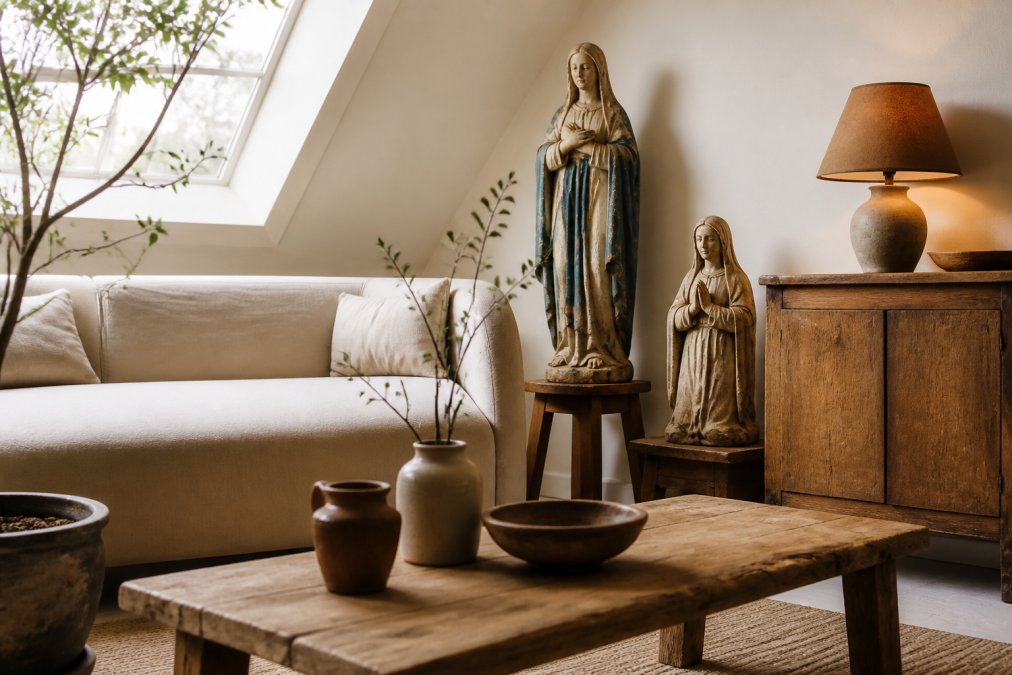
Vintage and modern together create a living space with a story.
Conclusion
Last updated: September 27, 2026
An attic-clearance alternative for vintage decor is about knowing where to look. Second-hand brocante items, religious devotional objects, and vintage furniture offer something that new production cannot: authenticity, sustainability, and a story.
Frequently Asked Questions
What is the difference between vintage, antiques, and brocante?
Vintage refers to objects from the 1920s-1980s, while antiques are usually more than 100 years old. Brocante is a broader term for second-hand items with character, regardless of age. At Chez Monique's 2e Leven, you will mainly find antique and vintage religious statues, such as the Belgian statue of Mary from around 1900 (€255.00) and the art deco statue of Mary from the 1920s-1930s (€185.00). These pieces have historical value and a unique appearance.
How can I recognize high-quality vintage objects and authentic devotional items?
Look for original signatures, maker's marks, or stamps on the underside. Check the condition: original patina and light signs of use indicate authenticity. Material matters - plaster, glass, and ceramic retain their quality well. For example, the French statue of Mary by Aux Santons D'Art (€152.50) has the maker's original mark from Marseille. Avoid items with excessive restoration or synthetic coatings.
Why is buying second-hand decor more sustainable than buying new?
Shopping second-hand prevents overproduction and reduces waste. Every vintage piece has already completed a life cycle, so you give it a second life without using new raw materials. Chez Monique's 2e Leven goes even further with sustainable packaging by reusing materials. This saves packaging waste and CO2 emissions. In addition, vintage objects are often better made than mass-produced items today.
Can I use religious statues in a modern interior if I am not religious?
Absolutely. Religious art objects such as statues of Mary have strong aesthetic value as decorations. They bring calm, texture, and nostalgia to an interior. For example, the art deco Madonna by Fostoria Glass (€72.00) works perfectly in minimalist or Scandinavian interiors because of its clean lines. Religious iconography is also popular in bohemian, classic, and vintage interior styles, regardless of faith.