

Special vintage Nativity sets for under the Christmas tree
Quick Summary
A vintage Nativity set is special for its craftsmanship, patina, and character: hand-painted plaster, solid wood, or porcelain show that the piece was made with care. When choosing vintage Nativity sets, consider the material, condition, provenance, and dimensions.
- A maker’s mark, signature, or label on the bottom helps determine its provenance and period.
- Tap the figure gently with your knuckle: plaster sounds dull, while porcelain rings clearly.
- Small chips are normal on older pieces, but major damage reduces their value.
- Sets up to about 20 centimeters fit on a tray; larger scenes need a sturdy base.
- Leave about 10 centimeters between the set and the lowest branches of the Christmas tree.
Table of contents
- Provenance, period, and features to look for
- Our selection of beautiful vintage nativity sets
- Styling vintage nativity scenes under the Christmas tree
- Buying secondhand Nativity sets: practical tips
- Restoring and safely storing religious statues
- Your next step: choose a nativity set that suits your interior
- Frequently Asked Questions
What makes a vintage Nativity set special?
Last updated: November 4, 2026
A vintage Nativity set beneath the Christmas tree tells a story that no new version can match. Visitors often want to know the history behind the little wooden, plaster, or porcelain figures. That’s why we carefully select our vintage Nativity sets.
In practice, a vintage Nativity set is a Nativity scene with figures that an earlier generation brought into their home. It features the Holy Family, sometimes joined by shepherds, animals, and the Three Wise Men. What makes a set special is the combination of craftsmanship, patina, and traces of use over the years.
Three things make all the difference:
- Material and craftsmanship: hand-painted plaster, solid wood, or fine porcelain show that the piece was made with care.
- Patina: minor wear on the edges and paint shows that the set has been used over time and wasn’t made just yesterday.
- Character: the figures’ expressions and poses vary by period and maker.
A set made in the 1950s or 1960s often has a softer look than modern reproductions. That makes it perfect for a warm, nostalgic Christmas.
Provenance, period, and features to look for
With a vintage Nativity set, provenance is the first thing to check. If you want to estimate the period of a comparable piece, prices of comparable vintage statues offers an overview for comparison. Look for a maker’s mark, signature, or label on the bottom of a figure. If there isn’t one, the material, shape, and finish can help estimate the period.
When examining a set, ask yourself whether the scene is arranged in a traditional way. Older sets often feature a neat, symmetrical arrangement. Later periods show more freedom in poses and use of color. A hand-painted face with a soft blush and hand-applied eyes often points to an older set; modern reproductions more often use decals or pad printing, which makes the face look flatter and more uniform.
Recognizing plaster, porcelain, stone, and wood
Plaster is lightweight, has a matte finish, and is easy to recognize by the figures' soft edges. Porcelain is smooth, cool to the touch, and often has thinner walls. Stone is heavy and has a grainy texture, while wood shows the grain and weight of the chosen type of wood. A quick check can help if you're unsure: gently tap the figure with your knuckle. Plaster sounds dull, porcelain rings clearly, and stone and wood sound somewhere in between. This isn't an exact method, but it quickly points you in the right direction.
A nativity set bought as vintage may combine different materials. So inspect each figure individually. Also check the inside of hollow plaster figures: a rough, uneven surface with mold seams points to an older mold, while a smooth, machine-finished interior is more common in newer production.
Period classification in practice
For a rough estimate of age, look for a few recurring patterns. This classification is not an exact science, but it can help when comparing pieces.
Assessing condition and originality
When assessing condition, look for cracks, broken parts, and paint damage. Small chips are normal on older pieces, but major damage reduces their value. Check that the paint is consistent across all the figures: a different color or sheen on one figure may indicate a later restoration. Original accessories, such as a matching stable or a separate shepherd's crook, make a set more complete and therefore more appealing to collectors.
Note: A set that looks complete at first glance may contain figures from different origins. So before buying, always compare the figures' scale, painting style, and thickness.
Our selection of beautiful vintage nativity sets
We select our nativity scenes based on their material, condition, and the atmosphere they bring. If you're also looking at other vintage home accessories, find more inspiration in vintage home accessories for your home. Below is an overview of some pieces from our collection, with prices in euros.
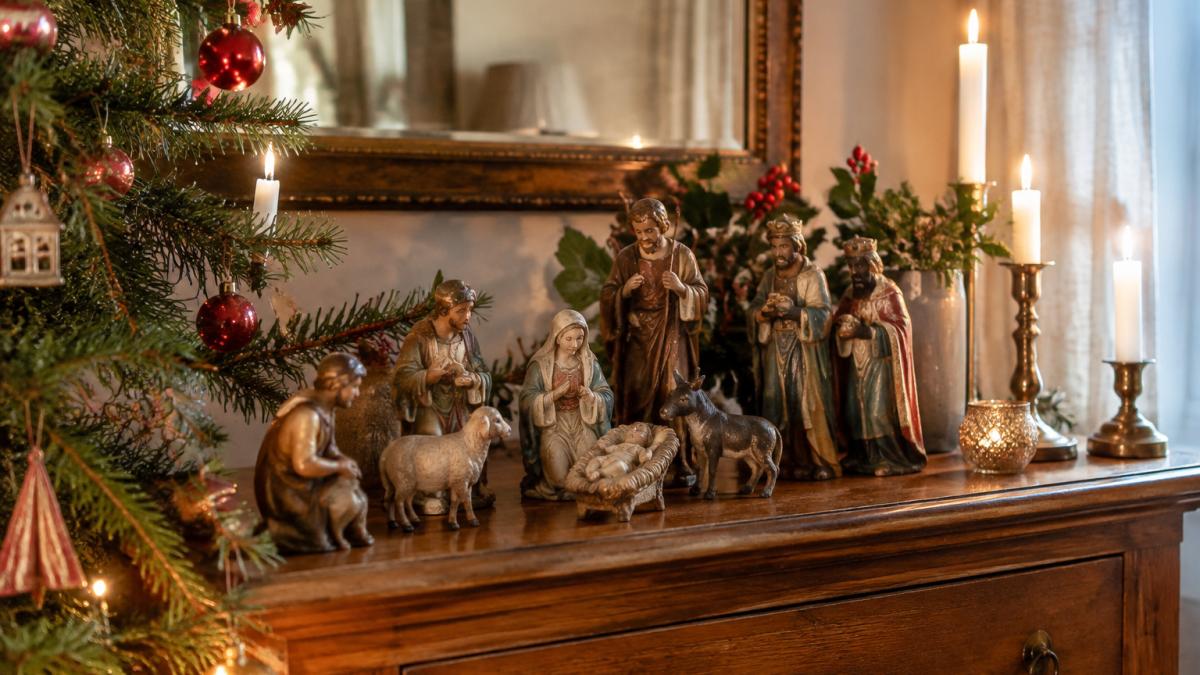
| Nativity scene | Material | Period | Dimensions (height) | Price |
|---|---|---|---|---|
| Beautiful old porcelain nativity set for Christmas | Porcelain | 1960s/70s | 19 cm | €29,50 |
| Fun old stone Christmas group | Stone | Antique | 18 cm | €57,50 |
| Christmas: beautiful 18-piece nativity scene with figures | Plaster | 1950s | Stable 35 cm | €110,00 |
| Beautiful rare old Belgian nativity scene | Plaster | 1930s | 25 cm | €155,00 |
| Hand-carved African ebony nativity scene | Ebony (Mpingo) | Modern handmade | 20 cm | €55,00 |
| Large antique nativity figure of King Melchior | Plaster | Late 19th century | 35 cm | €157,50 |
The porcelain group is a good choice for anyone looking to start a small, affordable collection. For a complete nativity scene with multiple figures, the 18-piece set from the 1950s offers the most.
Styling vintage nativity scenes under the Christmas tree
A nativity scene under the tree works best in a spot where you can see it up close. Place it on a tray with some moss or dry fir branches so the figures aren't just sitting on the floor. A tray with a raised edge of two to three centimeters keeps small figures together and makes the whole display easier to move when you want to vacuum the room.
Fun old porcelain Christmas group →
When placing them, pay attention to scale. A large nativity scene 50 centimeters wide needs space, while a standalone Holy Family measuring 16 centimeters fits easily beside a candle or Christmas ornament. Choose a style that suits your interior: wooden figures work well in a country-style living room, while plaster or porcelain suits a classic sitting room. For tips on integrating religious statues into a modern interior, see styling religious statues in a modern interior.
Comparing dimensions
Use the height of the figures as your first guide. Groups up to about 20 centimeters tall usually fit on a tray or low side table; groups measuring 25 to 35 centimeters need a sturdy base and look their best when placed slightly higher than the surrounding gifts. For a nativity scene 35 centimeters wide or more, a spot beside the tree is often more practical than directly underneath it, as the branches can otherwise block the view of the figures on the sides.
Placement and visibility
Place the Holy Family in the center and position the shepherds and animals slightly forward and to the sides, so you can see all the faces from around the room. Arrange them from largest to smallest: the stable or shelter at the back, the main figures in the middle, and the small animals at the front. This creates depth without having to stack the figures. If you place the set under the tree, leave about 10 centimeters between it and the lowest branches, so the needles don’t fall on the figures and you can set up the group without touching the tree.
Safe placement
Stability is more important than a perfect composition. Always place heavy stone or wooden statues on a flat, non-slip surface and avoid tall, narrow platforms from which they could easily fall. Keep pets and young children in mind: a set on the floor is tempting to touch. In that case, choose a spot on a low table or in a closed display case, or place the most fragile figures at the back.
Note: a loose set on a smooth floor can topple with the slightest bump; use a non-slip mat under the tray and check that the figures are standing firmly before leaving them unattended.
Buying secondhand Nativity sets: practical tips
For secondhand Nativity sets, condition determines the price and value. Check the figures for cracks, broken parts, and paint damage. Small chips are normal on older pieces, but major damage lowers their value.
Ask about the origin and maker. Read the description carefully and compare the dimensions with what you have in mind.
Also consider shipping. Heavy plaster statues need sturdy packaging.
Note: don’t buy without checking the dimensions, as a stable that looks large in the photo may be too big for your windowsill.
Restoring and safely storing religious statues
You can often repair a damaged set yourself with a few simple fixes. Remove dust with a soft brush. For step-by-step care instructions for wooden statues, see wooden rosary care. For plaster and porcelain, a damp cloth works well, as long as you wipe the statue dry afterward. Avoid cleaning products that could damage the paint.
Store the figures in a dry, cool place outside the Christmas season. Wrap them in soft paper and do not stack them. This prevents scratches and breakage.
A specialist restorer can be called in for extensive restoration of valuable pieces.
Your next step: choose a nativity set that suits your interior
Browse our collection and choose the figurine that suits your living room and your story. Every nativity set is unique and has its own history. Add the nativity set that speaks to you to your shopping cart and give these special pieces a new lease of life under your Christmas tree.
Frequently Asked Questions
Where can you find authentic vintage nativity sets?
You can find authentic vintage nativity sets at specialist antique and bric-a-brac shops, in online collections belonging to heritage collectors, and at auctions. Chez Monique's 2e Leven offers a carefully curated selection of antique and vintage religious figurines, including vintage nativity sets starting at €29,50. Ask about the figurine's origin, period, and any signature with every purchase so you can assess its authenticity yourself.
How can you identify a valuable vintage nativity scene?
Pay attention to the material, finish, maker, and condition. Plaster figurines from the late 19th or early 20th century often have a signature on the underside and a soft, handcrafted finish. A signed Linssen figure, such as King Melchior from the collection, offers a clue to the figurine's origin. Minor signs of age are normal; sharp, even shapes with modern paint are more likely to indicate a later reproduction.
How do you combine vintage Christmas decorations with a modern interior?
Choose one vintage nativity set as a focal point and keep the rest of the interior understated. A porcelain set from the 1960s or 1970s costing €29,50 works well on a sleek wooden shelf, while a larger stone set costing €57,50 contrasts beautifully with white walls. Use natural materials such as wood, moss, and linen as a base, and limit yourself to two or three vintage pieces per room.
What should you look for when buying second-hand religious figurines?
Check the condition for cracks, broken parts, and signs of damp or mold. Ask about the dimensions to make sure the set fits the available space under the Christmas tree; a 50 cm-wide stable requires much more room than an 11 cm set. Compare prices based on material and condition, and keep the proof of purchase for your collection.
