

Antique jewelry boxes as stylish storage for your home
Quick Summary
Antique jewelry boxes are usually more than a hundred years old and made of wood such as mahogany, walnut, or oak, with brass fittings and a velvet lining. They offer practical storage with drawers, ring holders, or a mirror in the lid, and add character to any interior.
- An antique jewelry box is usually more than a hundred years old.
- Many examples are made of mahogany, walnut, or oak, with brass or bronze fittings.
- Velvet or silk lining protects jewelry from scratches.
- Boxes with drawers, ring holders, or a mirror in the lid are the most practical.
- Keep an antique box out of direct sunlight, away from heaters, and out of damp rooms.
Table of contents
- Materials and finish: wood, metal, and velvet
- Storage and layout: drawers, ring holders, and mirrors
- Determining the value of an antique box
- Caring for antique wood and fittings
- Styling for different interior styles
- Choosing the right box for your interior
- Frequently Asked Questions
What makes a jewelry box antique?
An antique jewelry box is usually more than a hundred years old, although this age threshold is not always applied strictly in the trade. Age is not the only factor: the construction, materials, and finish often reveal its origin.
When assessing a box, look for visible signs of use. Light wear on the corners, a well-worn patina, and small scratches are part of old objects and are not flaws. These signs are what give a box character.
Materials and finish: wood, metal, and velvet
Most antique boxes are made of wood, often mahogany, walnut, or oak. The wood is usually finished with lacquer or paint. Metal fittings, such as hinges, clasps, and decorations, are made of brass or bronze and develop a warm, bronze-colored patina over time.
The interior is often lined with velvet or silk. Velvet protects jewelry from scratches and keeps the interior looking neat. Check the lining for tears or stains before buying a box.
Storage and layout: drawers, ring holders, and mirrors
A good antique jewelry box has a well-thought-out layout, and antique jewelry boxes with drawers are often the most practical. Many have small drawers, felt ring holders, or a mirror in the lid (Jewellery Box with Representations of the Gonini Expedition (1903-1904)). This keeps necklaces untangled and rings in place. The layout often determines how useful a box is for everyday use: a box with just one open compartment looks charming, but requires more organization on your part.
When choosing, consider how many compartments the box has and what kind. A large drawer works well for necklaces, while narrow slots are suitable for rings and earrings. A box without compartments is also useful, for example as a treasure chest for smaller items. Also consider the lid’s height: a deep lid can hold a mirror or a storage compartment for bracelets, while a shallow lid is mainly suitable for flat jewelry.
Common layouts include:
- One large compartment with a mirror in the lid, suitable for necklaces and larger jewelry, but less suitable for loose rings.
- Two or three small drawers beneath an open top compartment, practical for separating rings, earrings, and necklaces.
- Felt or velvet ring holders in the lid, keep rings in place and prevent them from rubbing against each other.
- Narrow slots or compartments for earrings, keep pairs together.
- A hidden compartment beneath the lining, some 19th-century examples have a secret compartment; check that the lining is still intact before relying on it.
For example, our Antique 19th-Century Wooden Toilet/Jewelry Box with Mirror (€76,00) has a mercury mirror in the lid and is suitable for small jewelry. It is 6 cm high, 13,5 cm wide, and 10 cm deep, so it fits on a dressing table or bedside table. Its limited height means it can hold mostly flat jewelry and small rings; a deeper box is more practical for necklaces with a large pendant.
Note: a box with a mirror in the lid may hit a low wall or shelf when opened; measure the space above the box before placing it on a narrow shelf.
The layout of an antique jewelry box determines how practical it is for everyday use. These are the most common layouts.
| Layout | Suitable for | Note |
|---|---|---|
| One large compartment with a mirror in the lid | Necklaces and larger jewelry | Less suitable for loose rings |
| Two or three small drawers beneath an open top compartment | Separate rings, earrings, and necklaces | Practical for separating jewelry |
| Felt or velvet ring holders in the lid | Rings | Preventing rings from rubbing against each other |
| Narrow slots or compartments for earrings | Earrings | Keeping pairs together |
| Hidden compartment beneath the lining | Small items | Check whether the lining is still intact |
Determining the value of an antique box
The value of an antique box depends on its provenance, condition, rarity, and finish. A box with original parts, such as an authentic mirror or the original lock, is generally worth more than one with replacement parts. Style also plays a role: 19th-century examples preserved in good condition are prized by collectors.
When comparing prices, check the description and, if in doubt, ask about the dating and condition of the components.
Caring for antique wood and fittings
Antique wood needs moisture regulation and should not be placed in the sun or near a heater. Wipe the box dry with a soft cloth and do not use harsh cleaning products. Step-by-step care for wooden objects is covered in Wooden Rosary Care: A Step-by-Step Guide for Beginners.
Care for the metal fittings with a soft, dry cloth. Don’t polish brass too vigorously, as this removes the patina that gives the object its value. Check the hinges and locks occasionally to make sure they aren’t loose.
Note: never leave an antique box in a damp room, such as a bathroom. Moisture can cause the finish to blister and the wood to swell.
19th-century Antique Wooden Toilet/Jewelry Box with Mirror →
Styling for different interior styles
An antique jewelry box suits many interiors, but how you style it depends on the look. Below are practical tips for each interior style—an angle most product pages overlook.
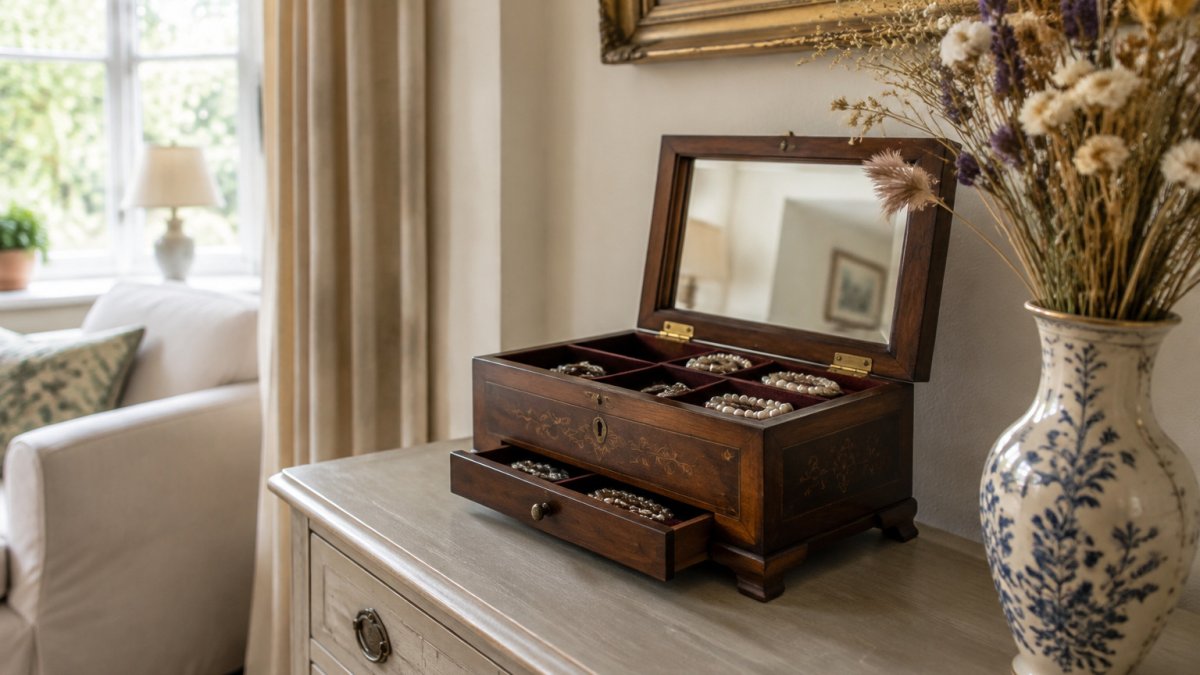
Classic interior. Pair the box with candlesticks, gilded frames, and velvet. Place it on a sideboard beside a dish of dried roses and a few antique books. Ideally, choose a box with brass fittings that complement the warm tones of the interior.
Modern minimalist interior. Use the box as a contrasting accent: a warm wooden object stands out among sleek, light-colored furniture without overwhelming the space. Display it on its own, without extra decorations around it, on a chest of drawers or in an open bookcase. One antique box per room is usually enough; more can quickly look cluttered.
Country or farmhouse interior. Choose a box with visible wood grain and light wear. Pair it with linen, pottery, and a simple vase of wildflowers. Place it on a wooden table or in a glass cabinet, where it blends in with other earthy materials.
Eclectic interior. Mix the box with modern and vintage pieces. An antique box beside a designer lamp or an abstract painting works precisely because of the contrast in age and texture. Dare to stack: place a small box on a stack of books or on a tray with other objects.
Retro or vintage interior. Pair it with items from the 1950s to the 1970s, such as an enamel dish or a teak piece of furniture. Pay attention to the color of the wood: mahogany goes with warm tones, while oak suits cooler ones.
Place the box on a chest of drawers, sideboard, or dressing table where it will be clearly visible. Pair it with a vase of dried flowers or a small devotional object as a focal point. See how antique devotional objects work as focal points in your interior. For a dressing table, place the box a little farther back so you can reach it every day without knocking it over.
!Antique wooden jewelry box with mirror on a chest of drawers in a bright living room
If you want to learn more about combining old and new pieces, read our overview of Antique vs. Modern Design for the Living Room. For beginners looking to build an interior around antiques, our [page:4] is a practical starting guide.
Choosing the right box for your interior
Choose a box based on where you want to use it and how much you want to store in it. For small jewelry and earrings, a box with drawers and compartments is most practical. For display on a shelf, a beautifully painted piece without compartments will do.
The [page:1] is a good example of a wooden box with a mirror. Also take a look at the [page:2] for another distinctive piece. If you want something special as a gift or for your own home, it helps to first decide what size and style suit you.
Discover our collection and give an antique jewelry box a second life in your home.
Frequently Asked Questions
What should you look for when buying an antique jewelry box?
Check the condition of the wood, lock, and finish. Make sure the hinges work smoothly and that the interior, such as the lining or mirror, is still original. Cracks and damage are normal in antiques, but they should be clearly described before you buy.
How do you care for antique wooden jewelry boxes?
Vacuum or wipe the box regularly with a soft, dry cloth. Avoid strong cleaning products and direct sunlight or heat, as these can dry out the wood and cause it to crack. Also check the lock and hinges regularly.
How do you style an antique box in a modern interior?
An antique jewelry box works well as a contrast in a sleek, modern interior. Place it on an open shelf, a sideboard, or a nightstand, among modern objects with clean lines. Choose a box with character, such as a painted or lacquered piece, so it creates a distinct accent. Keep the rest of the room uncluttered so the box can really stand out.
What is the difference between vintage and antique jewelry boxes?
In the Netherlands, antique generally means that an object is more than 100 years old. Vintage is a broader term for objects from a later period, often after the Second World War, that are considered stylish. A 19th-century box is therefore antique, while one from the 1950s is vintage. Both can make beautiful storage pieces; the main difference lies in age, finish, and price.
