

Antique silver vs silver-plated: buy with confidence
Table of contents
- The difference between antique silver and silver-plated ware
- Recognizing silver finenesses and hallmarks in antique silver
- Determining the value of antique silver: appraisal and market price
- Testing silver: practical methods for verifying authenticity
- Buying religious statues online: what to look out for
- Antique versus modern silver: authenticity and investment
- Care and cleaning of silver objects
- Conclusion
- Frequently Asked Questions
Last updated: September 20, 2026
The difference between antique silver and silver-plated ware
Antique silver differs from silver-plated ware because antique silver is solid silver with a fineness of 800-925 parts per thousand. Silver-plated ware has a thin layer of silver over copper or brass. This difference determines price, durability, and value.
Antique silver retains its value because the material itself is valuable. Silver plating wears off with use; without the silver layer, you have a worthless copper object.
Recognizing silver finenesses and hallmarks in antique silver
To determine whether you are dealing with antique silver or silver-plated ware, you need to know what to look for. Each country had its own standards and hallmarks, and those codes tell you exactly what you have in your hands.
Silver hallmark and maker's marks
The silver hallmark is your first clue. In the Netherlands and Belgium, hallmarks were legally required, with the maker's initials next to the fineness mark.
For religious objects, check the back or underside; many objects have hallmarks in less visible places.
Silver-plated objects sometimes have a stamp marked "verz." or a silver-plating hallmark, which is not the same as a silver fineness mark.
Alloy and fineness mark
The fineness mark tells you how much pure silver the object contains. The standards were:
- 925 silver (also called "sterling"): 92.5% pure silver, 7.5% other metals (usually copper)
- 800 silver: 80% pure silver, 20% alloy
- 750 silver: 75% pure silver (less common)
Many handmade antique religious objects have no hallmark. Without a hallmark, authenticity is more difficult to prove.
Determining the value of antique silver: appraisal and market price
The value of antique silver depends on the material, craftsmanship, and historical significance.
Material value as a basic calculation
Material value is the starting point: multiply the weight by the fineness to find the pure silver content.
Silver prices fluctuate daily, but material value is only the baseline, not the final price.
Calculation example:
- Object: silver devotional object, 150 grams, 800 silver
- Fine silver: 150 × 0.80 = 120 grams
- At €0.75/gram: 120 × €0.75 = €90 material value
This is what you would get if you melted down the object. Antique silver is rarely sold at material value.
Added value from craftsmanship and historical context
Antique silver is generally sold for 2-5 times its material value. 19th-century religious objects by respected silversmiths can fetch 2-3 times their material value. Original patina increases the value; repairs reduce it by 30-50%. Clear hallmarks add 20-40% in value; missing marks reduce it significantly.
Practical appraisal guidelines by category
Religious devotional objects (solid antique silver)
- Simple figurines (10-15 cm, 50-100 grams): €80-€150
- Detailed figurines (15-25 cm, 150-250 grams): €180-€400
- Artisan pieces or by named artists: €400-€1,000+
- Very rare iconography or early 19th-century: €600-€2,000+
Silver tableware (forks, spoons, knives)
- Individual pieces, standard design: €15-€40 per piece
- Complete cutlery set (6-12 pieces): €150-€400
- Artisan pieces or Art Deco: €400-€1,000+
Silver jewelry and small objects
- Rings, brooches, necklaces: €50-€200
- Antique jewelry with gemstones: €200-€800+
Silver-plated objects
- Standard silver-plated tableware: €10-€40 per piece
- Decorative silver-plated objects: €20-€100
- Artisan pieces or rare designs: €100-€300
Silver-plated objects have no material value, only aesthetic value. Once the silver layer wears away, the value drops to zero.
Investment risks: silver as an investment versus a collectible
Antique silver increases slowly in value (15-25% over 10 years) and depends on collector trends and market demand. Risks include limited liquidity, sensitivity to trends, and repair costs.
Buy antique silver because you like it, not for returns. For returns, buy bullion or silver funds.
Professional appraisal
For valuable objects (over €200), professional appraisal is always better than self-testing. A goldsmith or antiques dealer can:
- Confirm the fineness using non-destructive tests
- Determine the period and origin
- Identify restorations or forgeries
- Provide a written report for insurance purposes
Cost: €25-€75 per object, depending on complexity. This is a small investment for peace of mind.
Testing silver: practical methods for verifying authenticity
If you are unsure whether something is solid silver or silver-plated, there are several testing methods. Some require no tools, while others do. The method you choose depends on what you want to know and how certain you need to be.
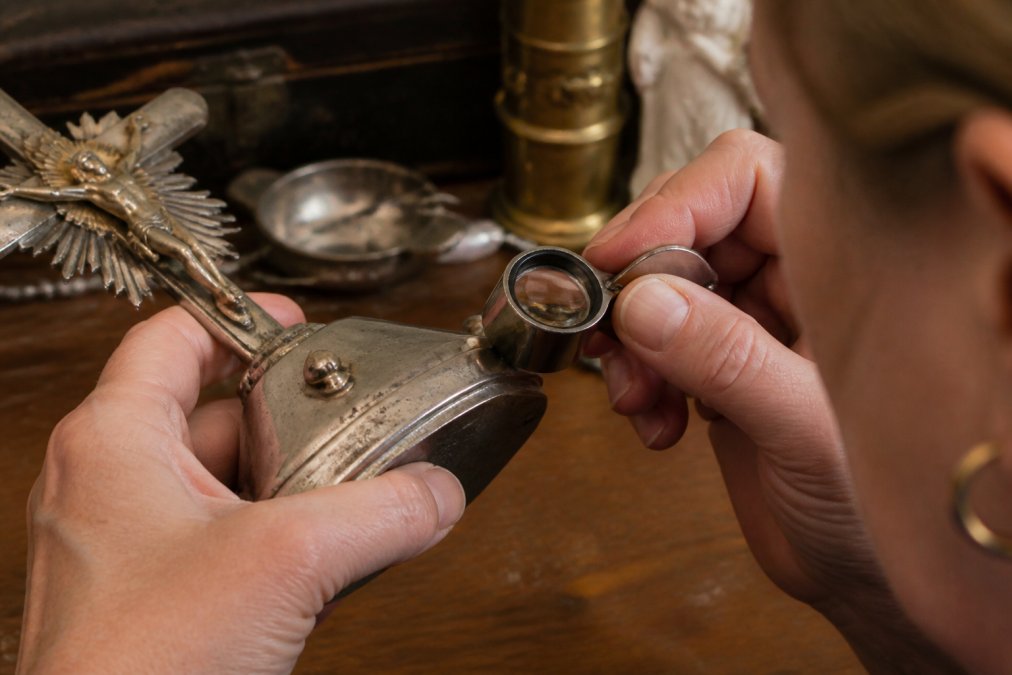
Quick screening tests (without tools)
The weight test: Silver-plated objects are much lighter than solid silver. Silver has a density of ~10.5 g/cm³; copper ~8.9 g/cm³. Hold two objects of the same size in your hand; solid silver feels considerably heavier.
The magnet test: Pure silver is not magnetic. Place a strong neodymium magnet against the object. Solid silver does not react. Silver-plated copper or brass may be slightly magnetic, especially if the silver layer is thin.
Limitations: Some alloys in antique silver (especially German 800 silver) may be very weakly magnetic. This test is therefore not conclusive, but it can still help.
Pure silver tastes neutral; copper or brass beneath a thin plating tastes bitter. This old goldsmith's trick works, but is not hygienic.
Reliable tests (with simple tools)
Checking the hallmark: This is the most reliable method without destructive testing. A 10x magnifying glass is sufficient. Look for:
- The fineness mark (925, 800, 750, etc.)
- The maker's mark (the silversmith's initials)
- The shape and depth of the hallmark
Solid silver has hallmarks that are deeply and sharply stamped. Fake hallmarks are often shallow, irregular, or blurry. Silver-plated objects sometimes also have a hallmark, but it indicates that the object is silver-plated (you may see "silver-plated" or a specific silver-plating hallmark).
Practical tip: Always check the back or underside of the object. Many religious statues have hallmarks in less visible places.
The density test: If you have a scale and water, you can calculate the density:
- Weigh the object (in grams)
- Submerge it in water and measure the volume (in ml or cm³)
- Density = weight ÷ volume
Silver: 10.5 g/cm³ Copper: 8.9 g/cm³ Brass: 8.4-8.7 g/cm³
If the density is close to 10.5, it is probably solid silver. This is very accurate, but requires precision.
Professional tests (destructive or advanced)
Nitric acid test: A small drop of nitric acid is applied to an inconspicuous spot. Solid silver does not react (it stays white). Copper or brass beneath silver plating turns green or black. This is destructive (it leaves a small mark), but it is conclusive.
Cost: €10-€20 if you do it yourself (buying nitric acid), or €30-€50 if a professional does it.
X-ray fluorescence (XRF): A portable XRF scanner determines the elemental composition without damaging the object.
Quick reference table for laypeople
| Test | Solid Silver | Silver-plated | White metal/Fake |
|---|---|---|---|
| Weight | Heavy for its size | Light | Very light |
| Magnetism | Not magnetic | May be weakly magnetic | Magnetic |
| Taste | Neutral metallic | Bitter/sharp (copper) | Metallic but different |
| Hallmark | Deep, sharp, clear fineness mark | Surface or "pl." mark | No hallmark or fake |
| Density | ~10.5 g/cm³ | ~8.5-9.0 g/cm³ | Varies |
| Nitric acid | No reaction (white) | Green/black (copper) | Color change |
| Cost | , | , | , |
| Reliability | High | High | High |
What if you cannot find a hallmark?
A missing hallmark makes authentication difficult, but not impossible. Many handmade antique objects, especially religious statues from the 18th and early 19th centuries, have no hallmark. This was not always legally required.
In this case:
- Check the weight and density
- Look at how it was made (handcrafted vs. machine-made)
- Examine the patina and wear (genuine antique silver shows specific signs)
- Have it professionally tested
Buying religious statues online: what to look out for
Buying religious statues and devotional objects online carries risks. You cannot handle the object before paying.
Antique versus modern silver: authenticity and investment
Antique silver (50+ years old) is generally handmade with deep, sharp hallmarks and purer material (often 950+). 19th-century religious objects are almost always solid silver.
| Aspect | Antique Silver | Modern Solid Silver | Silver-plated |
|---|---|---|---|
| Material value | High (800-950) | Average (925) | Almost none |
| Hallmark | Usually present | Almost always | Sometimes (silver-plating mark) |
| Handcrafted | Handmade/early industrial | Machine-made | Varies |
| Durability | Remains silver | Remains silver | Low (wears away) |
| Investment | Yes, slowly | No | No |
| Price | €100-€500+ | €50-€200 | €20-€100 |
Care and cleaning of silver objects
Solid antique silver is durable but requires careful care. Oxidation (patina) is normal, not damage.
Conclusion
The difference between antique silver and silver-plated determines what you are buying: an investment or a beautiful object. Solid silver remains silver and appreciates slowly. Silver-plated is consumable; it is beautiful until it is not.
Frequently Asked Questions
What is the difference between antique silver and silver-plated?
Antique silver is solid precious metal with a specific silver content (usually 800, 835, or 925 parts per thousand), while silver-plated items have a thin layer of silver over another metal. Antique silver has greater value and durability. Silver-plated objects are lighter and cheaper, but the silver layer can wear away. For religious figurines and devotional objects from earlier centuries, solid silver is much rarer and more valuable than silver-plated work.
How do I recognize hallmarks on antique silver?
Look for silver hallmarks, usually on the underside or inside of the object. These indicate the silver content (800, 835, 925) and often include a maker's mark from the silversmith. Antique German, French, and Dutch objects have country-specific hallmarks. A maker's mark with initials helps identify the maker. Solid silver feels heavier than silver-plated items and has no breaks in the silver layer.
How do I determine the value of antique silver?
The value depends on silver content, weight, craftsmanship, age, and condition. Religious figurines and devotional objects from the 19th and early 20th centuries often command premiums because of their historical and cultural value. Consult an appraiser for valuable pieces. Online market value varies by seller; collectors pay more for rare objects than for everyday-use items. Original condition and authenticity significantly increase the price.
What should I look for when buying religious figurines online?
Check photos for clear silver hallmarks, maker's marks, and dimensions. Read descriptions carefully; distinguish antique from vintage and solid silver from silver-plated. Buy only from sellers who guarantee authenticity or offer certificates. Ask about provenance and condition. Ensure safe packaging, especially for fragile plaster or ceramic objects. Check reviews from other collectors. Chez Monique's 2nd Life offers carefully selected religious objects with reused, sustainable packaging that ensures safety.