

Antique silver as an alternative to devotional items
Table of contents
- Why antique silver is an alternative to devotional items
- Determining the value of antique silver: hallmarks, silver marks, and appraisal
- Caring for antique silver: patina, shine, and maintenance
- Relimarkt vs dekofferzolder comparison: where should you buy antique silver?
- From silver tableware to curiosities: collectible objects with character
- Investment value versus emotional value of antique silver
- Interior styling with antique silver: heritage at home
- Conclusion: Give antique silver a second life
- Frequently Asked Questions
Last updated: September 17, 2026
Why antique silver is an alternative to devotional items
Anyone looking for a devotional object usually first thinks of copper, bronze, or pewter. Yet antique silver is a fully-fledged alternative to devotional items: it carries the same historical value and symbolism, but with a cooler, more refined appearance that suits almost any interior.
The difference lies in the details. Whereas devotional items are often explicitly religious and therefore appeal to a specific audience, antique silver is more neutral in character. An 18th-century silver cup or a 19th-century teaspoon can tell a story about artisanal metalworking and provenance, without the viewer having to interpret a religious meaning. That makes silver appealing to collectors and to people who buy purely for its aesthetics.
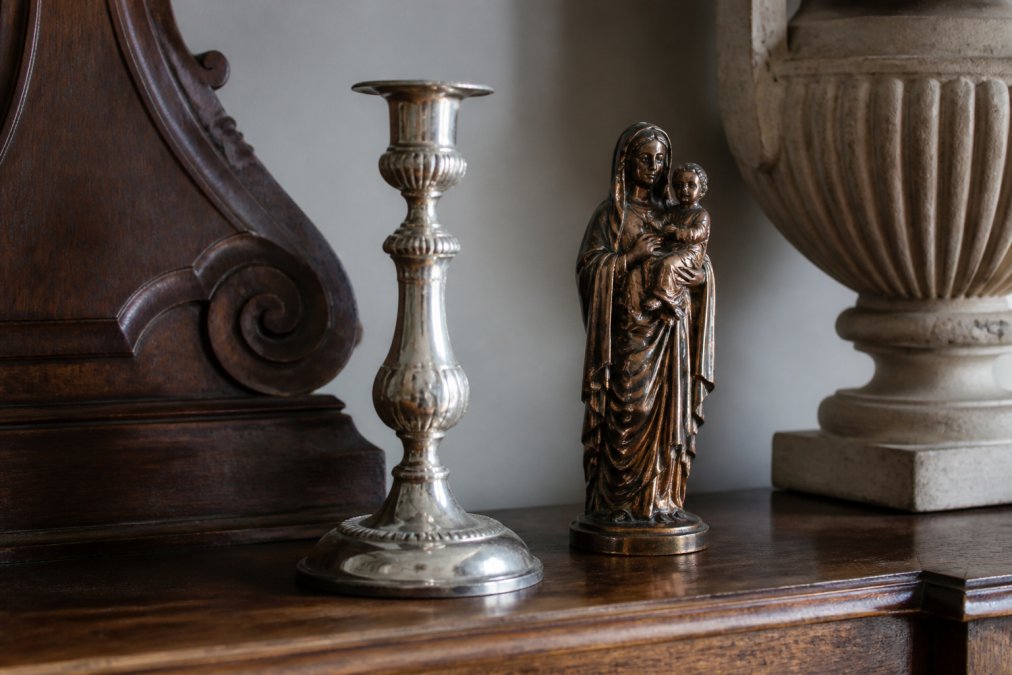
The historical value runs parallel. Both categories are heritage that lasts for generations, and both require careful maintenance. Silver's great advantage is that it is timeless enough to stand apart from a specific devotion, while it can take on the same emotional significance once it has a place in the home.
Determining the value of antique silver: hallmarks, silver marks, and appraisal
Determining the value of antique silver starts with the marks, not the shine. Silver marks and hallmarks can provide information about the maker, origin, and fineness of a piece. Without that information, the price can be uncertain. However, anyone considering a devotional object as an alternative may wonder whether the value of silver outweighs the significance of devotional items.
Recognizing silver marks and hallmarks
Silver marks are small stamps, usually found on the bottom or edge of an object. You look for three things: the maker's mark, the fineness mark, and the date letter. In the Netherlands, silver has traditionally been marked with fineness marks such as a lion for first-grade silver (925/1000) and a passant lion for second-grade silver (835/1000). A city mark can reveal the origin.
A 10x magnifying glass is not a luxury but a necessity; many marks are barely legible after decades of polishing.
Why devotional objects are valued differently
This is the difference most silver shops do not mention. Devotional objects, saint figurines, crucifixes, and holy-water vessels are rarely valued by weight or fineness. Their value comes from devotional rarity: a processional cross from a specific parish, a figurine by a recognizable maker, or an object connected to a pilgrimage site. This makes the market more opaque than that for silver, where fineness and maker provide an objective lower limit.

Valuation and provenance: what determines the price?
Valuation is about more than weight. Factors that determine the price:
- Provenance: a piece with a clear city hallmark and maker's mark has a different story than an anonymous object.
- Rarity: small artisanal pieces such as a pomander or a silver rattle are rarer than mass-produced items from later decades.
- Condition: patina is acceptable, but green residue and dents are not.
- Craftsmanship: richly worked silver carries more weight in the price than smooth surfaces.
- Weight: with silver, there is a certain lower limit based on the metal itself, an advantage devotional objects do not have.
Caring for antique silver: patina, shine, and maintenance
The basic rules:
- Do not polish with aggressive products; a soft cloth and lukewarm water with a drop of mild soapy water are usually enough.
- Leave dark discoloration in deep grooves. That is where the historical value lies.
- Store silver in a dry place away from direct sunlight; moisture and UV damage its shine.
- Touch objects as little as possible with bare hands; grease leaves stains.
For copper or bronze devotional objects, a similar approach applies: do not scrub, do not soak, just wipe dry. This keeps the heritage intact.
Relimarkt vs dekofferzolder comparison: where should you buy antique silver?
The comparison between the religious market and Dekofferzolder boils down to two different ways of buying: mass versus selection. On large platforms, you find plenty of choice but little quality control. With a smaller, carefully curated collection, you get less choice but more certainty about provenance and condition.
| Aspect | Large platform | Carefully curated collection |
|---|---|---|
| Selection | Very large, varies | Limited, selected |
| Authenticity check | Limited | Assessed individually |
| Negotiation | Often possible | Fixed prices |
| Shipping | Varies by seller | Carefully packaged |
| Personal contact | Rarely | Direct contact with the seller |
From silver tableware to curiosities: collectible objects with character
From silver tableware to curiosities, the category of collectible objects with character is broad. Devotional objects also fall within this range, and this is precisely where you can see how silver and religious objects complement each other.
Pomander, rattle, and birth gifts
A pomander, rattle, and birth gifts can form a distinct branch of collecting. The pomander was originally a perfume container worn on a chain; the silver rattle with bells was a classic birth gift. Both are handcrafted and often richly decorated.
Beautiful copper/bronze saint figurine St →
Art Deco and Art Nouveau: styles and periods
Art Deco and Art Nouveau are the two styles collectors mention most often. Art Nouveau from around 1900 is characterized by flowing lines and botanical motifs (Art Nouveau - an international style). Art Deco, from the 1920s and 1930s, is more geometric and streamlined. An eighteenth-century silver piece is quite different again: more understated, with the emphasis on proportions.
Investment value versus emotional value of antique silver
Investment value versus emotional value is at the heart of every collector's decision, and the two are more often at odds than people think. Anyone considering antique silver as an alternative to devotional objects would do well to weigh both values explicitly, precisely because the two categories behave very differently in this respect.
How silver and devotional objects compare in the long term
Antique silver may have one characteristic that devotional objects lack: the precious metal itself may retain residual value. A 19th-century silver spoon with an unclear maker's mark may not become completely worthless, because its silver content can provide a baseline value. With devotional objects, copper saint figurines, bronze crucifixes, and tin holy-water fonts, that baseline is absent. Their value depends entirely on collector demand, which fluctuates with fashion, availability, and broader interest in religious heritage.
Emotional value as a driver of market value
What most buyers do not know: emotional value often influences market value over time. Objects that remain within a family for generations become rarer and therefore more sought after. This applies to both silver and devotional objects, but at different rates. A silver birth gift can often be passed down and therefore appear on the market less frequently than a mass-produced item. A devotional object connected to a specific family or parish may become scarce for the same reason, but the circle of interested buyers is smaller.
Interior styling with antique silver: heritage at home
Interior styling with antique silver is all about contrast and light. A silver bowl on a rough wooden table, a candlestick next to a copper figurine, a silver teaspoon in a glass display cabinet: these are examples of small changes with a big impact.
Three practical principles:
- Work with light. Silver comes to life in daylight and candlelight. Do not place pieces in a dark corner.
- Mix materials. Silver alongside copper, bronze, or wood prevents a cabinet from feeling like a museum display case.
- Limit the number. Two or three striking pieces make a greater impact than a full shelf.
Conclusion: Give antique silver a second life
The challenge is not finding antique silver, but finding a piece you can be sure is authentic. Marks, provenance, and condition can determine whether you are buying a curiosity or a disappointment. At Chez Monique's 2e Leven, we select based on precisely those points: carefully inspected objects, sustainable shipping with reused packaging materials, and a collection in which devotional items and unique collectibles stand side by side.
Frequently Asked Questions
What is the value of antique silver and how do I determine it?
The value of antique objects depends on age, rarity, and condition. Have an item appraised by a specialist if in doubt. Pay attention to the patina: it can increase the historical value, but heavy damage lowers the price.
How do I care for antique silver without damaging the patina?
Caring for antique objects is about balance: remove tarnish with a soft cloth and avoid harsh chemicals. Leave patina in the deeper grooves, as it tells the story of the piece. Store objects in a dry environment. Do not polish too often, as each polishing can remove a microscopic layer of the material.
Why do collectors choose devotional items instead of antique silver?
Collectors of devotional items often choose them for their spiritual and emotional meaning, while antique silver is primarily appealing for its aesthetic and historical qualities. Devotional items such as saint figurines and crucifixes have a devotional function, while silver objects such as tableware and curios have a handcrafted and decorative value. Both categories share craftsmanship, patina, and heritage.
How does Relimarkt compare with Dekofferzolder if I am looking for antique silver?
A comparison between Relimarkt and Dekofferzolder comes down to selection, price, and reliability. Relimarkt often offers a wide range of objects, but the quality can vary. Dekofferzolder focuses more on devotional items and religious objects. Chez Monique's 2e Leven offers a carefully curated collection of antique and vintage objects, with a particular focus on religious statues, devotional items, and unique collectibles, with an emphasis on sustainability and safe shipping.
Are there hallmarks for antique silver that I should look out for?
Hallmarks and marks can be essential for antique objects. These marks can provide information about the origin and material. Always ask about the provenance and have an item appraised if in doubt.