

Dekofferzolder alternatives: 5 better vintage destinations
Table of contents
- Why dekofferzolder alternatives are needed for vintage collectors
- Comparison: relimarkt vs dekofferzolder vs Chez Monique's 2e Leven
- The best sustainable vintage online shops for interior and decoration
- Buying devotional items online: what should you look for in religious objects?
- Checking authenticity: how to recognize a genuine antique
- Maintenance and restoration of vintage finds
- Price–quality ratio: what are you really paying for with the alternatives?
- Conclusion: choose the right platform for your collection
- Frequently Asked Questions
Last updated: September 9, 2026
Why dekofferzolder alternatives are needed for vintage collectors
Anyone who has been buying from the same platform for years as a collector of devotional objects and antiques is unknowingly missing a large part of the market. The search for dekofferzolder alternatives for vintage collectors is not a matter of dissatisfaction, but of growth: every platform has its own collection, prices, and selection process. Those who limit themselves to one source simply see fewer remarkable pieces come by.
The key question is not whether you should expand, but where you should look. You can recognize a good alternative by three things: a carefully curated selection, transparent information about condition and provenance, and an approach that goes beyond simply reselling. At Chez Monique's 2e Leven, that combination is precisely what matters: every object is selected for authenticity and character, with a particular focus on religious art and devotional objects that rarely appear in general online shops.
Below, we compare the main options so you know which platform suits your collecting goals. We look at selection, price level, and the extent to which you can rely on the authenticity of what you buy.
Comparison: relimarkt vs dekofferzolder vs Chez Monique's 2e Leven
The three main types of sellers for vintage devotional objects differ fundamentally in their approach. A marketplace-style platform offers volume and low prices, but requires you to assess authenticity yourself. A specialized online shop such as Chez Monique's 2e Leven preselects items, reducing the risk of disappointment.
| Platform type | Selection | Authenticity | Price level | Best for |
|---|---|---|---|---|
| Marketplace model | Large, varied | Assess yourself | Low | Knowledgeable seekers |
| General vintage shop | Broad, unsorted | Limited inspection | Average | Atmospheric finds |
| Specialized online shop | Small-scale, handpicked | Extensive inspection | Higher | Serious collectors |
Those specifically looking for devotional objects notice the difference immediately. A general vintage online shop mainly sells home accessories and furniture; religious objects are secondary there. This means less knowledge of the materials, periods, and features that determine whether a piece is genuinely antique or a later copy.
The comparison between relimarkt and dekofferzolder and a specialized provider ultimately comes down to trust versus price. Chez Monique's 2e Leven consciously chooses the former: a carefully curated collection in which every object has been checked for authenticity, condition, and provenance.
The best sustainable vintage online shops for interior and decoration
Most overviews of vintage online shops stop at a simple list of names. But for a collector who wants to look beyond the first page of search results, the real challenge is not finding a shop; it is finding one that matches the specific search. A collector of devotional objects has different needs from someone looking for a 1970s dining chair.
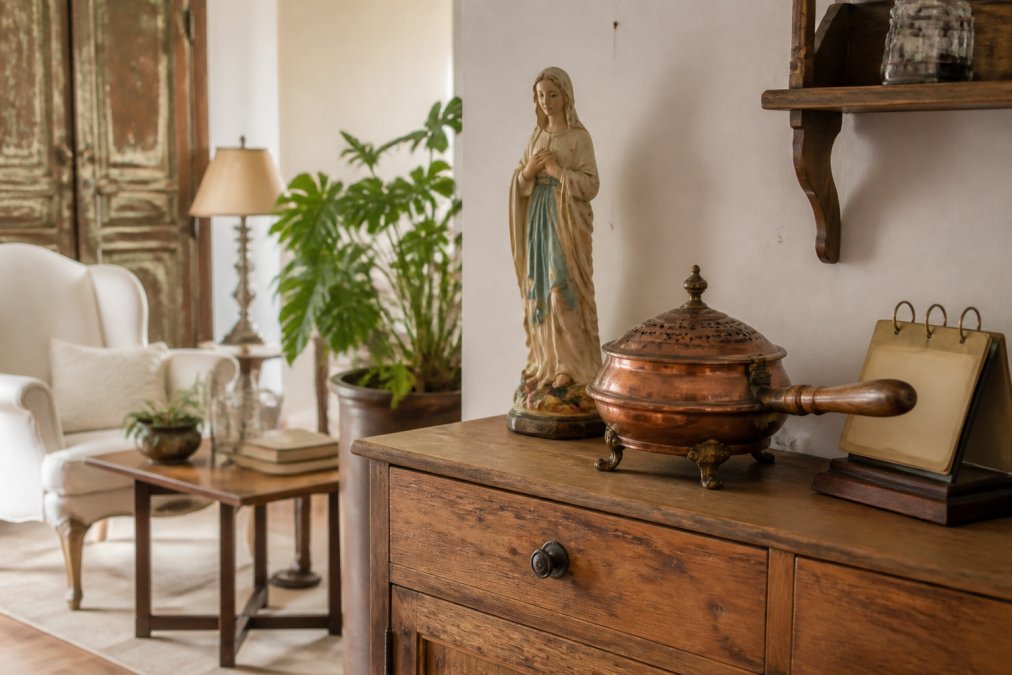
An effective strategy, therefore, is not just visiting well-known names, but using targeted search terms that the competition overlooks. Instead of searching for “vintage online shop,” search for “brocante shop specializing in religious objects” or “antique wooden objects online shop.” This often turns up smaller, specialized sellers that do not appear in Google's top 10 results but do have a carefully curated collection.
It is also important to look at how an online shop presents its objects. An online shop that describes the period, material, and condition of each object demonstrates expertise. An online shop that only says “beautiful old figurine” does not offer that same assurance. Also pay attention to the photography: an object photographed from multiple angles, including close-ups of details such as cracks or patina, demonstrates transparency.
A unique angle that virtually no overview mentions is using social media as a search tool. Many smaller vintage dealers do not sell their best pieces through their online shops, but showcase them first on Instagram or Facebook. A collector who actively follows brocante and antique dealer accounts sees objects days before they appear on the website. It is an accessible way to gain access to a selection that is not visible to everyone.
A second often-overlooked strategy is visiting physical brocante markets and antique fairs in the Netherlands and Belgium. Online shops are convenient, but many unusual finds are never offered online. Those who build a relationship with a regular dealer at a market are often the first to hear when new pieces come in.
Sustainability plays a greater role in this choice than many buyers realize. Reusing existing objects saves the raw materials and energy involved in producing new ones. Choosing a vintage interior contributes to a circular economy without compromising on style or quality. Reusing packaging materials, as Chez Monique's 2e Leven does, reinforces that principle right to your doorstep.
An antique 19th-century wooden jewelry box with its original mercury mirror costs around €76.00 and immediately adds character to a cabinet or sideboard (rijksmuseum.nl). The foot warmer from the 1930s is an affordable statement piece at €72.50 that is still functional. This is how you combine sustainability with objects that tell a story.
Buying devotional items online: what should you look for in religious objects?
Religious objects require a different assessment from ordinary vintage decor. When buying devotional items online, it is about more than appearance alone: the period, material, and provenance determine the value. A French plaster statue of Mary from the 1920s–1940s with authentic patina differs fundamentally from a modern reproduction designed to look old.
The first question to ask is: was the object made for devotional use or purely as decoration? Antique holy water bottles from Lourdes, such as a lot of six dating from the 1950s to the 1980s, served a religious purpose. That history makes them valuable to collectors, but also interesting for anyone who wants to use them purely as vintage objects with character.

Also look for specific features that reveal authenticity. A maker's mark, such as 'Aux Santons D'Art / J Spery' on a French statue of Mary, is a strong indication of authenticity. The condition of the material also tells a story: natural patina on plaster or wood develops only through years of use and is virtually impossible to fake.
Checking authenticity: how to recognize a genuine antique
Identifying genuine antiques requires knowledge of materials, production techniques, and period-specific features. A common mistake is relying solely on appearance. For example, there are Madonna statues that look authentic at first glance, but the absence of a monogram or maker's mark raises questions about their provenance.

The most reliable checks are: material examination, stylistic features, and documentation. A glass Madonna by Glasfabriek Leerdam from 1929 is immediately recognizable by its Art Deco design, even without Steph Uiterwaal's monogram (boijmans.nl). The Fostoria Glass Madonna “Silver Mist,” on the other hand, still bears its original sticker, underscoring its authenticity.
This is where a specialist webshop sets itself apart from a general platform. The selection at Chez Monique's 2e Leven is made by someone who recognizes the period, material, and maker, significantly reducing the risk of forgeries or incorrect dating.
Maintenance and restoration of vintage finds
Vintage objects require maintenance suited to their age and material, not modern cleaning methods. An antique wooden box dating from around 1810–1840 with an original mercury mirror requires a different approach from a recently manufactured piece of furniture. Aggressive cleaning products can irreparably damage the varnish, painted decoration, or patina.
The basic rule is: less is more. Removing dust with a soft, dry cloth is sufficient for most objects. For copper objects such as the copper foot warmer, polishing with a mild copper polish will restore the shine, but you should protect the velvet upholstery. Glass and crystal are best cleaned with lukewarm water and a mild dishwashing liquid, without abrasive sponges.
Important when it comes to restoration: be cautious. An original mercury mirror with slight clouding, silver spots, and black specks is authentic. Replacing or recoating it destroys precisely the characteristics collectors value. What may seem like an imperfection to a layperson is proof of age to an expert.
Price–quality ratio: what are you really paying for with the alternatives?
The price differences between platforms are greater than the recommended retail prices might suggest. A low purchase price on a marketplace-style platform does not automatically mean a good deal: without authentication, you run the risk of buying copies or heavily restored objects.
To make an informed choice, it is useful to consider what you get for your money. A simple rule of thumb among collectors is that the price of an object consists of three components: the object itself, the knowledge needed to assess it, and the certainty that it is authentic. A marketplace-style platform offers only the first; a specialist webshop provides knowledge and certainty.
Specifically, this means that a comparison based solely on purchase price is not enough. A Madonna statue offered for €50 on a marketplace may later turn out to be a reproduction. The same statue, inspected and documented by a specialist dealer for €150, offers certainty. The difference is not the price, but the certainty.
With specialized providers, you pay for selection, expertise, and certainty. A rare Madonna by Steph Uiterwaal for Glasfabriek Leerdam from 1929 costs €262.50, but that is an investment in an authentic piece of Dutch glass art. An antique Napoleon III perfume box from around 1860 with original crystal bottles is priced at €215.00, a fair price for a well-preserved 19th-century object (britishmuseum.org).

A practical approach for anyone setting a budget is to use a three-part discussion: determine in advance your maximum expenditure for a specific type of object, research the prices commonly charged by specialized dealers, and be prepared to wait for the right piece. Those in a hurry often pay more for an object that does not fully meet their expectations.
It is also wise to consider the condition of an object and the potential cost of any repairs. A statue with a crack requiring professional restoration may seem cheaper in the short term, but restoration costs can quickly drive up the total amount. When in doubt, always ask about the condition and whether any restorations have previously been carried out.
Serious collectors would rather build a collection of authentic pieces than one of questionable finds.
Conclusion: choose the right platform for your collection
The choice of platform depends on your ambition as a collector. Those mainly seeking atmosphere and content with decorative vintage will find sufficient offerings at general webshops. However, those who collect devotional items and antiques with a specific focus would do well to choose a provider that puts expertise and selection first.
Chez Monique's 2nd Life combines a carefully curated collection with sustainable shipping through the reuse of packaging materials, without compromising the safety of your purchase. Its focus on religious statues and unique collectibles makes the platform a logical choice for those who want to look beyond the standard dekofferzolder alternatives for vintage collectors.
Frequently Asked Questions
What are reliable alternatives to dekofferzolder for vintage collectors?
Reliable alternatives include specialized webshops such as Chez Monique's 2e Leven, which offer a carefully curated collection. Unlike large marketplaces, they provide guarantees regarding the object's authenticity and condition. Choose platforms that specialize in your collecting area, such as religious artifacts or art deco glassware. This way, you will find unique pieces more quickly and know for certain that the quality has been checked.
How do I know whether a vintage object is authentic?
Check for maker's marks, such as Steph Uiterwaal's monogram or the 'Aux Santons D'Art' label on French plaster statues. Always ask the seller about the object's provenance and request additional photos of the details. With specialized webshops, the chance of finding authentic pieces is greater because they carefully examine their objects. A mercury mirror with characteristic clouding or a natural patina are strong indications of authenticity.
What is the difference between brocante and antiques?
Antiques are officially more than 100 years old and often have a high collectible value. Brocante consists of second-hand decorations that are usually younger, often from the 1950s to the 1980s, and have a more rustic or French style. For collectors of religious artifacts, the distinction is important: a statue of the Virgin Mary from 1929 is an antique, while a holy-water bottle from the 1970s is brocante. Both can be valuable additions to your collection.
Are sustainable vintage webshops more expensive than marketplaces?
Not necessarily. Sustainable vintage webshops such as Chez Monique's 2e Leven offer transparent prices that reflect the quality and authenticity. An antique French statue of the Virgin Mary costs €152.50. You are paying for the expertise, careful inspection, and sustainable shipping. For unique objects such as a rare Steph Uiterwaal Madonna priced at €262.50, that is a fair price.
Can you also use religious artifacts as interior decoration?
Certainly. Many religious artifacts, such as statues of the Virgin Mary, holy-water bottles, and statues of saints, fit perfectly into a vintage or eclectic interior, even without a religious background. An antique French statue of the Virgin Mary with child from Marseille brings history and character to any room. The clean lines of art deco glassware or the warm appearance of copper create a unique atmosphere you will not find in regular home furnishing stores.
The right place to buy ultimately determines the quality of your collection. Choose a seller that checks every object for authenticity and condition, and makes exceptional pieces accessible. Discover the selection from Chez Monique's 2e Leven and give special objects a second life in your own interior.