

7 reasons to choose an antique wooden altar cross
Last updated: November 4, 2026
Quick Summary
An antique wooden altar cross is worthwhile because it is a tangible piece of religious heritage that has been preserved for generations and is now given a second life in the home. The solid wood, woodcarving and patina make each piece unique and impossible to replicate. This way, you add a historically valuable heirloom that will last for generations with proper care.
- Check the patina, grain, weight and surface in daylight, without rushing.
- Mortise-and-tenon joints with wooden pegs point to old-world craftsmanship.
- Keep the humidity between approximately 45 and 60 percent to prevent cracks and mold.
- Dust it with a soft, dry cloth and do not use furniture polish containing silicone.
- Present the cross as a sculpture with a story, not as a religious object.
Table of contents
- Why an antique wooden altar cross is increasingly finding its place in the home
- Craftsmanship and solid wood: what makes an old cross unique
- How to recognize authentic religious antiques: how to inspect an altar cross
- Symbolism and Iconography of Altar Crosses: More Than a Crucifix
- Caring for antique wood: preserve the patina without restoring it
- Styling devotional objects in a modern home
- Sustainable design and heirlooms: why a second life matters
- Choose your altar cross from the Chez Monique's 2e Leven collection
- Frequently Asked Questions
Why an antique wooden altar cross is increasingly finding its place in the home
An antique wooden altar cross is a devotional object that transcends its original purpose: a tangible piece of religious heritage, preserved for generations and now given a second life in living rooms, hallways and quiet spaces.
The reason is simple. A solid wooden cross from the seventeenth or eighteenth century cannot be replicated without losing its soul.
Below, we explain what to look for when making such a purchase, how to recognize an authentic piece and why giving one a second life offers more than buying a new reproduction.
Craftsmanship and solid wood: what makes an old cross unique
First, look at the material.
Also look at the corpus. Is it made of wood, porcelain, copper or bronze? Each material belongs to a different tradition and price range. In our collection, for example, you’ll find an old wooden altar cross with porcelain corpus, 51 cm tall, and an antique wooden altar with a crucifixion and a copper corpus.

How to recognize authentic religious antiques: how to inspect an altar cross
Recognizing authentic religious antiques starts with a few things you can check yourself: patina, wear and wood type. Here is a step-by-step guide.
Step 1: examine the cross in daylight, without rushing
Place the cross on a table by a window. Artificial light hides color variations and makes fresh varnish invisible. Slowly turn the object around and look for the following four points:
- Color variation: real old wood has uneven coloring. Darker spots where hands have touched it, lighter spots where it has stood. An imitation is often evenly stained or has an artificial dark border along the grain.
- Grain: in solid wood, the grain continues across the arms of the cross. In veneer or a cast piece, the grain stops abruptly at the corners. Look especially at the transition from the vertical beam to the crossbeam.
- Weight: oak feels heavy and cool; limewood is lighter and has a finer grain. A cross that feels remarkably light for its size is often made of a modern type of wood or is hollow inside.
Step 2: examine the joints and the corpus
Turn the cross over and look at how the beams are joined. This is the most reliable sign you can identify as a layperson:
- Mortise-and-tenon joint with wooden pegs: indicates old craftsmanship. The pegs are often slightly darker than the surrounding wood and sometimes protrude a fraction.
- Screws or nails: modern screws have a fine, machine-cut thread and a sharp head. Old nails are hand-forged, irregular in shape, and often square in cross-section.
- Corpus: hand-carved work shows small differences between the left and right sides; a modern reproduction is uniformly smooth. On old pieces, the INRI inscription is painted or carved by hand, not stamped.
- Attachment of the corpus: an old corpus is often secured with a wooden peg or a wrought-iron pin; a modern reproduction uses glue or a small screw.
Step 3: assess wear in the right places
Wear is convincing only when it makes sense. A cross that has always stood on an altar shows wear on the bottom of the base and along the edges where it was handled. A cross that hung on a wall often has marks from a hanging hook and slight wear on the top of the crossbeam. Artificial wear is usually distributed too evenly or appears in places where no one would have touched the object.
- Base: should have scratches and small dents from being set down.
- Arms: the ends of the crossbeam are often slightly worn from leaning against a wall or other objects.
- Back: the reverse is often finished more roughly than the front; this is normal for old handmade pieces.
Step 4: smell and listen
Smell is an underrated tool. Old wood smells of dust, wax, and sometimes a hint of incense. A new reproduction smells of glue, paint, or chemical stain. Put your ear against the cross and tap the beam gently: solid wood sounds dull and full, while a hollow or cast construction sounds higher and thinner.
Step 5: reach a final verdict and know your limits
If more than one point differs, exercise caution. You can read more in our guide to antique crucifixes versus modern replicas.
Symbolism and Iconography of Altar Crosses: More Than a Crucifix
An altar cross is never just a cross. Its iconography tells a story that varies by period: the corpus, the position of the head, a skull at the base, the halo. Each element has meaning within the Catholic visual tradition. Once you learn to read the symbolism, you can see why one cross moves you and another does not. Below are the main elements, along with the periods in which they were common.
The corpus: from triumph to suffering
The corpus’s posture reveals the period and theological emphasis. An early medieval or Romanesque cross often shows Christ upright, with open eyes and a royal crown: a sign of victory, not an image of suffering. From the Gothic period onward, the emphasis shifts to suffering: the head droops, the eyes are closed, and the wounds are highlighted. The Baroque period takes this further with a dramatic corpus; a nineteenth-century example is more often restrained and symmetrical.
The skull at the base: Adam and redemption
A skull or pile of bones at the foot of the cross refers to Adam. According to tradition, the cross stood at the site of Adam’s grave, and the skull symbolizes that Christ’s death overcomes original sin. If you come across a skull, it usually points to a Catholic origin and a period when this symbolism was explicitly valued, often from the seventeenth through the nineteenth century.
The halo and the inscription INRI
The halo around Christ’s head is an ancient Christian symbol of holiness. On older crosses, it is often carved or painted on the wood; later examples may also feature a separate metal ring. The inscription INRI (Iesus Nazarenus Rex Iudaeorum) appears in almost every tradition, but its execution varies: hand-painted, carved into the wood, or on a metal plaque.
Other attributes you may encounter
- Latticework or rays behind the corpus: Common in the Baroque period and later, intended to suggest divine light.
- Candle holders and holy water basin: A miniature altar, often from the eighteenth or nineteenth century, intended for private prayer.
- Reliefs on the base: Floral motifs, chalices, or angel heads refer to the Eucharist or heavenly protection.
- Colors: Gilding and painting in red, blue, and gold follow the liturgical tradition; flaking is itself a dating aid.
Why this matters to collectors
For collectors, that is the difference between a beautiful object and an interesting one. Curating a collection is not about the number of pieces, but about the stories they tell together. A cross with a skull at its base tells a different story from a plain nineteenth-century example. Our guide to the meaning of iconography in religious art explores this in more depth.
Antique Wooden Altar Cross with Porcelain Corpus 51 cm →
Caring for antique wood: preserve the patina without restoring it
There’s one rule for caring for antique wood: do as little as possible. The patina is what gives it value. Every time you sand, varnish, or restain it, you remove a hundred years of history and risk lowering its value to collectors.
A few practical guidelines we share with our customers:
- Dust with a dry, soft cloth. Don’t use a wet cloth on untreated wood.
- Keep it away from radiators, heaters, and direct sunlight. Wood responds to changes in temperature.
- Keep humidity at around 45 to 60 percent; wood that’s too dry cracks, while wood that’s too damp grows mold.
- Don’t use furniture wax containing silicone. It soaks into the grain and can’t be removed.
The guiding principle here is restoration ethics: conserve, yes; renew, no. If you’d still like to take steps to care for the wood, our step-by-step guide to restoring vintage wooden furniture explains how to preserve the patina.
Styling devotional objects in a modern home
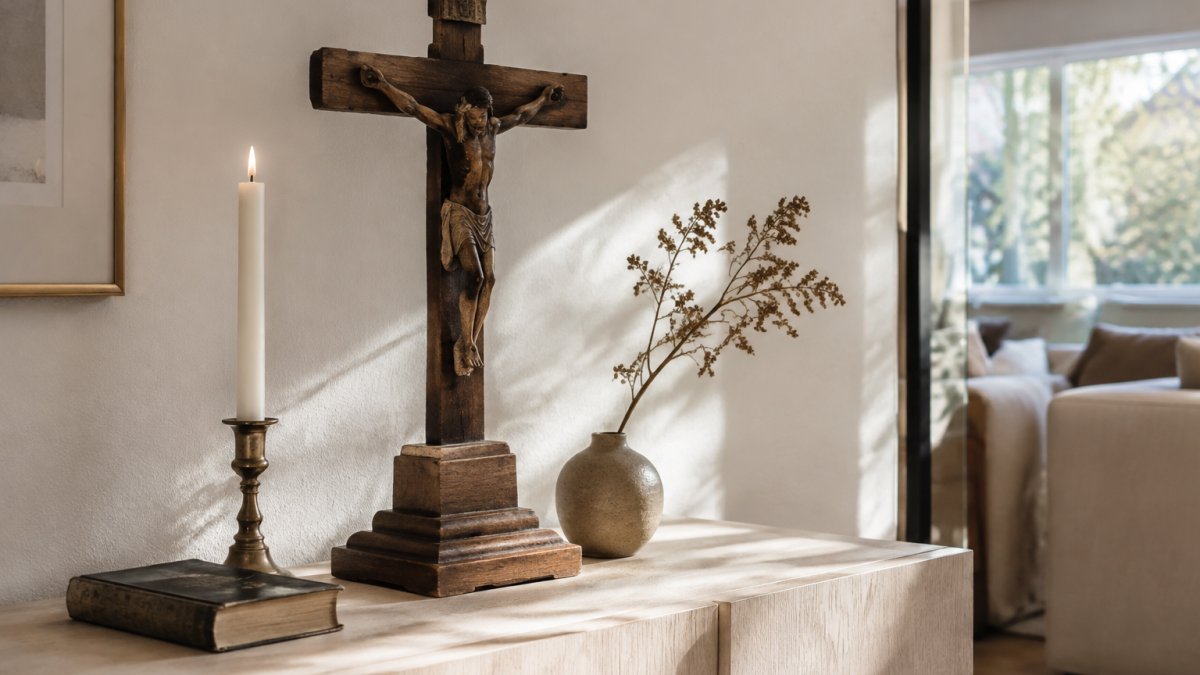
Styling devotional objects in an interior works best when you present the cross not as a religious object, but as a sculpture with a story.
Scale matters. A 51 cm tall cross needs space around it; on a crowded shelf, it disappears.
You don’t have to be religious to find an object like this beautiful.
Sustainable design and heirlooms: why a second life matters
Sustainable design starts with asking what already exists. Every antique object given a second life doesn’t need to be made again: no new raw materials, no new emissions, no new packaging.
There’s also the idea of an heirloom. A cross passed down through generations of a family carries something you can’t buy.
In practice, that also means careful shipping. We reuse packaging materials without compromising the safety of your purchase. A broken corpus can’t be replaced.
Choose your altar cross from the Chez Monique's 2e Leven collection
Our collection of crucifixes has been carefully curated. You’ll find a 51 cm antique wooden altar cross with a porcelain corpus from the 1970s for €71.50, an antique German wooden crucifix with candle holders and a holy water font from the 1920s or 1930s for €70.00, and a wooden crucifix from the 1930s with a bronze corpus for €55.00. Looking for a larger statement piece? The 33 cm antique wooden altar with a crucifixion scene is a great choice at €135.00.


Every piece is unique and will only be sold once. Browse the collection, look closely at the photos, and if you are unsure about an item's condition?
Choosing an antique wooden altar cross is a choice that calls for patience: an object that has lasted for decades and, with proper care, will stand for generations to come.
An overview of the pieces mentioned from our crucifix collection, with their features and prices.
| Object | Feature | Price |
|---|---|---|
| Old wooden altar cross | Porcelain corpus, 51 cm high, 1970s | €71,50 |
| Antique German wooden crucifix | With candle holders and holy water bowl, 1920s or 1930s | €70,00 |
| Wooden crucifix | With bronze crucifix, 1930s | €55,00 |
| Antique wooden altar with crucifixion scene | 33 cm high | €135,00 |
Frequently Asked Questions
How can you recognize an authentic antique wooden altar cross?
Look at three things: the patina, the joints, and the corpus. Truly old wood has an uneven, deep sheen that cannot be imitated, and the mortise-and-tenon joints are handmade. The corpus is often made of copper, bronze, or porcelain and shows signs of wear of its own. Compare details with photos of similar pieces.
What is the difference between an altar cross and a wall cross?
An altar cross is intended to stand on an altar or table and often has a wider base or a corpus. A wall cross is flatter and has a hanging hook or loop. Antique altar crosses are generally larger and heavier, such as examples measuring 51 cm or 36 cm high. In a modern interior, you can also place an altar cross on a sideboard, as long as it stands securely.
What determines the value of an antique wooden crucifix?
The value depends on age, type of wood, condition, and completeness. Oak and linden are popular, as are exotic woods. An original corpus made of copper, bronze, or porcelain increases the value, as do intact mortise-and-tenon joints and the preservation of the original finish. Damage to the corpus or extensive restoration lowers the price. Provenance documentation helps, but is often missing for devotional objects.
How do you care for an antique wooden altar cross without losing its patina?
Dusting with a dry, soft cloth is usually enough. Do not use damp cloths or harsh cleaners, as they damage the patina. Keep the cross out of direct sunlight and away from radiators so the wood does not dry out further or crack. If you want to do something about dullness, use a minimal amount of furniture oil on an inconspicuous spot. Leave restoration to a professional.
