

7 Features for Recognizing an Antique Rosary
Table of contents
- Why Recognizing an Antique Rosary Is About More Than a Year
-
The Seven Characteristics: A Checklist for Recognizing an Antique Rosary
- 1. Beads and Material: Recognizing Rosary Bead Material
- 2. How Many Beads Does a Rosary Have and What Does That Say About Its Age?
- 3. Construction: Chain, Connections and Asymmetry
- 4. Crucifix and Medal: Symbolism and Design
- 5. Wear and Patina: Genuine Age versus Artificial Aging
- 6. Style, Typography and Period: 19th Century to Early 20th Century
- 7. Provenance, Marks and Inscriptions
- Antique Rosary Value: What Determines the Price Without an Exact Appraisal
- Safe Examination: Non-Destructive Checks at Home
- Practical Examples: From 18th-Century XL to the 1930s
- Conclusion: Recognizing an Antique Rosary with Confidence
- Frequently Asked Questions
Last updated: October 12, 2026
Why Recognizing an Antique Rosary Is About More Than a Year
An antique rosary is a prayer bead string more than a hundred years old, recognizable by beads, construction, crucifix, and patina that together reveal a period. At Chez Monique's 2nd Life, we regularly receive the question of how to truly recognize such a piece, and the honest answer is: not by a single year. Recognizing an antique rosary requires examining seven characteristics side by side, from bead material to inscription.

Many buyers look for one magical piece of evidence. It does not exist. An 18th-century rosary may look younger than one from the 1950s, and an attractively aged piece from 1930 may be mistaken for something much older. The key lies in the pattern, not in the isolated detail.
Below, we go through the seven characteristics step by step, exactly as we do when assessing devotional objects.
The Seven Characteristics: A Checklist for Recognizing an Antique Rosary
This checklist of seven characteristics helps you recognize an antique rosary by its material, number of beads, construction, crucifix, wear, style, and provenance. No single characteristic is decisive on its own, but together they provide a reliable picture of age and authenticity.
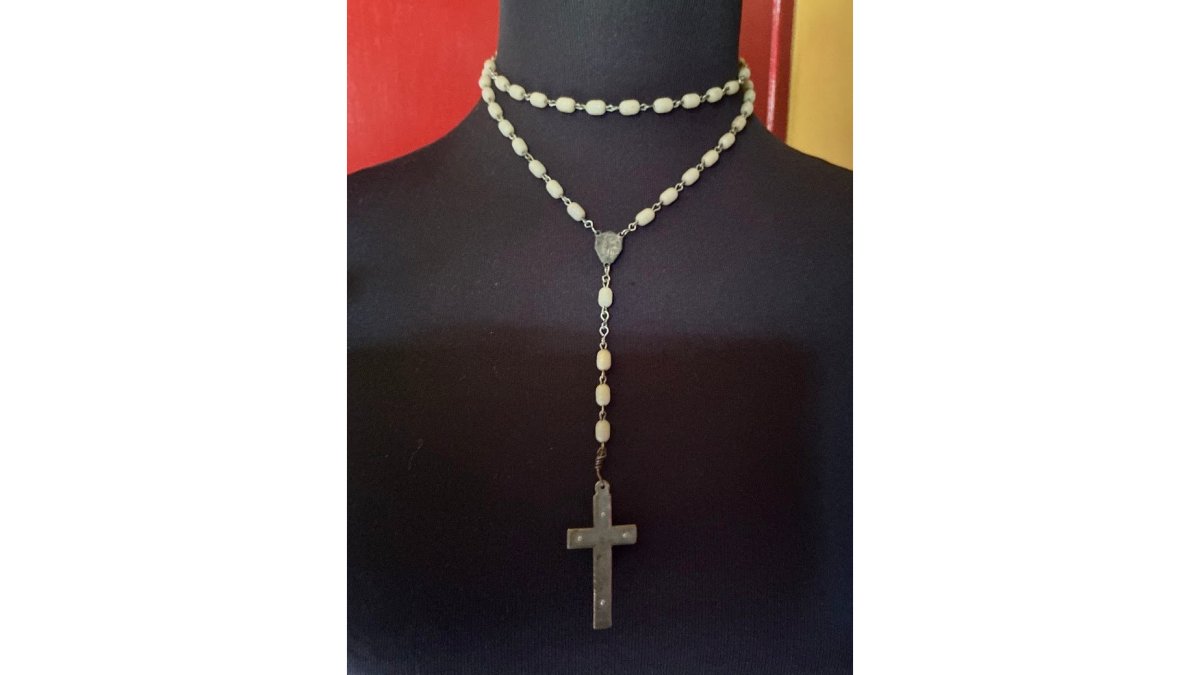
1. Beads and Material: Recognizing Rosary Bead Material
Recognizing rosary bead material starts with the bead's weight and warmth in your hand. Antique beads are often made of wood, glass, bone, or metal, while modern reproductions more often use plastic that feels light and cold.
Wooden beads, such as ebony, are dense and dark and develop a soft sheen over the years. Glass beads, including the distinctive blue glass, are hand-blown or pressed and show small irregularities. Metal, usually copper or silver, is used for the chain and crucifix.
Watch for asymmetry: handmade beads are rarely perfectly round. That is not a flaw, but a sign of age.
2. How Many Beads Does a Rosary Have and What Does That Say About Its Age?
How many beads does a rosary have? A traditional Catholic rosary has 59 beads: five decades of ten small beads, separated by larger beads, plus an appendage. This number is centuries old and changes little, so it says less about age than many people think.
What does reveal something is how that number is executed. Older rosaries often have irregular spacing and larger beads that were carved by hand. In a 19th-century or early 20th-century rosary, the groups of ten may be made slightly more compactly.
A rosary with an unusual number of beads is usually a prayer chain or a pater noster, not a standard rosary.
3. Construction: Chain, Connections and Asymmetry
The construction often tells you more than the beads themselves. Antique rosaries are strung by hand, with metal chains or wires connected by small loops.
Look at the connections between the beads. Modern rosaries often use a continuous wire, while older examples have separate links or chains. These links are sometimes uneven in length, indicating handwork.
Asymmetry in the construction is normal for antique pieces. A perfectly symmetrical rosary is usually machine-made and therefore younger.
4. Crucifix and Medal: Symbolism and Design
The crucifix and medal carry most of the religious symbolism and often reveal the period. A Lourdes cross with an inscription, a Mary medal or a reliquary indicates where a piece came from.
Look at the shape of the cross. 19th-century crosses are often slimmer and simpler, while early 20th-century examples are more richly decorated. A cross that opens with a fine screw, as with a reliquary, points to devotional use that was especially common from the 1930s to the 1950s.
The image on the medal often indicates a period: specific saints or apparitions became popular in particular decades.
5. Wear and Patina: Genuine Age versus Artificial Aging
Genuine age and artificial aging are the most difficult to distinguish. Patina is the natural sheen and discoloration that wood, metal and glass acquire over the decades through handling and exposure to light.
Authentic wear appears where the rosary was held: the larger beads, the crucifix and the connections. Artificial aging is usually evenly distributed and often feels sticky or rough.
6. Style, Typography and Period: 19th Century to Early 20th Century
Style and typography help date a rosary. The letters and numbers on medals and crucifixes reflect the fashions of each period.
19th-century inscriptions are often ornate and hand-engraved. Early 20th-century lettering is more precise and regular. Inscriptions in French often point to an origin in France, where many devotional items were made.
Also consider the overall style: a calm, austere appearance suits the 19th century, while richer decoration is more common in the early 20th century.
7. Provenance, Marks and Inscriptions
Provenance and marks are invaluable when dating an item. An inscription such as "T.T Trappist" or a reference to Rome or Lourdes indicates not only a period but also a religious context.
Maker's marks are rare on rosaries, but when present, they reveal a great deal. A small stamp or engraved initial may point to a specific workshop.
Religious inscriptions, such as a souvenir from Lourdes, often place a piece in a specific decade. This makes provenance one of the strongest indications of authenticity.
Antique Rosary Value: What Determines the Price Without an Exact Appraisal
The value of an antique rosary depends on rarity, condition, material, and provenance, not on a fixed price tag. What we can say is which factors drive up the price.
An 18th-century rosary with a Lourdes cross and a puffed heart is rare and therefore more valuable than a mass-produced rosary from the 1950s. A reliquary holder with authentic relics increases its value even further.
Condition is at least as important. A rosary with its original patina and intact construction is worth more than one that has been restored. Original parts carry more weight than a beautiful finish.
Safe Examination: Non-Destructive Checks at Home
Always examine a rosary without damaging anything. Non-destructive checks give you the most information without diminishing its value.
Start with good lighting and a magnifying glass. Examine the beads, connections, and inscriptions without cleaning them. Never clean with harsh agents, as they can damage the patina.
Weigh the piece in your hand and compare it with known materials. Photograph details up close so you can compare them with reference material later.
Practical Examples: From 18th-Century XL to the 1930s
In our own collection, you can see the seven characteristics in practice. A Rare 18th-Century XL Rosary measuring 136 cm, with an 8 cm Lourdes cross, displays precisely the combination of historical value and symbolism that collectors seek.

An Antique rosary with reliquary holder from the 1930s to the 1950s shows how an inscription and an opening crucifix reveal its origin. And an Antique French Nuns' Rosary from the early 20th century demonstrates how black and brown wooden beads create a serene, authentic appearance.

Each piece tells its own story, and that personal story is precisely what makes devotional items so beloved.
Conclusion: Recognizing an Antique Rosary with Confidence
Recognizing an antique rosary is not a matter of one specific year, but of seven characteristics that you assess together. However difficult it may seem, with patience and a checklist, you can go a long way.
At Chez Monique's 2e Leven, we carefully select every piece and honestly describe what we see, from the bead material to the inscription. Our sustainable shipping with reused packaging materials ensures that you receive your fragile devotional items safely at home. Browse our collection and give a special religious heirloom a second life in your interior.
Frequently Asked Questions
How many beads does a rosary have?
A traditional Catholic rosary has 59 beads: 53 small beads for the Hail Marys and 6 larger ones for the Our Fathers. Antique rosaries may differ from this, for example by having an extra bead or a different arrangement. Always count the beads and compare them with the standard. An unusual number is not immediately a sign of forgery, but may indicate a specific period or an artisan maker.
What materials were used for antique rosaries?
Antique rosaries are made from wood (ebony, brown wood), glass (blue glass, glass beads), metal (copper, silver), and sometimes Bakelite. Wooden beads are common in French rosaries from the 1920s to the 1950s. Glass beads are often hand-blown and show irregularities. Metal is used for crucifixes, medals, and chains. The material reveals a great deal about the period and provenance.
How can you tell whether a rosary is antique rather than vintage?
Antique means more than one hundred years old, so dating from before approximately 1925. Vintage is younger. Look at the wear: on an antique rosary, the beads are often unevenly worn, the metal is dull, and it shows patina. The construction is usually handmade, with visible connections. On vintage pieces from the 1950s or 1960s, the material is often more uniform and less timeworn.
How do you determine the value of an antique rosary?
The value depends on age, rarity, material, condition, and provenance. An 18th-century rosary with an unusual crucifix and inscription is worth more than a simple rosary from the 1930s. Marks, inscriptions, and religious symbols increase its value. Always have a piece with high expected value appraised by a specialist. Without an appraisal, the value remains an estimate.
How do you store an old rosary without damaging it?
Store an antique rosary in a dry, dark place away from direct sunlight. Use a soft fabric pouch or an acid-free box. Avoid plastic bags that trap moisture. Wooden beads can dry out, so consistent humidity is important. Clean only with a dry, soft cloth. Never submerge it in water or use harsh cleaning products, as these can damage the patina and material.