

Determining the value of an old rosary: tips
Table of contents
- What determines the value of an old rosary?
- Identifying an antique rosary: material and age
- Condition and originality: how wear affects the price
- Provenance, maker and religious context as added value
- Appraising a rosary: assess it yourself or have it appraised
- Selling an old rosary: pricing and sales channels
- Conclusion: how to determine the value step by step
- Frequently Asked Questions
Last updated: October 5, 2026
What determines the value of an old rosary?
Tips for determining a rosary's value begin with one simple question: why would someone want this piece? At Chez Monique's 2e Leven, we get that question often. The answer determines everything.
A rosary is a string of prayer beads with a cross. Devotional items such as these have been made and used for centuries.
The price depends on five things:
- Material of the beads and cross
- Age and period of manufacture
- Condition and any damage
- Provenance and maker
- Rarity on the market
No single factor carries all the weight. A rare rosary with a cracked chain is worth less than an ordinary example in top condition.

Devotional, decorative, and collector's value
There are three types of value, and they do not always align.
Devotional value is what a piece means to someone who prays with it. This value is personal and cannot be expressed in monetary terms.
Decorative value concerns how the object looks in an interior. More and more people buy devotional items purely for the atmosphere they create.
Collector's value is what a collector pays for rarity, age, and originality. This is usually the highest of the three.
Identifying an antique rosary: material and age
You can identify an antique rosary by its material, wear, and details. Together, these three reveal more than any single hallmark.
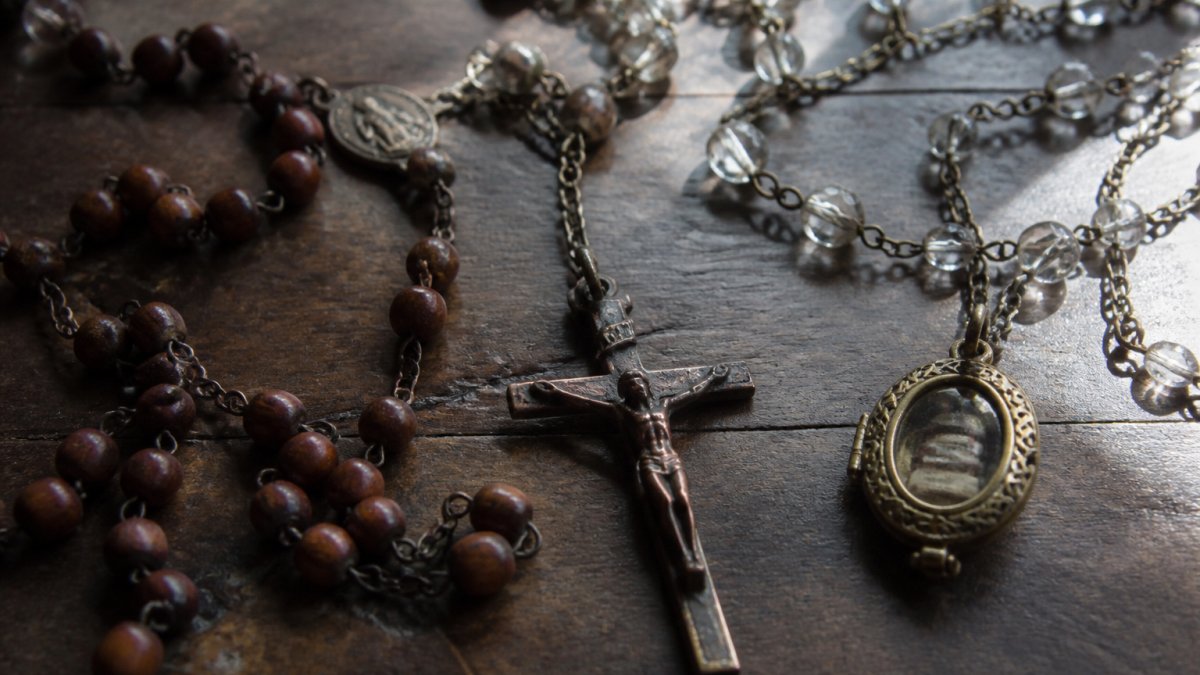
Start by looking at the beads. Wood, glass, metal, and gemstones are the most common materials. Each material shows its own signs of age.
Wooden beads develop a dark sheen from years of use. Glass beads may have small air bubbles.

Also pay attention to the little cross and the medal. Handmade examples often have small differences between individual pieces. Factory-made items are much more uniform.
Characteristics by period: from 18th-century ebony to 1950s Bakelite
Each period has its own characteristics. This makes dating much easier.
| Period | Material | Feature |
|---|---|---|
| 18th century | Ebony, bone | Heavy, hand-carved cross, long chain |
| 19th century | Glass, silver | Fine beads, engraved medals |
| 1920s-30s | Ebony, Bakelite | Deep black sheen, Art Deco medals |
| 1950s-60s | Bakelite, plastic | Lighter beads, bright colors |
Bakelite is an early type of plastic. It feels warm and sounds dull when tapped gently. This distinguishes it from later plastic.
An 18th-century rosary is often extra long and heavy. The beads are hand-turned, so they are never exactly identical.
Condition and originality: how wear affects the price
Condition is the factor that changes the price most quickly. A minor defect can make a difference of hundreds of euros.
Always assess these points:
- Are all the beads still present?
- Is there a crack or break in the cross?
- Is there glue residue from an old repair?
- Is the chain still intact and flexible?
- Have any parts been replaced later?
Missing parts reduce the value the most. A rosary rarely loses a single bead without you noticing.
Glue residue is a warning sign. It indicates a repair that affects the originality.
Light wear is actually beneficial. Patina and signs of use prove that a piece is genuinely old.
Provenance, maker and religious context as added value
Provenance elevates a rosary to a higher level. An inscription or medal tells you where a piece comes from.
Look for names, dates and place names. Sometimes a pilgrimage site is shown on the cross.
A reliquary is a special detail. It is a hollow cross that contains a small memento.
The maker also matters. Renowned workshops from France and Italy make a piece much more sought-after.
Religious context affects the price.
Appraising a rosary: assess it yourself or have it appraised
A rosary can be appraised in two ways: yourself or by an expert. Always start by assessing it yourself, so you know whether an appraisal is worthwhile.
The five-step method with checkpoints
Complete the steps in this order. Do not skip any: poor condition can completely negate the value of a rare material.
- Record the facts. Length in centimeters, number of beads, bead diameter in millimeters, material of the beads, cross and medal, presence of a reliquary or inscription.
- Determine the period. Use the characteristics for each period from the previous table. If you are unsure between two periods, note both.
- Assess the condition. Go through the checklist and count how many points differ.
- Determine the rarity. Search within the same material, period, and type of cross. The fewer comparable items you find, the greater the rarity.
- Compare with realized prices. Do not search only for asking prices, but also for items that actually sold or were auctioned.
Asking price versus sale price: the biggest misconception
An asking price is what a seller hopes to receive. The sale price is what was actually paid. This difference is often large for devotional items because supply is limited and buyers rarely have prices to compare.
A practical approach:
- Collect at least five comparable items with asking prices.
- Cross out the highest and lowest; they are often outliers or distress sales.
- See whether you can determine if those five items were actually sold. An advertisement that disappears after some time is a weak signal; an auction result or confirmed sale is a strong signal.
- Use the midpoint of the remaining range as a realistic indication.
Price ranges by category
The ranges below are indicative and based on what buyers actually pay in practice for common types. They are not an appraisal and do not constitute a guarantee.
| Category | Features | Indicative price range |
|---|---|---|
| Modern devotional rosary | Plastic, simple metal, from the 1970s onward | A few euros to approximately €15 |
| Vintage rosary | Wood or glass, 1950s to 1970s, light wear | Approximately €15 to €45 |
| Antique rosary | 19th-century glass or silver, good condition | Approximately €45 to €150 |
| Rare or documented rosary | 18th-century ebony, reliquary, provenance | Approximately €150 to €400 or more |
Within each price range, the condition determines whether you end up at the lower or upper end. A missing bead or a broken little cross can push an item from the mid-range category down to the lower end.
When self-appraisal is no longer sufficient
Call in an expert if you notice any of these signs:
- The piece has an inscription, year, or place name indicating a specific origin.
- It contains a reliquary or a medal from a pilgrimage site.
- The material is a precious metal or a gemstone that you cannot identify yourself.
- The range you find yourself is above approximately €150.
Choose between an auction house, a specialized antiques dealer, or an independent appraiser. Always ask about the costs in advance and how the appraiser arrives at an amount. An appraiser who only gives a final amount without justification is of little use to you.
Do you want certainty about a genuinely rare piece? Have it appraised by an auction house or a specialized appraiser.
Selling an old rosary: pricing and sales channels
Selling an old rosary starts with a realistic price. Set it slightly above your lower limit, because buyers almost always negotiate down. But the choice of channel is at least as important as the price itself. Below are the Dutch channels with their costs, target audience, and trade-offs.
Determining the price: lower limit, asking price, and room for negotiation
Work with three amounts:
- Lower limit: the amount below which you will not sell. Determine this based on the range from the valuation section.
- Asking price: the lower limit plus 10 to 20 percent room for negotiation.
- Target price: the amount in the middle of the range that you realistically hope to receive.
On an advertising platform, 10 to 20 percent room for negotiation is customary. At an auction, things work differently: the audience determines the price, and you pay costs on both sides.
Channel comparison by costs and target audience
| Channel | Costs | Target audience | Suitable for |
|---|---|---|---|
| Online marketplace | Usually free or a small fee per listing | Broad audience, many bargain hunters | Common vintage and antique rosaries |
| Specialized online shop | Commission or purchase price | Collectors and enthusiasts of devotional items | Pieces with provenance, a reliquary, or rare materials |
| Thrift store or bric-a-brac shop | No costs, but low proceeds | Casual buyers | Pieces in poorer condition or without distinctive features |
| Auction house | Buyer’s premium and often a submission fee | Collectors and dealers | Rare, documented pieces above approximately €150 |
At an auction house, you generally pay a buyer’s premium on top of the hammer price and sometimes fees for submitting and photographing the item. Always ask about these costs in advance, as they can consume a large part of the proceeds for lower amounts.
Originality and repairs: what you should mention
Condition and originality matter more than the sales channel. A buyer who discovers a replaced bead or traces of glue will lose interest or offer much less.
Therefore, always mention:
- Replaced beads or parts, even if they fit well.
- Previous repairs, even if they were carried out neatly.
- Missing parts, such as a missing bead or medallion.
- Whether the cross, medal, and chain still originally belong together.
An honest description may cost you a few euros on the asking price, but it prevents disputes and returns later. When selling online to a consumer, that consumer generally has a right of withdrawal (cooling-off period). More information about consumer rights when selling online is available from the Netherlands Authority for Consumers and Markets.
Packaging and shipping
A rosary is fragile: beads can crack, metal can bend, and a chain can break. Therefore, always use cushioning around the cross and medal, and make sure the beads cannot rub against one another. Use a box that is large enough, not an envelope. We reuse packaging materials where possible without compromising the safety of the object.
Selling or keeping: the considerations
Not every piece needs to be sold. A rosary with a strong devotional or family history may be more valuable to preserve than to sell. Unsure? First compare the piece with the ranges in the appraisal section.
Would you like to place a piece in good hands? View our selection, such as the Rare 18th-Century XL Rosary priced at €320.00 or the Antique rosary with reliquary holder priced at €185.00.

Conclusion: how to determine the value step by step
Determining a rosary's value does not require a laboratory. It requires a keen eye and the right sequence.
Look at the material, age, condition, and provenance. Then compare it with actual realized prices, not overly optimistic asking prices.
Unsure about a special piece? At Chez Monique's 2e Leven, you will find carefully selected devotional objects and antique collectibles. Our collection of religious objects gets a second life, with an eye for history and sustainable shipping.
Add your favorite to the cart and give a special object a new home.
Frequently Asked Questions
How do you determine the value of an antique rosary?
Assess four factors: material (gemstones or silver carry more weight than plastic), age (18th-century pieces are rarer than those from the 1950s), condition (missing beads or glue residue reduce the price), and provenance (an inscription or reliquary increases the value). Then compare it with asking prices for similar examples. An 18th-century XL rosary with a Lourdes cross fetches considerably more than a simple devotional rosary from the 1930s.
Which materials make a rosary valuable?
Wooden beads, ebony, glass beads, gemstones, and metal components such as copper or silver increase the value. Bakelite from the 1920s and 1930s is popular with collectors because of its authentic appearance. Also look at the cross and medal: finely executed images of Mary and Jesus indicate skilled craftsmanship. Plastic beads from the 1970s are generally worth less.
Does a damaged rosary still have value?
Yes, but less. A missing bead, a crack in a medal, or visible glue residue lowers the price, especially for common devotional objects. With rare pieces, the value often remains intact because collectors prioritize originality over perfection. Restoration can restore the value, but only if carried out expertly and with appropriate materials. Always disclose damage honestly when selling.
Where can you have an old rosary appraised?
You can consult a specialized antiques dealer or an auction house that handles religious heritage. Always ask for supporting evidence based on comparable sale prices, not just an amount. For a first impression, you can compare asking prices for similar examples yourself. Have a written appraisal prepared if you want to sell or insure the rosary.
An old rosary deserves a buyer who appreciates its history. Chez Monique's 2e Leven selects antique religious objects with attention to authenticity and condition, ships sustainably using reused packaging materials, and checks every package for safe transport. Browse our collection of devotional objects and give a unique piece a second life.