

Semi-precious stone vs. wooden rosary: Comparison
Table of contents
- Semiprecious stone or wood rosary: what should you consider when choosing?
- Comparison table: semiprecious stone and wood side by side
- Material differences: quartz, jade, amber, and wood types
- Symbolism of prayer beads: what the beads mean
- Weight, texture, and skin reactions: the tactile difference
- Caring for an antique rosary: cleaning wood and semiprecious stone
- Determining the value of religious objects: price and value retention
- Conclusion: which rosary is right for you?
- Frequently Asked Questions
Last updated: October 4, 2026
Semiprecious stone or wood rosary: what should you consider when choosing?
A comparison of a semiprecious stone and wood rosary ultimately comes down to one question: what suits your hand, your use, and your budget? A prayer bead strand made of quartz or jade feels different from an antique rosary with wooden beads, and you only really notice that difference when you hold it.

Semiprecious stone is a natural mineral material cut into beads, such as quartz, jade, or amber. Wood, on the other hand, is an organic material that has been used for paternosters and rosaries for centuries.
Below, we compare both materials in terms of hardness, symbolism, maintenance, and price. The five antique pieces from our own collection show exactly what this difference means in practice.
Comparison table: semiprecious stone and wood side by side
This table summarizes the main differences between the two materials. Use it as a starting point before making a choice.
| Feature | Semiprecious stone | Wood |
|---|---|---|
| Hardness | High, scratch-resistant | Low to medium, susceptible to scratches |
| Weight | Heavier, cool to the touch | Light, warm to the touch |
| Wear resistance | Very good for daily use | Good, but wears with intensive use |
| Maintenance | Wipe with a soft cloth | Little needed, sometimes oil |
| Price indication | Often higher per piece | More affordable |
| Skin reactions | Rarely, unless there is nickel in the setting | Almost never |
| Symbolism | Purification, protection, healing | Modesty, earthly connection |
What the table does not show is how a rosary feels in your hand. That is precisely what often determines the choice in practice.
Material differences: quartz, jade, amber, and wood types
Each material has its own character. Hardness determines how long a beaded strand stays beautiful, while the type of wood mainly determines its appearance and weight.
Hardness and wear resistance of semiprecious stones
Quartz and jade are among the harder semiprecious stones and retain their shine for years. Amber is softer and requires more care because it scratches more easily and is sensitive to heat.
For daily use, a harder stone is usually the better choice. If you mainly wear the rosary on special occasions, that hardness matters less.
Wood types in antique rosaries
Ebony is the classic among wood types. It has a fine grain, a dark color, and feels pleasantly heavy for a type of wood. It appears time and again in our collection.
Take the Antique French Ebony/Bakelite Rosary. The Antique French Brown Wood & Copper Ebony Rosary combines brown wooden beads with a copper crucifix inlaid with ebony.


That combination of wood and metal is more common than you might think. The crucifix is the focal point, while the beads convey the feeling.
Symbolism of prayer beads: what the beads mean
The symbolism of prayer beads differs between traditions, but the core is the same everywhere: each bead marks a prayer or a moment of attention. A mala from the East has 108 beads, while a rosary has its own arrangement of decades and spacer beads. This structure is not decoration; it determines the rhythm of the prayer itself.
The Christian rosary: structure as prayer
The rosary is structured around the decades: ten small beads between each larger bead, with a spacer bead marking the beginning of a new decade. The crucifix or medal at the end is the starting point.
In monastic traditions, such as those of the Trappists and Carthusians, rosaries were often made of wood, precisely because the material is modest and does not cause distraction. Wood therefore carries its own symbolism: simplicity, an earthly connection, the ordinary becoming sacred through use.
Semi-precious stone: meaning varies by type of stone
A semi-precious stone adds its own meaning to the prayer structure, and that meaning differs by mineral:
- Quartz (including rose quartz and rock crystal) is associated with purification and clarity in many spiritual traditions.
- Jade symbolizes harmony and vitality in Eastern traditions.
- Amber is not a mineral but fossilized resin, and has traditionally been regarded as a protective stone; its warm color and light weight reinforce that feeling.
- Lapis lazuli and amethyst appear in both Christian and Eastern contexts, with meanings that vary between traditions.
Whether you take that meaning seriously or not, it gives a string of beads an extra layer. It is important to note, however, that these meanings have developed culturally and have not been scientifically established. A rose quartz rosary is not "more effective" than one made of ebony; the meaning lies in what the wearer attributes to it.
Why this makes a difference when choosing
If you choose a rosary purely as a prayer instrument, the symbolism of the material is secondary to how it feels in the hand. If you also choose it as a personal object, something you wear or keep in a fixed place, the meaning of the stone or type of wood may be the deciding factor. An amber rosary with protective associations feels different to some wearers from a plain wooden paternoster, even though the prayer structure is identical.
Weight, texture, and skin reactions: the tactile difference
You notice the tactile difference between semiprecious stone and wood as soon as you hold both in your hands. Semiprecious stone feels cool and smooth, while wood feels warm and slightly rougher. That may sound like a detail, but with a rosary you hold for a long time, it makes all the difference.
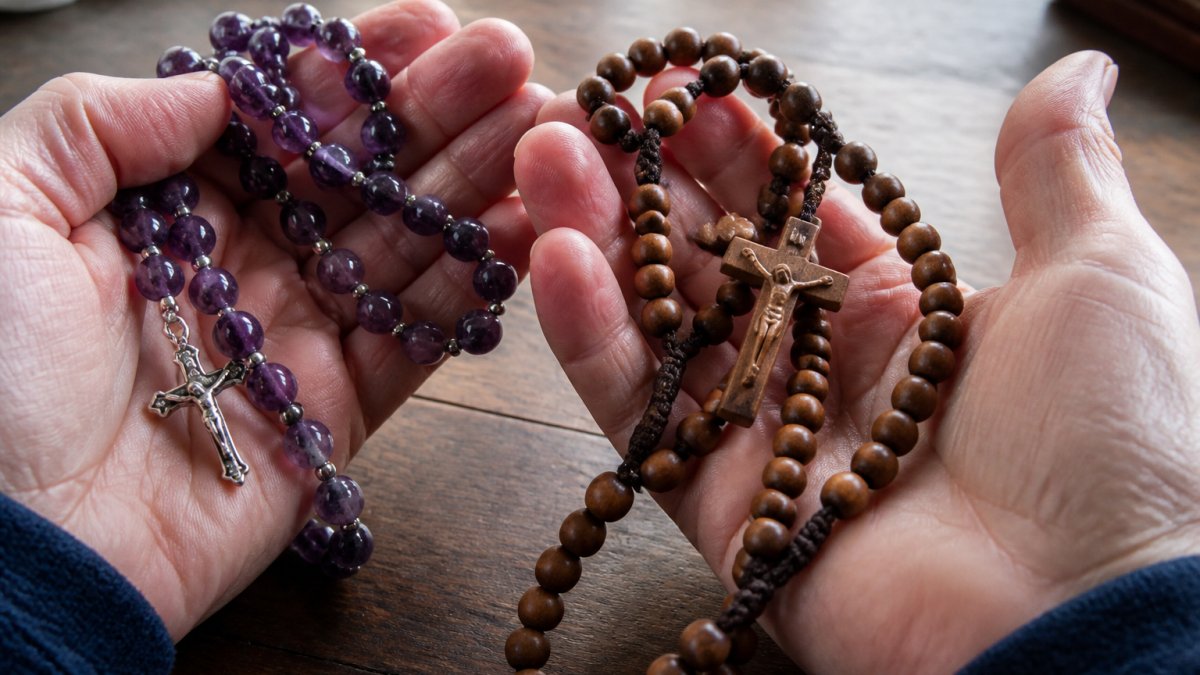
Weight: density determines how it hangs
The weight of a rosary is determined by the material’s density. Quartz is around 2.6 grams per cubic centimeter, jade is slightly heavier, while amber is much lighter; amber is so light that it floats in water.
In practice, this means that a rosary made of quartz or jade pulls on the cord and feels substantial in the hand. An ebony rosary comes closer to that weight than you would expect based on the fact that it is made of “wood,” while lighter woods such as pine or spruce feel almost weightless.
Temperature and texture: thermal conductivity and surface
The difference in temperature is caused by thermal conductivity. Stone conducts heat well, so a semiprecious stone bead takes on the temperature of your hand and initially feels cool. Wood conducts heat poorly and instead retains the ambient temperature, which makes it feel warm right away.
Antique rosary with reliquary pendant →
Texture is a second mechanism. Semiprecious stone is polished to a smooth, sometimes mirror-like surface. Wood is sanded or oiled and retains a subtle grain and pores.
Climate: how both materials respond to moisture and temperature
This determines how a rosary behaves over the years.
- Wood is hygroscopic: it absorbs moisture from the air and expands, then contracts again in dry conditions. In a humid climate or a damp storage area, beads can expand, jam, or even crack. In a heated living room with dry air, wood may instead shrink, causing the cord to become looser.
- Semiprecious stone is not hygroscopic and barely reacts to humidity. However, it is sensitive to sudden temperature changes: a stone that is cold and heats up quickly could theoretically crack if it already has a weak spot. Amber is the most sensitive; it is soft and can deform with prolonged heat or direct sunlight.
Practical advice: store a wooden rosary in a room with a reasonably stable indoor climate, not in a damp basement or on a drafty windowsill. A stone rosary can tolerate more, but keep amber out of direct sunlight.
Skin reactions and allergies
Skin reactions are rare, but not impossible. Some people react to nickel in the setting of a cross or medal, not to the stone itself. Wood almost never causes a reaction, with one exception: some tropical woods contain natural oils that can cause mild irritation on sensitive skin.
If you have sensitive skin, look at the metal components. That is where most irritation occurs. Copper and brass can leave a green discoloration on the skin after prolonged contact, harmless but worth knowing about.
What this means for your choice
If you want a rosary that feels the same for years and requires little maintenance, semiprecious stone is the safer choice, with the caveat that amber is softer than quartz or jade. If you prefer warmth, light weight, and a tactile texture, wood wins, provided you store it in a stable place. For those with sensitive skin, the metalwork is more important than the bead material.
Caring for an antique rosary: cleaning wood and semiprecious stone
Caring for an antique rosary requires more attention than caring for a new one, simply because the material is older. For wood, a dry, soft cloth is usually sufficient.
Semiprecious stone can tolerate a little more. A slightly damp cloth removes dust without damaging the shine. Let the beads dry thoroughly before storing the rosary.
Always store an antique piece in a dry place, away from direct sunlight. This applies to both materials. This preserves the texture and prevents the cord from drying out.
Determining the value of religious objects: price and value retention
The value of religious objects is determined by their age, origin, material, and condition. A rosary with a remarkable provenance often stands out above the rest.
A good example is our Antique rosary with reliquary from the 1930s-1950s.
For those who want to start with a smaller piece, the Antique French Rosary Mary Medal and Ebony from the 1920s/1930s is an excellent introduction.
| Rosary | Material | Price |
|---|---|---|
| Antique rosary with reliquary holder | Wood, reliquary | €185,00 |
| Antique French Rosary Ebony/Bakelite | Ebony or bakelite | €55,00 |
| Antique French Rosary Wooden Beads & Copper Cross | Wood, copper, ebony | €52,50 |
| Antique French Rosary Mary Medal and Ebony | Ebony, Mary medal | €47,50 |
| Antique French Rosary Brown Wood & Copper Ebony | Brown wood, copper, ebony | €40,00 |
Antique pieces generally retain their value better than new rosaries. This is due to their scarcity: fewer are being added, while demand remains.
Conclusion: which rosary is right for you?
If you choose daily use and want something that will last for years, semi-precious stone is the stronger choice because of its hardness and resistance to wear. If you prefer warmth, light weight, and an affordable price, wood wins.
For collectors, the consideration is different. An antique rosary with wooden beads and an interesting provenance tells a story that a new type of stone can never equal.
The challenge is not choosing between beautiful and affordable, but between two characterful options that both have their own value.
Frequently Asked Questions
What is the difference in durability between a wooden and a stone rosary?
Semi-precious stones such as quartz and jade are harder and less prone to scratching than wood. Wood is more sensitive to moisture, temperature fluctuations, and drying out, which can cause beads to crack. An antique wooden rosary therefore requires more care: keep it out of direct sunlight and do not store it for long periods in a damp room. With proper care, both materials will last a long time.
Which rosary is most suitable for daily use?
For daily use, a rosary made with semi-precious stones or ebony is more practical: the beads are more resistant to wear and retain their shine or color longer. Wooden beads feel warmer and are lighter, which is comfortable during long periods of prayer. With an antique piece, always check the condition of the beads and crucifix before using it daily.
Do semi-precious stones have a specific symbolic meaning in devotional items?
In devotional items, certain stones are attributed with specific meanings. Amber is known for its warm glow and is associated with protection, while quartz is considered a symbol of purity. In some traditions, jade is associated with wisdom. These meanings vary by culture and religious tradition and are not officially established within the Catholic tradition.
How do I care for an antique wooden rosary?
Clean wooden beads with a dry, soft cloth and avoid water or chemical products, as they soak into the wood and cause cracks. Store the rosary in a cotton pouch in a dry place, away from direct sunlight. You can carefully polish the copper or silver crucifix with a soft cloth. This helps preserve the object's value.
What should I look for when buying a vintage rosary?
Check that the beads are uniform and that none are missing or cracked. Examine the clasp and the crucifix: original parts increase the value. Ask about the provenance and any inscriptions, such as 'T.T Trappist' or '3 fountains from Rome'. Well-documented provenance makes a religious object more appealing to collectors.