

Finding Custom Religious Statues: 7 Steps to the Perfect Find
Table of Contents
- Why seeking custom religious statues is more than just a purchase
- Step 1: Determine the purpose of your custom religious statues
- Step 2: Recognize the materials and finish of antique statues
- Step 3: Understand the symbolism and iconography of saint statues
- Step 4: Collecting antique devotional items: what to look for?
- Step 5: Buying religious statues from a reliable provider
- Step 6: Restoring religious statues: how to approach it
- Step 7: Durability and shipping: your statue safely home
- Frequently Asked Questions
Last updated: September 4, 2026
Why seeking custom religious statues is more than just a purchase
Those seeking custom religious statues are doing more than acquiring an object: you are searching for a piece of history, a silent presence that imbues a room with atmosphere or evokes a personal memory. In this guide from Chez Monique's 2e Leven, we will lead you in seven steps to the perfect find.
The search begins not with the first available webshop, but with the question of what the statue means to you. An antique statue of Mary tells a different story than a modern devotional print, and the choice of plaster, wood, or bronze determines both the appearance and the care the statue requires.
Many collectors underestimate how personal this purchase is. Those looking for a statue for a specific prayer corner or an eclectic interior quickly discover that the online selection is limited. The art is to search purposefully, with an eye for authenticity and quality.
Step 1: Determine the purpose of your custom religious statues
Seeking custom religious statues requires a clear purpose beforehand. Is it a devotional object for personal prayers, a decorative accent in a classic interior, or a historical collector's item for a display cabinet? The answer determines which period, style, and condition of the statue are acceptable to you.
For a prayer room, you often choose a statue with a serene appearance, such as a Madonna and Child. For interior design purposes, visual impact is more important than religious meaning. A large plaster statue from the 1920s or 1930s, like the signed statue of Mary we have in our collection, then functions beautifully as a focal point on a console table or in a spacious hall.

Ask yourself three questions: what size fits the space, what material can withstand the environment, and what budget do you want to spend? A conscious budget prevents impulse purchases that you later regret.
Step 2: Recognize the materials and finish of antique statues
The material largely determines the charm, durability, and value of a religious statue. Those seeking custom religious statues do well to recognize the differences between plaster, wood, and bronze, as each material requires a different approach to purchase and maintenance.
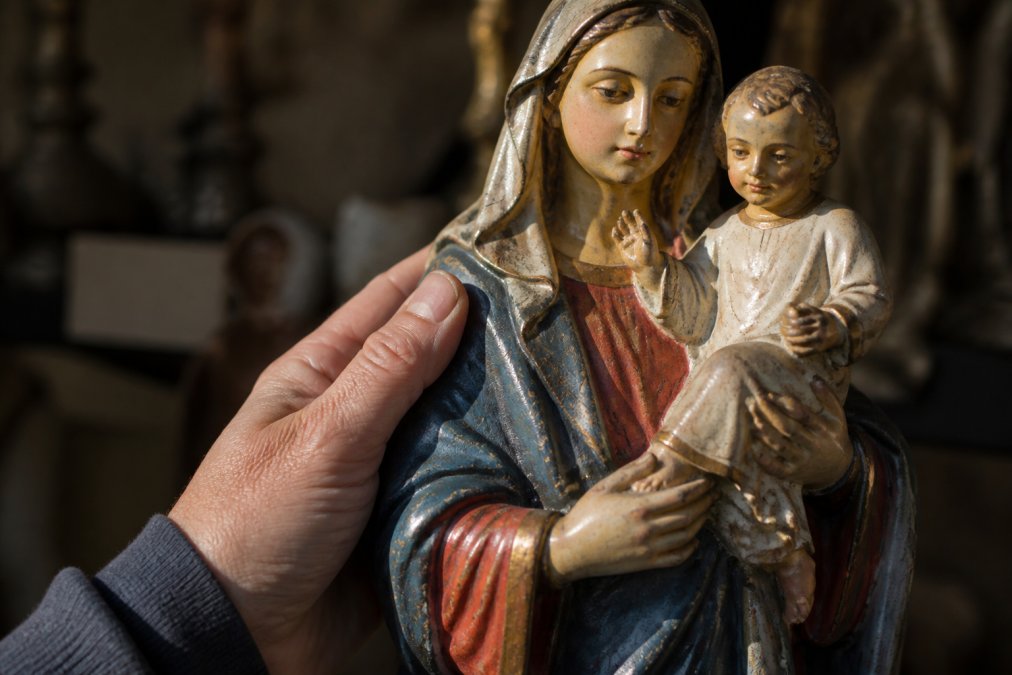
Plaster, wood, or bronze: which suits your quest?
Plaster statues form the most accessible category and were enormously popular in Catholic households well into the 1960s (peer-reviewed research). They are relatively light, often hand-painted, and due to their fragility, have an authentic patina that contributes to their charm. A hand-painted plaster statue with glass eyes, such as the statue of Our Lady of Fátima from Portugal, is a beautiful example of this artisanal tradition.

Wooden statues, often hand-carved, exude warmth and are generally more robust than plaster. Always check wood for woodworm, cracks, and old repairs. Bronze statues are the heaviest and most durable, but also considerably more expensive. For the novice collector, plaster offers the best balance between authenticity, price, and visual impact. An important detail: always look at the finish of the face and hands, as that's where quality distinguishes itself from mass production.
Step 3: Understand the symbolism and iconography of saint statues
Sacred art is imbued with meaning; those who search without understanding symbolism miss an essential layer. Each saint has recognizable attributes: Saint Anthony the Abbot, for example, is depicted with a pig at his feet, a reference to his role as the patron saint of animals.

This iconography not only helps you identify statues but also appreciate their historical value. A Madonna and Child can vary from a rigid, hieratic pose to an intimate, almost human interaction. The posture, hand gesture, and attributes tell us the period and region in which the statue was crafted.
For those seeking a statue with a specific meaning, it is advisable to delve into the saint or Marian apparition central to it. Our Lady of Fátima refers to the apparitions in Portugal and has its own unique devotion. This knowledge makes the purchase more personal and prevents you from acquiring a statue that does not align with your intention.
Step 4: Collecting antique devotional items: what to look for?
Those who collect antique devotional items develop a keen eye for authenticity. But where do you start when the search for custom religious statues becomes serious? The difference between a valuable antique piece and a later replica lies in the details. These are the specific characteristics you should look for.
The secret of patina and surface
With an authentic statue, the patina is the first thing that stands out: a natural layer of oxidation and aging from decades of light, dust, and temperature fluctuations. On plaster statues from the 1920s and 1930s, this appears as fine craquelure, an irregular network of hairline cracks that follow the contours. A replica or recently repainted statue often has an even, 'dead' paint layer without depth.
Also, pay attention to the underside: a statue that has stood in one place for a long time often has a ring of dried dust or discoloration on its base. Traces of old glue or fasteners are signs of a life in a household, something a new copy cannot replicate.
Construction reveals the past
Before 1900, statues were often carved from a single piece of wood or cast in solid plaster. From the early 20th century, it became common to make statues in parts. A common feature of Dutch and Belgian workshops from the 1920s-1950s is a hollow plaster construction. This was done to reduce weight and prevent cracking during drying.
An important detail is how the statue is attached. Old statues often have a wooden or metal peg at the bottom that was screwed into a pedestal. Check whether this mechanism is original or if a new connection has been made recently. A new, tight screw in an old hole could indicate a restoration, but also a replica attached to an old pedestal.
The signature and the workshop
Not all statues are signed, but a signature is a goldmine. Many workshops used a specific style or mark: a name, a stamped number, or a workshop mark, often on the back of the base or under the feet.
A difficult-to-read signature can be photographed and viewed under magnification; sometimes the inscription only becomes visible with side lighting. A signed statue from a well-known workshop generally has a higher value, but the most important thing is that the signature is consistent with the period and style.
Common pitfalls in evaluation
- Too perfect details: A statue that looks as if it was made yesterday is often a replica. Antique statues have minor imperfections, such as an air bubble in the plaster or a slightly misaligned hand.
- Modern paint under UV light: If you doubt whether it has been repainted, use a UV lamp. Modern paint often glows differently than historical pigments. This is a simple test you can do at home.
- The weight: A solid plaster statue is surprisingly heavy. If a large statue is remarkably light, it is likely that it was hollow-cast or made from a modern, lightweight material such as polyester. This is a strong indication of a replica.
This knowledge not only makes you a better buyer but also deepens your appreciation. A statue you recognize as the product of a specific workshop or period tells a richer story than an anonymous piece; this layer of understanding makes collecting so fascinating.
Step 5: Buying religious statues from a reliable provider
The reliability of the seller is at least as important as the quality of the statue. Those seeking custom religious statues must be able to rely on an honest description, clear photos, and careful handling. A specialized provider like Chez Monique's 2e Leven selects objects with an eye for authenticity and accurately describes their condition.
When making an online purchase, pay attention to the details in the product description. Is the period mentioned, the material, and any specific features such as a signature or origin? A provider who is transparent about the object's condition, such as mentioning glass eyes or a hard-to-read signature, demonstrates expertise. When in doubt, always ask for additional photos or information.
Pricing is a second indicator. A significant price difference compared to other providers can indicate quality differences that are not immediately visible in photos. The plaster statue of Mary from the 1920s/1930s for €185.00 may be more expensive than a more recent example, but its age, signature, and pristine condition justify the higher price for serious collectors.
Step 6: Restoring religious statues: how to approach it
Restoring a religious statue is a craft that can be approached with knowledge and patience. Many antique statues show signs of use: a broken finger, a hairline crack, or a discolored varnish layer. Before you begin, it's crucial to identify the material, as plaster, wood, and composite materials each require a completely different approach.
First aid for plaster statues
Plaster is porous and relatively soft; the most common damage is a crack or a broken piece. For a small crack, you can make a restoration paste from plaster and water yourself. First, clean the crack with a soft, dry brush, lightly moisten the edges with water, apply the paste with a small spatula, and press firmly. Work quickly, as plaster dries hard.
A common mistake is using modern fillers such as acrylic sealant or wood filler; these shrink or expand differently than plaster and can cause new stresses. Always use a material that is close to the original in terms of hardness and structure.
Repainting: a delicate matter
The greatest damage is often caused by well-intentioned but incorrect restorations. Repainting with modern wall paint or acrylic paint is fatal to the value and appearance. The original paint layer, often a mixture of pigments and glue or casein, has a silky sheen that modern paints cannot replicate.
If you are touching up a damaged area, first try to match the color in an inconspicuous spot. Preferably use a reversible water-based paint, such as gouache or restoration paint, and apply it in several thin layers with a fine brush. The goal is not to make the damage invisible, but to stabilize it and restore its readability.
Wooden statues: watch out for woodworm and glue
For wooden statues, woodworm is the greatest enemy. Check for small, round holes and piles of fine sawdust; if you find these, the statue may be actively infested. Place the statue in a sealed plastic bag and put it in the freezer for several weeks to kill the larvae, a safe, non-toxic method for small objects (canada.ca).
For gluing loose parts, use a reversible glue suitable for wood, such as hide glue or furniture glue based on polyvinyl acetate (PVA). Apply the glue thinly to both broken surfaces, press the parts firmly together, clamp, and let dry for at least 24 hours.
When to call a professional?
Sometimes it's best not to start on your own. A statue with complex polychromy (multiple layers of paint with gold leaf or special pigments), great historical value, or doubt about its structure, is a case for a professional restorer, who can, for example, take an X-ray to see the internal structure and weak spots.
The most beautiful thing about restoration is that you give a statue a second life. A small crack or a weathered nose tells a story of a long domestic life; it is not always necessary to completely erase these traces. Sometimes it is better to stabilize a statue and preserve its character. This respect for historical integrity is the core of sustainable collecting.
Step 7: Durability and Shipping: Your Statue Safely Home
Caring for your statue doesn't end with the purchase. A fragile plaster statue must be well-packaged to safely make the journey to your home. Sustainable shipping is not at odds with safety. At Chez Monique's 2e Leven, we reuse packaging materials without compromising the protection of your purchase.
Proper packaging begins with stabilizing the statue in the box so that it cannot shift. Use plenty of filling material that won't scratch the statue, and individually wrap fragile parts such as outstretched hands or a raised arm. Before shipping, check that the box is sturdy enough for the weight.
An antique statue cannot withstand extreme temperatures or moisture. Do not leave a package outside for too long, and after receiving it, place the statue in a dry, stable place out of direct sunlight. This way, your acquisition will be preserved for generations, and you will contribute to a more sustainable approach to valuable objects.
Frequently Asked Questions
Where can I have custom religious statues made?
At specialized providers of antique devotional objects, such as Chez Monique's 2e Leven, you can specify your wishes. Although the offerings vary, you can often indicate which saint, period, or material you are looking for. A good establishment will keep your search profile on file and contact you when a suitable statue becomes available. This way, you combine the convenience of an existing collection with the personal approach of a custom-sourced find.
What is the difference between antique and new religious statues?
Antique statues, such as plaster Madonna statues from the 1920s or wooden saint statues from the 1930s, carry historical value and artisanal craftsmanship. They show signs of use that are part of their story. New statues lack this authenticity but are often more affordable. Those seeking custom religious statues with an eye for character and history generally choose antiques for their unique appearance and the serene atmosphere they lend to an interior.
How do I determine the value of a religious statue?
The value depends on age, material, condition, rarity, and provenance. A signed plaster statue from the 1920s with original hand-painting is generally worth more than an unsigned example. Iconography also plays a role: statues of popular saints like Saint Anthony the Great with a pig are sought after. If in doubt, consult a specialist in antique devotional objects who can interpret the provenance.
How do I maintain antique religious statues?
Carefully dust plaster and wooden statues with a soft, dry cloth. Avoid water and aggressive cleaning agents, which can damage the paint layer and patina. Do not place fragile statues in direct sunlight or in a damp place. In case of cracks or flaking paint, professional restoration is recommended. Those who seek and purchase custom religious statues are well advised to immediately inquire about the best maintenance method for the specific material.
This article was written using GrandRanker