

Checking the authenticity of antique religious objects: here's how to do it
Table of contents
- Why checking the authenticity of religious objects is difficult
- Materials of antique religious objects: the first clue
- Recognizing age from wear and craquelure
- Origin and documentation: the provenance of your sculpture
- Step-by-step guide to checking the authenticity of religious objects
- How to recognize an antique rosary: what should you look for?
- Determining the value of religious statues: a realistic assessment
- Common mistakes when assessing religious statues
- Frequently Asked Questions
Last updated: September 7, 2026
Why checking the authenticity of religious objects is difficult
An antique crucifix or statue of the Virgin Mary can be a valuable heirloom, but the market is full of reproductions that are barely distinguishable from the originals. Many collectors only discover after years that their devotional objects are copies, often made in the twentieth century.

The authenticity of objects cannot always be established immediately. The crux of the problem lies in the combination of mass production and craftsmanship. Factories in France, Belgium, and Germany continued producing statues well into the 1960s that were visually identical to their older, handmade predecessors (britannica.com). Only by carefully examining the material, wear, and historical context can you make a reliable initial assessment.
Materials of antique religious objects: the first clue
The materials used often reveal more about an object's age than its appearance. Antique objects were generally made from wood, plaster, copper, or marble, while later reproductions are more often made from composite materials or plastic. A plaster statue from the 1920s feels more porous, and the polychrome decoration was applied by hand.

Wood carving is also a strong indication: a hand-carved crucifix displays irregularities that a mold can never reproduce. Antique statues are often hollow or show rough, unfinished areas. Weight also matters: antique copper is heavy and solid, while modern copies often feel noticeably light.
Recognizing age from wear and craquelure
When checking religious objects, natural aging of the surface is one of the most reliable indicators, but only if you look beyond the naked eye. Most collectors stop at identifying craquelure, while the real assessment begins where the eye stops: in the microstructure of paint, wood, and metal.
Craquelure under the microscope: what you are really seeing
Genuine craquelure forms because the paint and the ground expand and contract differently; this takes decades and is never uniform (getty.edu). Under magnification of ten to twenty times, authentic hairline cracks start at a point of tension and branch out in a river-delta pattern. The edges are sharp and slightly raised.
A crucial test is depth: genuine craquelure extends into the ground or gesso layer, while fake craquelure appears only in the top varnish layer and often runs in parallel lines or circles.
Wear patterns: the anatomy of use
Wear reveals how an object was actually used. A rosary shows beads worn dull where the thumb moved them; sculptures show wear at points of contact such as the feet or hands. This wear is irregular and deeper where the greatest pressure was applied.
Wood touched for centuries develops a smooth, greasy patina that penetrates deep into the pores and cannot be replicated with wax or oil. Under UV light, genuine patina may appear as a dull, even glow; artificial patina glows unevenly or remains dark (si.edu).
The pitfall of artificial aging
Forgers use techniques such as paint that shrinks when heated to create fake craquelure, treating wood with vinegar or ammonia, and rubbing metal with salt and sulfur to create a green patina.
These techniques age only the surface, not the structure beneath it. An antique wooden sculpture also has signs of age on the inside; in an artificially aged object, the inside remains light and fresh. Therefore, always check the unfinished areas; if they look new while the surface appears old, something is wrong.
The combination test: three signals at once
No single indicator is conclusive on its own. Combine three signals: deep craquelure, wear in logical places, and an interior that is consistent with its age. If two match, further examination by an appraiser may be useful; if only one or none matches, the likelihood of a reproduction is greater.
Origin and documentation: the provenance of your sculpture
The origin, or provenance, is powerful evidence of authenticity: old photographs, sales receipts, inheritance documents, or inventory lists from a monastery or church. The more detailed the context, the more valuable the object is for appraisal and insurance.
A signature or stamp from the foundry or workshop is an excellent starting point; some Belgian plaster statues from around 1900 bear a marking such as "Depose 12". Check whether the signature is consistent with the period and material.
Step-by-step guide to checking the authenticity of religious objects
A thorough inspection requires no expensive equipment, but it does require patience and a systematic approach. The following steps will help you make an initial assessment yourself before consulting an expert.
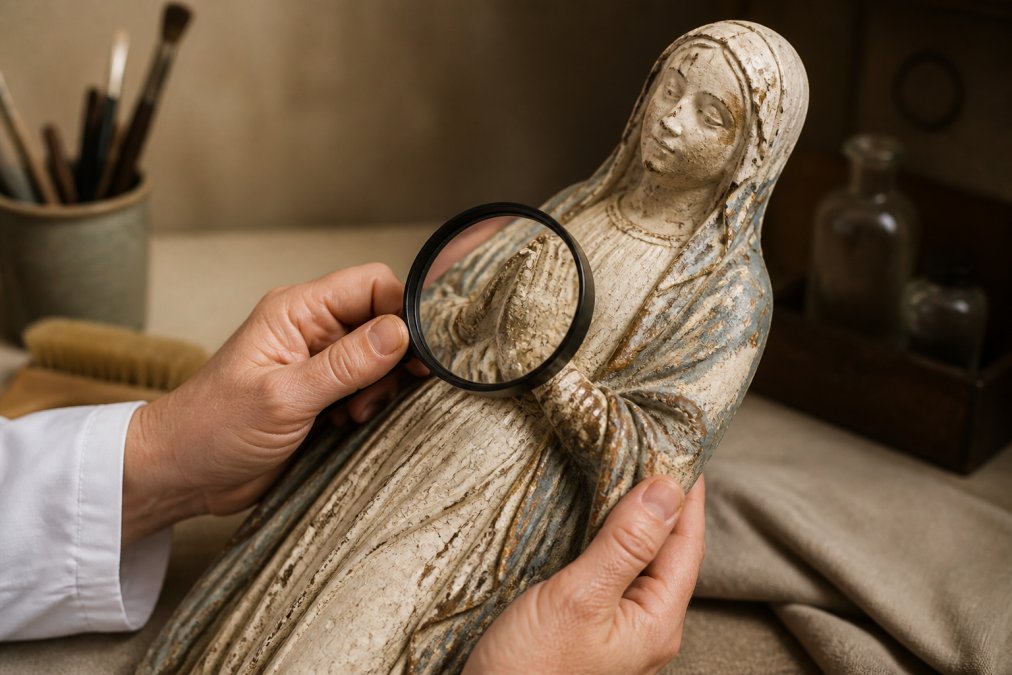
Step 1: Examine the surface with a magnifying glass
A ten-power magnifying glass reveals whether craquelure extends into the substrate or is confined to a varnish layer. Hand-painted statues show brushstrokes and color transitions; reproductions often have an even, machine-painted finish. Old dirt embedded deep in the pores is difficult to imitate.
Step 2: Examine stamps, signatures, and hallmarks
Turn the object over and examine the underside and back. Antique statues often bear a stamp or signature; compare the style with known examples from the period. A modern engraving tool leaves different marks from a handwritten marking from the 1920s. Photograph all stamps for your records and appraisal.
Step 3: Weigh and feel the object
Weight is a surprisingly good indicator: antique plaster feels heavy and compact, while modern plaster or composite is lighter and more brittle. A solid copper crucifix weighing 620 grams has a density you can feel immediately. Antique material feels cool and warms slowly; plastic quickly absorbs body heat.
| Inspection point | What to look for | Sign of reproduction |
|---|---|---|
| Craquelure | Organic, irregular pattern | No craquelure or only in the varnish layer |
| Polychromy | Brushstrokes, color transitions | Even, machine-painted finish |
| Stamp or signature | Hand-struck, consistent with the period | Modern cast or engraved |
| Weight | Heavy, compact material | Strikingly light, hollow-sounding |
| Wear | Worn smooth at points of contact | No wear or unnaturally distributed wear |
How to recognize an antique rosary: what should you look for?
The antique rosary is one of the most widely produced devotional objects. Authentic examples from the nineteenth and early twentieth centuries were made of wood, bone, glass paste, or precious metal; the beads were strung by hand and show irregularities, while modern examples are perfectly uniform.
Look at the cross and medals: older examples have a corpus that was cast separately and attached, and the links are soldered with small irregularities. A dull patina from years of use is a good sign; shiny or blotchy metal indicates restoration or a later copy.
Determining the value of religious statues: a realistic assessment
Determining the value of religious statues involves more than just their age: rarity, quality of craftsmanship, state of preservation, and demand among collectors all play a role. A rare depiction, such as a statue of the Virgin Mary with a sheep, can be worth considerably more than a common type.

Statues with clear provenance from a church or monastery often have greater collectors' value. For a serious appraisal, seek the assistance of a specialist, but use your own observations as an initial filter. Always ask for documentation when buying; a reliable dealer can substantiate the provenance with photographs and descriptions.
Common mistakes when assessing religious statues
Even experienced buyers fall into the same traps. The most common mistake is trusting appearance alone; a statue that looks old is not necessarily old. Recognizing the subtler flaws helps you form a more reliable judgment.
Mistake 1: Looking only at the surface
Forgerers use artificial craquelure and imitation patina made with soil and soot, but these are hidden beneath a layer that does not hold up under closer examination. Turn the object over: the underside, the inside of a hollow statue, and the back tell the true story. An antique object is old everywhere, not just on the front.
Mistake 2: Ignoring restorations
A second mistake is ignoring restorations: a heavily restored statue loses value and authenticity. Always ask whether restorations have been carried out and which parts are original. Look for a different tone of color in a crack, a glossier varnish layer, or a finger filled in too perfectly; restorations often become visible under UV light.
Mistake 3: Believing a story that sounds too good to be true
Finally, do not be tempted by a story that sounds too good to be true. A convincing provenance story without evidence is a well-known sign to stay alert. Stories about dissolved monasteries or old families are not necessarily untrue, but they cannot be verified without documentation.
Your own checklist for the antiques market
A structured approach prevents you from being overwhelmed on the spot. Take a magnifying glass, a UV light, and a notebook to the antiques market, and work through each step systematically.
Before you buy something:
- Examine the surface with a magnifying glass (10x magnification). Does the craquelure extend into the substrate, or is it confined to a varnish layer? Are the cracks organically branched or parallel?
- Examine the polychromy. Can you see brushstrokes and color transitions, or is the paintwork uniform and machine-made?
- Check the back and underside. Are they also aged, or do they look fresh? Antique wood is dark and dry on the inside as well.
- Weigh the object in your hands. Does it feel heavy and dense for its size, or unusually light? Antique plaster and copper are denser than modern composites.
- Feel the material. Antique material feels cool and warms slowly. Plastic quickly absorbs body heat.
Documentation and provenance:
- Ask for written proof. Sales receipts, old photographs, inheritance documents, or inventory lists from a church or monastery.
- Check stamps and signatures. Does the style fit the period? A hand-stamped mark differs from a modern heat-branded mark.
- Photograph all markings. This will help later with appraisal and insurance.
The seller:
- Ask specific questions. Who sold the object to the current dealer? When was it purchased? Can the seller provide evidence?
- Be alert to vague answers. A reliable dealer can generally substantiate the provenance. Evasive answers are a warning sign.
- Ask about restorations. Which parts are original? Have any repairs been carried out, and by whom?
After the purchase:
- Have the object appraised by a specialist. A professional appraisal confirms or disproves your own findings.
- Keep all documentation. This is essential for insurance and any potential resale.
This checklist does not replace a professional appraisal, but it significantly reduces the risk of an expensive mistake. Those who work systematically are less likely to be quickly persuaded by a compelling story or a convincing surface.
Frequently Asked Questions
How do you know whether a religious object is genuinely antique?
Check the materials, such as solid plaster, wood, or copper, and look for natural signs of age such as craquelure, patina, and wear patterns. Also examine the stamp, signature, or hallmark, and always ask about the provenance. Objects from before 1950 are generally hand-painted and may show irregularities that a reproduction lacks. If in doubt, have an appraiser or art historian specializing in this field examine it.
What characteristics indicate the age of devotional objects?
Look for craquelure in the paint layer, natural patina on copper or wood, and wear in areas that have often been touched, such as the base of a figure. Older plaster figures often have hairline cracks and irregular polychromy. The materials used are also helpful: solid plaster, wood carving, or heavy copper indicates production before 1950. A reproduction is often too pristine, too light, and lacks this natural aging.
What should you look for when buying antique religious figures?
Always ask about the provenance, estimated date, and any documentation. Examine the figure in daylight and check whether the polychromy or wood carving is consistent with the stated period. A signed figure, such as the Belgian statue of Mary with “Depose 12,” supports its authenticity. Compare the price with the condition: a flawless figure from the 1920s is worth more than a restored example with visible damage.
How do you determine the value of antique religious objects?
The value depends on four factors: age, rarity, condition, and provenance. A rare depiction, such as Mary with the infant Jesus and a lamb, is more valuable than a common figure. The signature and a clear stamp also increase the appraised value. Check comparable objects with specialized antique dealers and, if in doubt, have an official appraisal carried out. It is wise to adjust your expectations: not every old object is automatically worth a lot of money.