

Best vintage devotional items for collectors in 2026
Table of contents
- What are vintage devotional objects and why do people collect them?
-
Top 7 antique and vintage devotional objects for collectors
- 1. Antique statue of the Virgin Mary with the Infant Jesus (1920s/1930s) – large plaster statue
- 2. Antique statue of the Infant Jesus on a globe (1920s)
- 3. Antique French copper crucifix with corpus (circa 1900)
- 4. Saint Anthony the Abbot with pig – hand-carved wooden statue (1930s/50s)
- 5. Old French wooden rosary XXL Lourdes (1950s/60s)
- 6. Porcelain statuette of Our Lady of the Miraculous Medal (1950s)
- 7. Rare statue of Saint Barbara of Nicomedia (1930s)
- What should you look for when buying a rosary with a silver cross?
- How do you determine the value of antique saint statues?
- Recognizing signs of authenticity and fakes
- Care, storage, and presentation of vintage devotional items
- Conclusion: your next addition to the collection
- Frequently Asked Questions
Last updated: September 12, 2026
What are vintage devotional objects and why do people collect them?
Vintage devotional objects are religious items from the past that were used for personal devotion: statues of saints, crucifixes, rosaries, and holy cards. Collectors seek them for their handcrafted appearance, their history, and their connection to the Catholic tradition.
At Chez Monique's 2e Leven, we see every day why people buy these objects. One person is looking for a statue of the Virgin Mary for a quiet corner of the home, while another has been hunting for years for a specific statue of Saint Barbara. What unites both groups is that each piece carries a story that mass production can never match.

The market for religious heritage has become fragmented. That makes it more difficult to distinguish genuine pieces from counterfeits. Below are seven pieces worth collecting, along with how to determine their value and prevent deterioration.
Top 7 antique and vintage devotional objects for collectors
These seven pieces combine skilled craftsmanship with a clear provenance. Each example is hand-painted, signed, or from a recognizable period, which adds to its collectible value.
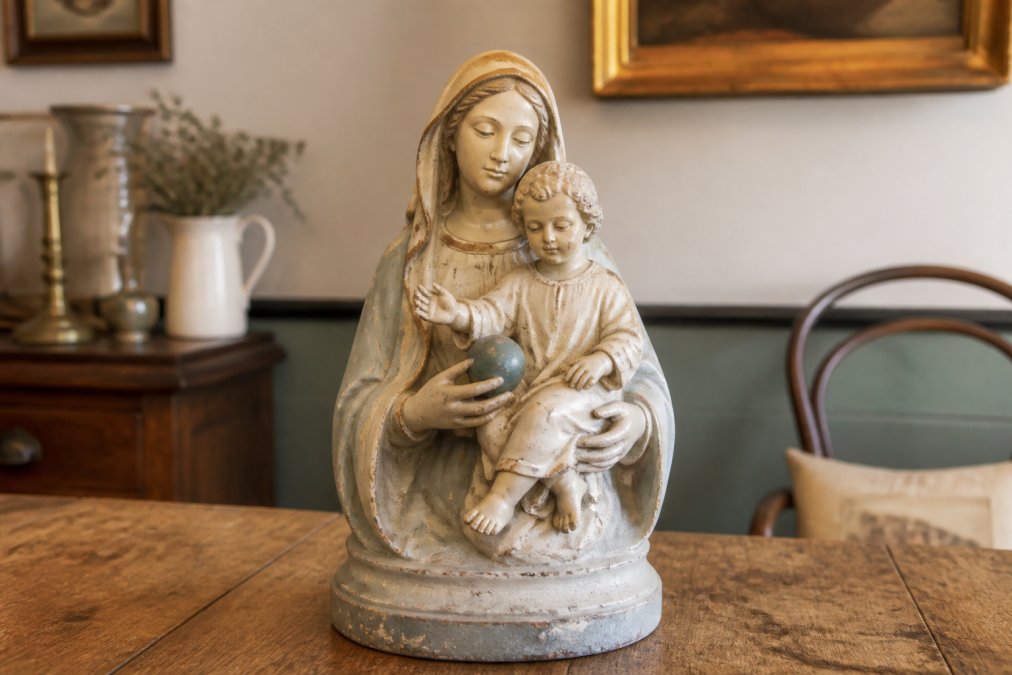
1. Antique statue of the Virgin Mary with the Infant Jesus (1920s/1930s) – large plaster statue
A large plaster statue measuring 55 cm in height, signed on the back, in excellent antique condition. The signature is difficult to read, which is more common with this type of work. For €185.00, you can purchase a stately piece that looks equally at home in a classic interior or a prayer corner. The soft color tones reveal the craftsmanship of the 1920s and 1930s. Anyone looking for their first large statue of the Virgin Mary will find a strong foundation here.

2. Antique statue of the Infant Jesus on a globe (1920s)
Pristine condition is rare for an object nearly a hundred years old. This statue of the Infant Jesus on a globe stands on a matching wooden console and measures 23 cm. The symbolism of the globe makes it a beloved devotional object. At €75.00, this is one of the most affordable ways to bring an early twentieth-century saint statue into your home.
3. Antique French copper crucifix with corpus (circa 1900)
This richly decorated copper crucifix weighs 620 grams and dates from around 1900. The sharp decorative details and warm patina reveal French craftsmanship. At 34 cm high and 20.5 cm wide, it is a substantial wall piece. For €135.00, you get a crucifix that has lived through generations.
4. Saint Anthony the Abbot with pig – hand-carved wooden statue (1930s/50s)
Hand-carved wood from a German antiques market, with the traditional pig at the saint's feet. Saint Anthony the Abbot is regarded as the patron saint of farmers and domestic animals. The detailed woodcarving makes this statue a gem of religious folk art. Price: €155.00 for 21 cm of handcrafted work.
5. Old French wooden rosary XXL Lourdes (1950s/60s)
A 125 cm prayer chain, with richly carved wooden beads and a copper corpus, originating from Lourdes. This type of Lourdes souvenir from the 1950s and 1960s is popular among collectors of religious prints and devotional cards. For €80.00, you can bring a piece of pilgrimage history into your home.
6. Porcelain statuette of Our Lady of the Miraculous Medal (1950s)
Fine porcelain, perfect condition, 16 cm high. The statuette of Our Lady of the Miraculous Medal from the 1950s displays refined details rarely seen in plaster. At €40.00, it is an accessible starting point for those just beginning to collect.
7. Rare statue of Saint Barbara of Nicomedia (1930s)
Saint Barbara, patron saint of miners, depicted with a miner's lamp and tower. This plaster statue from Belgian Limburg is in pristine condition and measures 40 cm. For €165.00, you get a piece with a clear regional origin, which strengthens its provenance.
What should you look for when buying a rosary with a silver cross?
A rosary with a silver cross is one of the most common entry-level pieces for collectors, but also one of the most frequently imitated. Pay attention to four things: hallmark, connection, bead material, and context. Reading all four helps distinguish an authentic devotional piece from modern souvenir production.
1. The hallmark and silver finenesses
A genuine silver cross bears a hallmark, usually a small stamp on the back or on the loop from which the cross hangs. In the Netherlands and Belgium, the following finenesses are especially common in religious ornaments from the nineteenth and early twentieth centuries: (waarborg.nl)
- 925 or sterling: the most common fineness for fine silverware
- 835: a slightly lower fineness commonly found in German and Belgian devotional items
- 800: common in more solidly produced nineteenth-century crucifixes
A cross without any hallmark is not automatically fake, but it does require further research. Use a 10× magnifying glass to read the hallmark; faint or irregular hallmarks often point to a later addition (waarborg.nl).
2. The connection between the beads and the crucifix
In authentic rosaries, the connection is handmade: a small silver loop soldered through the crucifix, with a sturdy link to the first bead. Modern reproductions often use a machine-pressed loop that is looser or shows a casting seam. Run your fingertip along the edge of the crucifix: a sharp, straight edge reveals a casting mold.
3. Bead material and wear pattern
Beads made of wood, glass, bone, or mother-of-pearl each have their own wear pattern:
- Wood: dark, glossy areas where the beads have been rolled between the fingers for years
- Glass: small scratches and a matte sheen on the areas touched most often
- Bone: a warm, ivory-like patina that cannot be imitated with plastic
- Mother-of-pearl: an iridescent sheen that is often too uniform in modern imitations
A rosary that looks as though it has never been used is suspicious. Devotional objects were worn and prayed with; light signs of use are part of their authenticity.
4. Context: box, prayer card, and pilgrimage site
The presence of an original box, prayer card, or pilgrimage card significantly increases its collectible value. A rosary from Lourdes with its accompanying card from the 1950s is worth more than a loose chain without context. Always ask about its provenance and whether the box or card belongs with it.
Price indication
A simple silver rosary from the 1950s generally sells for between €30 and €80. A complete example with its original Lourdes box and prayer card can fetch €120 or more. A nineteenth-century example with a clear hallmark and undamaged beads often sells for over €150.
How do you determine the value of antique saint statues?
The value of antique statues of saints depends on five factors: condition, provenance, material, signature, and rarity. A flawless statue with a legible signature from a renowned region fetches more than a damaged example without context.
- Condition: missing fingers, cracks, or overpainting significantly reduce the price
- Provenance: a statue from the French Ardennes or Belgian Limburg has documented provenance
- Material: wood carving and porcelain are generally more valuable than plaster
- Signature: a legible name or studio mark increases collector value
- Rarity: saints such as Saint Barbara with a miner’s lamp are rarer than a standard statue of the Virgin Mary
A rule of thumb: an intact signed plaster statue from the 1930s often sells for between €100 and €200. A rare example with clear provenance may fetch more.

Recognizing signs of authenticity and fakes
Genuine vintage devotional items reveal their age through small imperfections. Fakes are precisely too perfect. This is where most buyers make a mistake.
Look for these signs:
- Mold seams: a sharp, straight seam running across the entire statue indicates a modern mold
- Paint: old paint develops craquelure and uneven color tones; new paint is even and glossy
- Weight: antique plaster is heavier and denser than modern plastic
- Wear: genuine pieces show wear in places that are frequently touched
- Base: look underneath the base; this is where you can see age, dust, and sometimes a studio mark
Care, storage, and presentation of vintage devotional items
Plaster, wood, porcelain, and metal each require a different approach. Improper cleaning can reduce the value of a piece by dozens of euros. This guide covers safe cleaning, proper storage, and presentation that does justice to your collection.
Safe cleaning by material
Plaster and gypsum
Plaster is porous and absorbs moisture (erfgoed.nl). Never use a damp cloth: the water soaks into the material and leaves stains or cracks. Dust with a soft, dry brush (a makeup brush or soft paintbrush works well). For stubborn dust in grooves, use a soft toothbrush, dry, with light pressure. Leave age-related discoloration as it is; it is part of the patina.
Wood
Wooden statues can dry out and crack. Do not treat them with oil or wax unless you are certain they are made of untreated wood. A dry, non-greasy cloth is usually sufficient. In case of woodworm, isolate the piece immediately. Woodworm does not go away on its own and can spread to other pieces in your collection.
Porcelain
Porcelain is hard but fragile. Clean only with lukewarm water and a soft cloth when truly necessary. Never use dish soap or a dishwasher. Be careful with gilding: it wears away with every touch. Hold porcelain statues by the base, not by the head or arms.
Metal (copper, bronze, silver)
Copper and bronze develop a patina that actually increases their value. Do not polish it off. Green deposits (verdigris) indicate moisture problems: move the piece to a drier place and let it dry. Silver crosses can be carefully polished with a silver polishing cloth, but avoid abrasives that could damage the hallmark.
Storage: acid-free and stable
- Wrap each piece separately in acid-free paper or Ethafoam; newspaper and plastic wrap can leave stains
- Store small pieces in an acid-free box with a layer of Ethafoam on the bottom
- Keep temperature and humidity as stable as possible: sudden fluctuations are more harmful than a constant, slightly too-dry environment
- Never place heavy statues on top of lighter pieces
- Label the box with a photo and description so you do not lose track of the provenance
Display: light, location, and stability
Direct sunlight is the greatest enemy of paint, wood, and textiles. UV radiation causes colors to fade and wood to dry out. Choose a spot away from windows, heating, and air conditioning.
- Display cabinet: the safest option for dust-sensitive spaces. Choose a cabinet with glass doors and a stable base
- Open display: only for pieces that are not sensitive to dust. Place them on a non-slip mat
- Wall mounting: use a sturdy hook and wall plug for heavy crucifixes, not a nail
- Moving: always lift statues with both hands by the base, never by protruding parts
Conclusion: your next addition to the collection
The market for religious heritage requires a discerning eye. Learning to assess condition, provenance, and signs of authenticity allows you to buy with confidence and build a collection that retains its value.
At Chez Monique's 2e Leven, you will find a carefully curated collection of antique and vintage devotional objects, from statues of Mary to rosaries. Each object is inspected and shipped safely, while we reuse packaging materials wherever possible without compromising the safety of your purchase. This way, you contribute to a better environment and give a special object a second life in your own interior. Add your next treasure to the shopping cart and discover the history behind each piece.
Frequently Asked Questions
What exactly is included under the term devotional items?
Devotional items are objects used for personal or communal devotion. Examples include rosaries, prayer cards, statues of saints, crucifixes, and holy water fonts. They are often handcrafted or mass-produced objects with a religious function, such as praying or venerating a saint. Vintage devotional items are examples from, for instance, the 1920s to the 1960s that, in addition to spiritual value, also have collectible value because of their age and design.
How do you determine the value of antique saint statues?
The value of antique saint statues depends on factors such as rarity, condition, provenance, and material. A signed plaster statue from the 1920s in pristine condition is often worth more than a damaged mass-produced example. Also consider the provenance: a statue from a specific region or with a remarkable history can drive up its price. For an indication of value, follow auctions and specialized marketplaces.
What should you look for when buying a vintage rosary?
When buying a vintage rosary, pay attention to the material of the beads (wood, glass, or metal), whether it has a silver crucifix, and its overall condition. Check that the chain is not broken and that the crucifix is genuine silver, often identifiable by a hallmark. A rosary with a silver crucifix from Lourdes, such as one from the 1950s, is sought after by collectors. Always ask about its provenance and whether any original parts are missing.
How do you care for delicate vintage devotional items made of plaster or wood?
Plaster and wooden devotional items are sensitive to moisture, temperature fluctuations, and direct sunlight. Dust them carefully with a soft brush and avoid water or chemical cleaning products. Store them in a dry room with a stable temperature, such as a display cabinet. For wooden statues, you can occasionally use a little colorless furniture wax, but test it first on an inconspicuous area. This will help keep your vintage devotional items in good condition.
Are there specific fairs for religious collectibles?
In the Netherlands and Belgium, antique and flea markets regularly offer religious devotional items. These include fairs in larger cities and specialized events focused on religious heritage. Online platforms and auction houses are also good sources. It is worth keeping an eye on local announcements, as some fairs are one-off events or take place in churches and parish halls. Ask the organizers about the specific focus on devotional items.